




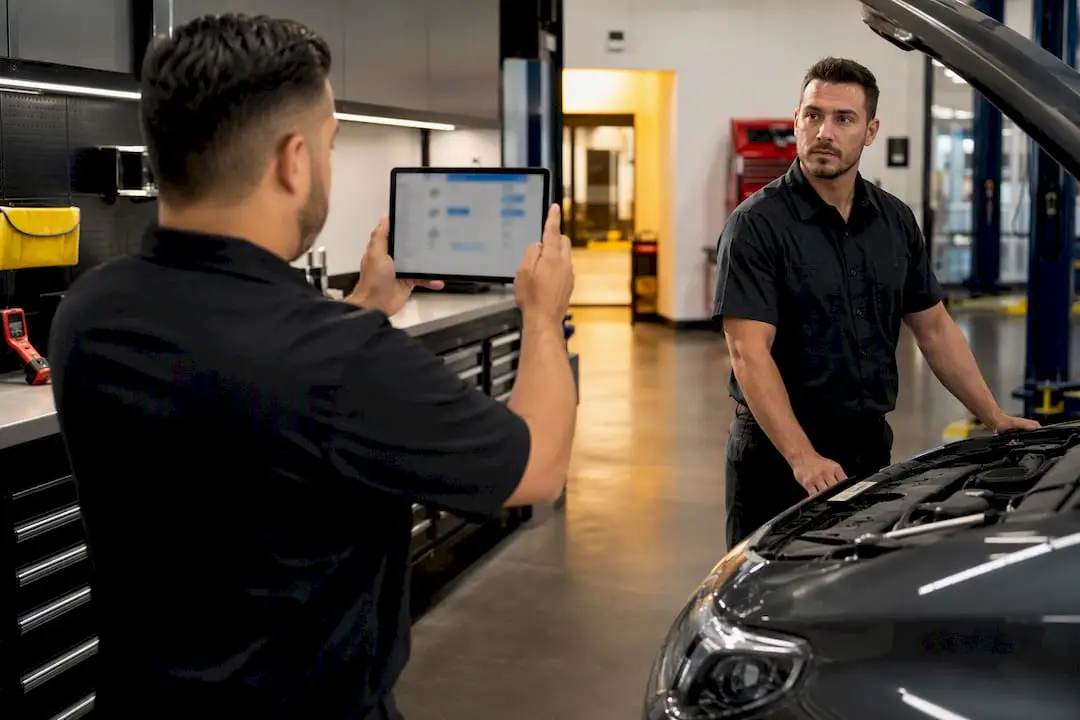
A 2 year/24,000 mile warranty means a repair shop stands behind its work for whichever limit hits first: two years from the invoice date or up to twenty-four thousand additional miles on your odometer. Most shops that offer it cover both parts and labor, not just replacement parts, which is the detail that actually protects your wallet. It’s most valuable after major repairs like engine or transmission work and for used-car buyers inheriting someone else’s maintenance history. For a $40 wiper blade or an air filter, it barely matters.
TL;DR:
- A 2-year/24,000-mile warranty typically covers both parts and labor for specific repairs, especially major ones like engine or transmission work, but excludes routine wear items and unrelated damage.
- The warranty applies only to the repair performed, so failure of a replaced part within the period is covered, while normal wear and tear or unrelated issues are not.
- A shop’s repair warranty is included automatically with the service, unlike third-party extended contracts that require separate purchase and often restrict where you can get repairs done.
- To maximize protection, always obtain written warranty terms on your invoice, document the repair with photos or reports, and keep all receipts for proof in case of a claim.
- Federal law ensures your manufacturer’s warranty cannot be voided by using independent shops or third-party parts, emphasizing the importance of documented, legitimate warranty coverage.
Table of Contents
- What a 2 Year/24,000 Mile Repair Warranty Covers and Excludes
- Repair Warranty vs. Extended Service Contract: What’s the Difference?
- How to Verify, Document, and Claim Your Warranty
- Is a 2 Year/24,000 Mile Warranty Worth It?
- How Kwik Kar of Van Alstyne Handles Your Repair Warranty
- The Legal Baseline Every Driver Should Know
- Get Your Next Repair Backed by a Real Warranty
- Sources
- FAQ
What a 2 Year/24,000 Mile Repair Warranty Covers and Excludes
The phrase “parts and labor” does a lot of work in that sentence, and it’s worth pausing on. A warranty that only replaces a defective part but makes you pay for the mechanic’s time to install it again is a fraction of the protection a full parts-and-labor warranty gives you. Labor on something like an alternator or a starter can cost more than the part itself, so ask directly: does this warranty cover labor, or just the component?
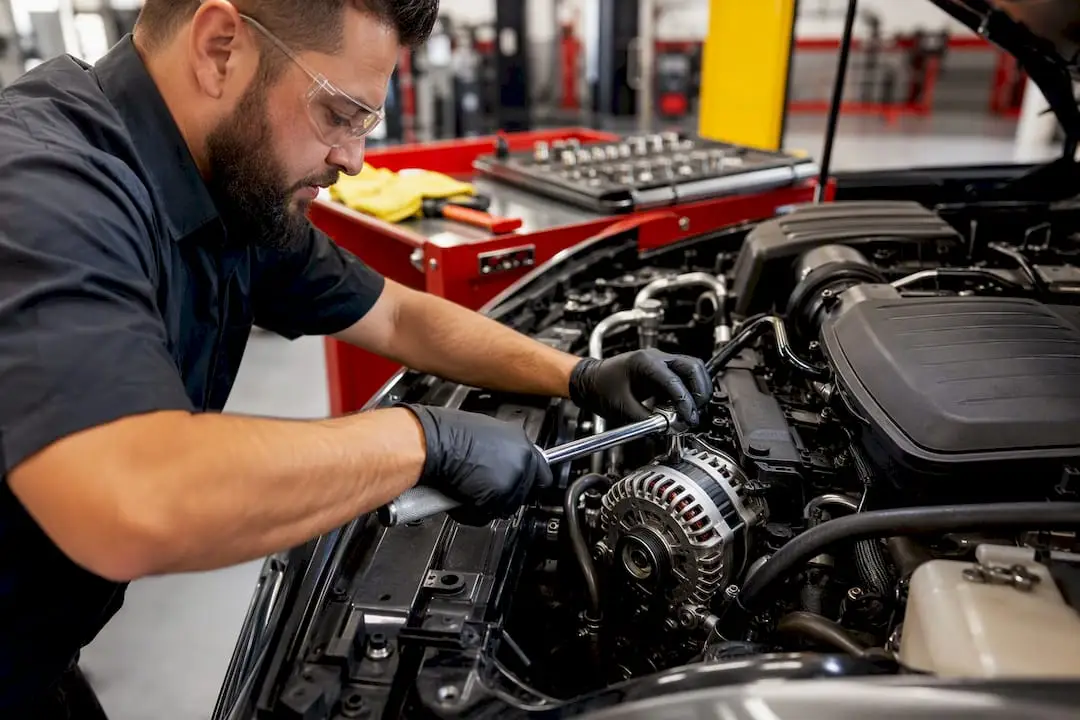
Coverage under a typical 2 year/24,000 mile warranty applies to the repair that was performed, not the whole vehicle. If a shop replaces your water pump and it fails again within the warranty window, that’s covered. If your brakes wear out six months later from normal use, that’s not a warranty issue, it’s routine wear. Sample warranty language from shops offering this coverage typically states the repair covers defects in materials and workmanship for parts and labor over 24 months or 24,000 miles, whichever comes first, with the shop retaining the option to repair, replace the part, or refund the original repair cost.
Here’s what tends to fall inside and outside that line:
- Typically covered: the specific part replaced or repaired, the labor to reinstall it, and failures traceable to the original repair.
- Typically excluded: normal wear and tear (brake pads, tires, wiper blades), damage from an unrelated cause, and problems caused by driver misuse or an accident.
- Also excluded: pre-existing issues the shop didn’t touch, and repairs performed elsewhere after your original service.
- Timing is measured from the invoice: the date and odometer reading recorded when the work was completed start the clock, so an accurate invoice matters as much as the repair itself.
A practical example: if a shop repairs a coolant leak from a cracked hose and the same hose starts leaking again eight months later, that’s a textbook warranty claim. If your check engine light comes on eleven months later for an unrelated sensor failure, that’s a new repair, not a warranty callback. The line between the two is exactly why written terms matter so much, which is the next thing worth getting right before you ever need to use one.
Repair Warranty vs. Extended Service Contract: What’s the Difference?
These two get confused constantly, and the confusion costs consumers money. A repair warranty is something a shop includes for free with the work it performs. An extended service contract, often marketed under the misleading name “extended warranty,” is a separate product you buy, usually from a third-party company or a dealership, covering future mechanical failures unrelated to any specific repair job.
- Who provides it and when. A shop’s repair warranty comes automatically with the service you paid for. A service contract is purchased separately, sometimes for hundreds or thousands of dollars, and can be bought any time, even years after you own the car.
- Where you can use it. Repair warranties are usually tied to the shop that did the work, or its network locations if it has any. Service contracts often restrict which shops can perform covered repairs, and the FTC warns that reading the fine print on where service must happen is essential before you sign anything.
- Cost structure and deductibles. A repair warranty typically costs you nothing extra since it’s included. Service contracts carry a purchase price plus, in many cases, a per-visit deductible.
- What can go wrong. The FTC has taken enforcement action against companies that told customers their warranty would be void for using third-party parts or independent shops, language the agency found illegal and misleading. Service contracts can also duplicate coverage you already have through a factory warranty, so it’s worth comparing before buying one.
The bottom line: a repair warranty protects the specific job you paid for. A service contract is a bet on the future, and it’s a bet you should research carefully, not one you should feel pressured into at the sales counter.
How to Verify, Document, and Claim Your Warranty
A warranty is only as good as your ability to prove it exists and prove your car qualifies. Here’s the sequence that actually protects you.
Before you leave the shop:
- Get the warranty terms in writing on your invoice, not just a verbal promise from the service writer.
- Confirm the invoice lists the date and your odometer reading, since that’s how the 24-month/24,000-mile clock is measured.
- Ask for and keep any digital vehicle inspection report or photos documenting the repair, since these serve as evidence of the vehicle’s condition at the time.
- Save the original receipt along with any documentation of the specific parts replaced.
When something goes wrong:
- Contact the shop first and explain the symptom, referencing your original invoice and date of service.
- Expect the shop to re-inspect the vehicle to confirm the failure is related to the original repair, not a new, unrelated issue.
- A legitimate warranty claim usually results in a repair, a replacement part, or in some cases a refund toward the original repair cost.
Pro Tip: Photograph your odometer the day of service, even if the shop’s own inspection includes one. A timestamped photo on your own phone is a backup you control if paperwork ever gets misplaced.
If a shop denies a legitimate claim by insisting your factory warranty is void because you used an independent repair shop, that claim itself may be illegal under the Magnuson-Moss Warranty Act. Federal law says a warrantor generally cannot require you to use a specific brand of part or a specific shop unless that part or service is provided free under the warranty. If you hit a wall with a shop, the FTC’s consumer protection booklet recommends escalating to your state consumer protection office, which can investigate patterns of warranty abuse.
Is a 2 Year/24,000 Mile Warranty Worth It?
Whether this warranty matters to you depends heavily on the size and type of the repair, not on the warranty length alone.
- High-value scenarios. Major engine or transmission repairs, where a repeat failure could cost thousands, are exactly where a parts-and-labor warranty earns its keep. Used-car buyers relying on a mechanic’s recent work, and high-mileage drivers who will hit that 24,000-mile mark within a year or two, get the most practical protection from this coverage.
- Low-value scenarios. A $60 sensor swap or a battery replacement rarely needs a two-year safety net, since these parts either fail immediately from a bad install or last for years regardless. Don’t let warranty length be the deciding factor when the repair itself is inexpensive.
- The checklist that matters more than the number. Ask whether labor is included, not just parts. Ask if coverage transfers to a new owner if you sell the car within the warranty period. Ask whether the shop is part of a network that honors the warranty at other locations if you travel or move, an increasingly common feature among shops that back their work with confidence.
Think of it as a trade-off between repair cost risk and warranty longevity. A $1,200 transmission repair with a two-year, parts-and-labor warranty is a fundamentally safer bet than the same repair with a 90-day, parts-only promise, even if both shops quote the same price. The warranty terms are part of the price, whether or not they show up on the invoice total.
How Kwik Kar of Van Alstyne Handles Your Repair Warranty
Some repair shops back their repairs with a 2-year/24,000-mile warranty, and the way they document that coverage can make claims straightforward if you ever need one.
- Every repair, from brake work to engine diagnostics, is performed by ASE-certified technicians who record what was done and why.
- Each job includes a Digital Vehicle Inspection with real-time updates and time-stamped photos, so you have visual proof of your vehicle’s condition before and after the repair.
- Convenience features like after-hours drop-off and free local rides mean you’re not stuck rearranging your whole day around a repair visit.
- Your invoice records the date and odometer reading that start your warranty clock, the same documentation the FTC recommends every driver keep.
If you’re due for service, or you’re dealing with a repair that needs the kind of complex diagnostic work that benefits from documented, photo-backed inspection, starting a claim or booking an appointment is as simple as calling the shop directly at (903) 712-5945. Bring your original invoice if you’re following up on prior work. Local drivers rely on a thorough paperwork trail precisely because it’s what makes a warranty enforceable instead of just a promise on a sign.
— Kwik Kar
The Legal Baseline Every Driver Should Know
Federal law doesn’t require shops to offer a repair warranty at all, which is exactly why the terms in writing matter so much. What federal law does guarantee, through the Magnuson-Moss Warranty Act, is that a legitimate independent repair generally can’t void your manufacturer’s warranty just because you skipped the dealership. The Federal Trade Commission enforces that protection and has penalized companies for claiming otherwise.
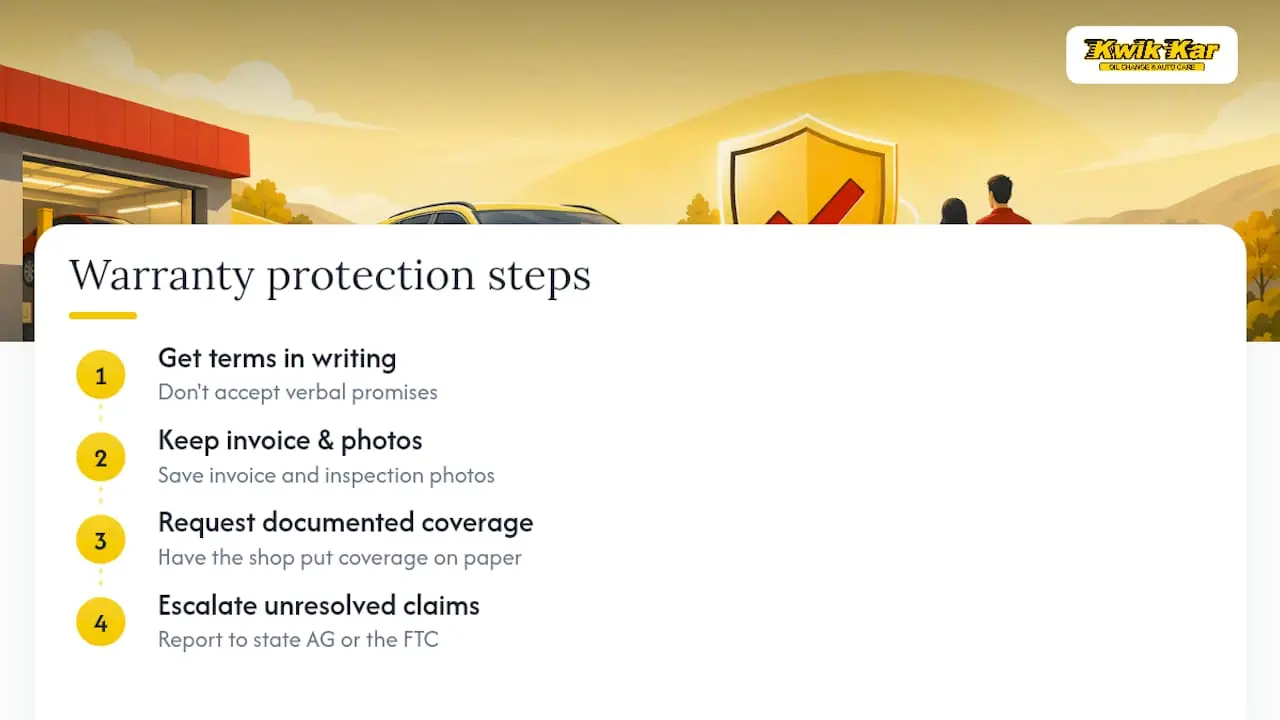
Your job as a consumer is simple: get terms in writing, keep your invoice and inspection photos, and don’t accept a verbal warranty promise as the final word. If a shop refuses to honor documented, legitimate coverage, that’s a pattern worth reporting to your state attorney general’s consumer protection division or the FTC directly. A shop confident in its work puts that confidence on paper.
Get Your Next Repair Backed by a Real Warranty
Plenty of shops will quote you a lower price and skip the paperwork trail that actually protects you after you drive off the lot. Some repair shops offer a 2-year/24,000-mile warranty covering parts and labor documented through a Digital Vehicle Inspection with photos customers can keep as proof of work performed.

That documentation is the difference between a warranty that’s easy to invoke and one you have to fight for. Whether you need brake service, a transmission repair, or a full diagnostic workup after a warning light comes on, Technicians may log repair details on your invoice when the work is done, so the two-year, 24,000-mile clock starts with a paper trail in place.
If you’re a driver in Van Alstyne, Anna, Howe, Melissa, or Gunter and you want repairs done with that kind of transparency, call (903) 712-5945 or request an appointment for your next service. Ask specifically about the warranty terms before the work starts, and keep your invoice once it’s done. That’s the whole process.
Sources
For the federal rules behind repair warranties, start with the FTC’s guidance on auto warranties and service contracts and its consumer booklet on protecting your auto repair investment. For an example of how shops write coverage into plain language, this sample 2-year, 24,000-mile warranty document shows the kind of terms worth looking for on your own invoice. If a dispute ever escalates, your state’s consumer protection office is the next call.
- Auto Warranties and Auto Service Contracts | Consumer Advice
- FTC says companies’ warranty restrictions were illegal
- 2-YEAR, 24,000 MILE NATIONWIDE, WORRY FREE WARRANTY
FAQ
Is a 2-Year Extended Warranty Worth It?
It depends on what “extended warranty” means in context. A shop’s included repair warranty covering parts and labor for two years or 24,000 miles is worth having for major repairs, since it protects you from paying twice for the same failure. A separately purchased service contract is a different decision entirely, and the FTC recommends comparing it against your existing coverage before buying, since it can duplicate protection you already have.
What Is the Best Warranty Option for a Vehicle Over 200,000 Miles?
High-mileage vehicles typically qualify for fewer manufacturer or third-party coverage options, which makes a shop’s own repair warranty more valuable, not less. A 2-year/24,000-mile parts-and-labor warranty on a specific repair still applies regardless of your car’s total mileage, since it covers the work performed, not the vehicle’s overall age.
What Are Two Things Typically Not Covered Under a Repair Warranty?
Normal wear items like brake pads, tires, and wiper blades are almost never covered, since they’re expected to degrade with use regardless of repair quality. Damage from an unrelated cause, such as an accident or driver misuse after the original repair, is also excluded.
What Is the $3,000 Rule for Cars?
This isn’t a formal legal or warranty rule, but a rough budgeting guideline some drivers use: if a single repair estimate approaches or exceeds a large fraction of the car’s current value, it may be time to weigh repair against replacement. It has nothing to do with warranty coverage itself, and a repair warranty doesn’t change that math since it only covers the specific repair, not the car’s overall value.
Does Kwik Kar of Van Alstyne’s Warranty Cover Labor as Well as Parts?
Yes, Kwik Kar of Van Alstyne’s 2-year/24,000-mile warranty applies to both parts and labor on covered repairs. Ask your service writer about specific terms for your repair before work begins, and keep your invoice as your documentation.