




When your AC blows cold then warm, the cause is almost always a pressure or airflow problem, most often low refrigerant, a struggling compressor clutch, or a weak condenser fan that lets the system overheat or ice over. Before you add refrigerant, check airflow and fan operation first. If you hear the compressor clutch cycling rapidly or notice unusual noises, stop and get the system inspected rather than driving on it.
TL;DR:
- Low refrigerant or a leak can cause evaporator icing and irregular compressor cycling, leading to temperature fluctuations.
- A failing condenser fan or blocked airflow restricts heat dissipation, especially at idle or in traffic, causing warm air to return.
- Proper diagnosis involves checking compressor clutch engagement, fan operation, ice presence, and airflow restrictions before considering repairs.
- Leak detection and system evacuation are necessary before refrigerant recharge, which can cost $150 to $300, depending on the repair complexity.
- Myths like adding refrigerant without fixing underlying issues or system resets by turning off do not address root causes and may worsen damage.
Table of Contents
- Why Does My AC Change Temperature? Common Causes
- How to Diagnose AC Cooling Issues Yourself
- What Repairs Cost and What a Technician Actually Does
- Common Myths About AC Blowing Cold Then Warm
- Why a Measured Diagnosis Beats a Guessing Game
- Get Your AC Diagnosed the Right Way
- Sources
- FAQ
Why Does My AC Change Temperature? Common Causes
Most cold-then-warm complaints trace back to one of six culprits, whether you’re dealing with a car dashboard vent or a home register. Matching your symptoms to the list below gets you closer to an answer before a technician ever touches a gauge.
- Low refrigerant or a slow leak. When charge drops, the evaporator can ice over and block airflow, which is one of the most common reasons an AC blows cold then warm in a car. Low pressure also triggers the compressor clutch to cycle on and off instead of running steadily.
- A slipping or overheating compressor clutch. Electrical or mechanical clutch problems make the compressor engage and disengage erratically, so cold air keeps interrupting itself.
- A weak or dead condenser fan. This is the classic reason a vehicle cools fine on the highway but blows warm at idle or in stop-and-go traffic, since the condenser needs airflow to shed heat and doesn’t get enough from the vehicle’s own motion.
- Restricted airflow. A clogged cabin filter, blocked vents, or a dirty indoor coil starves the evaporator of warm air to pull moisture and heat from, which can cause it to freeze over.
- A stuck or dirty expansion valve or orifice tube. Moisture or debris inside the metering device disrupts refrigerant flow, causing inconsistent cooling that comes and goes without warning.
- Thermostat, control module, or blend-door faults. In cars, a failing blend-door actuator can let warm air bleed into the cold airflow. In homes, a thermostat stuck in the wrong mode or a failing control board can cause the same on-again, off-again pattern.
Each of these has a distinct fingerprint once you start watching when the warm air shows up.
How to Diagnose AC Cooling Issues Yourself
You don’t need a shop bay to gather good clues. A few careful observations often point straight at the likely cause before a technician even connects a gauge set.
- Watch the compressor clutch. With the hood open and the engine running, look at the compressor pulley. It should engage smoothly and stay locked in. Rapid clicking on and off every few seconds usually points to low refrigerant or a failing pressure switch, a pattern frequently reported in driver discussions of AC cycling behavior.
- Check the condenser fan at idle. With the AC on and the engine idling, the condenser fan (usually in front of the radiator) should spin. If it’s silent or weak while the compressor runs, heat has nowhere to go. Keep hands, tools, and loose clothing well clear of the fan blades and belts while checking this.
- Look for ice or frost. Popping the hood after a warm-then-cold cycle and spotting frost on the low-pressure line, or finding a puddle of water under the car after parking, both point toward evaporator freeze from low charge or restricted airflow.
- Note the timing. Warm air that shows up after 10 to 20 minutes of driving usually means evaporator icing or low charge. Warm air that only appears at idle or in traffic points to the condenser fan. Random, rapid cycling with no clear pattern often means a clutch or pressure-control issue.
- For homes, check the thermostat fan setting. Set to “On,” the blower runs constantly and can pull warm air across an iced coil, mimicking a car’s symptoms. Setting it to “Auto” and confirming the outdoor unit’s fan spins are two of the fastest checks you can run.
- Inspect filters and vents. A blocked cabin or HVAC filter restricts airflow enough to freeze a coil. Swapping it is cheap insurance and worth doing before any other diagnosis.
Once you’ve gathered manifold pressure readings, a leak-detection dye result, or an electrical scan for pressure-switch faults, a technician can confirm what your own checks already suggested.
Pro Tip: Write down exactly when the warm air started, whether the engine was idling or moving, and how long it took. That single detail often saves a diagnostic technician 20 minutes of guesswork.
What Repairs Cost and What a Technician Actually Does
Knowing the fix ahead of time keeps you from being surprised at the counter. Costs vary by vehicle and region, but the ranges below reflect typical shop work.
- Low refrigerant with a slow leak: a technician uses UV dye or an electronic sniffer to find the leak, repairs or seals it, then fully evacuates and recharges the system. Recharging with a leak check typically runs $150 to $300. Simply adding refrigerant without finding the leak is a short-term patch, not a fix, and it can mask a bigger problem while it slowly drains the compressor’s lubrication.
- Compressor or clutch failure: diagnosis starts with pressure testing and an electrical check. A worn clutch alone is a smaller repair, but a full compressor replacement can be a significant expense depending on the vehicle, especially if internal damage has occurred.
- Condenser or outdoor fan motor: a technician bench-tests the motor, then replaces the motor or the whole fan assembly if it’s seized or drawing too much current. This job usually takes a few hours of shop time.
- Airflow restrictions: Cabin filters cost a modest amount and are an easy DIY swap on many vehicles. Duct or coil cleaning on a home system is best left to an HVAC technician, since disturbing a dirty coil incorrectly can bend fins and reduce airflow further.
- Expansion valve or orifice tube problems: these require flushing the system, removing moisture, and replacing the metering device, a more involved job because the whole refrigerant loop has to be evacuated and recharged afterward.
- Electrical controls and sensors: pressure switches, relays, and blend-door actuators get diagnosed with a scan tool and multimeter, and pricing depends heavily on which component and vehicle you’re working on.
Refrigerant work in the United States legally requires an EPA Section 608 certified technician, which is one reason a proper recharge isn’t something to attempt in a driveway with a store-bought can.
Common Myths About AC Blowing Cold Then Warm
A lot of bad advice circulates around this symptom, and some of it costs drivers and homeowners real money.
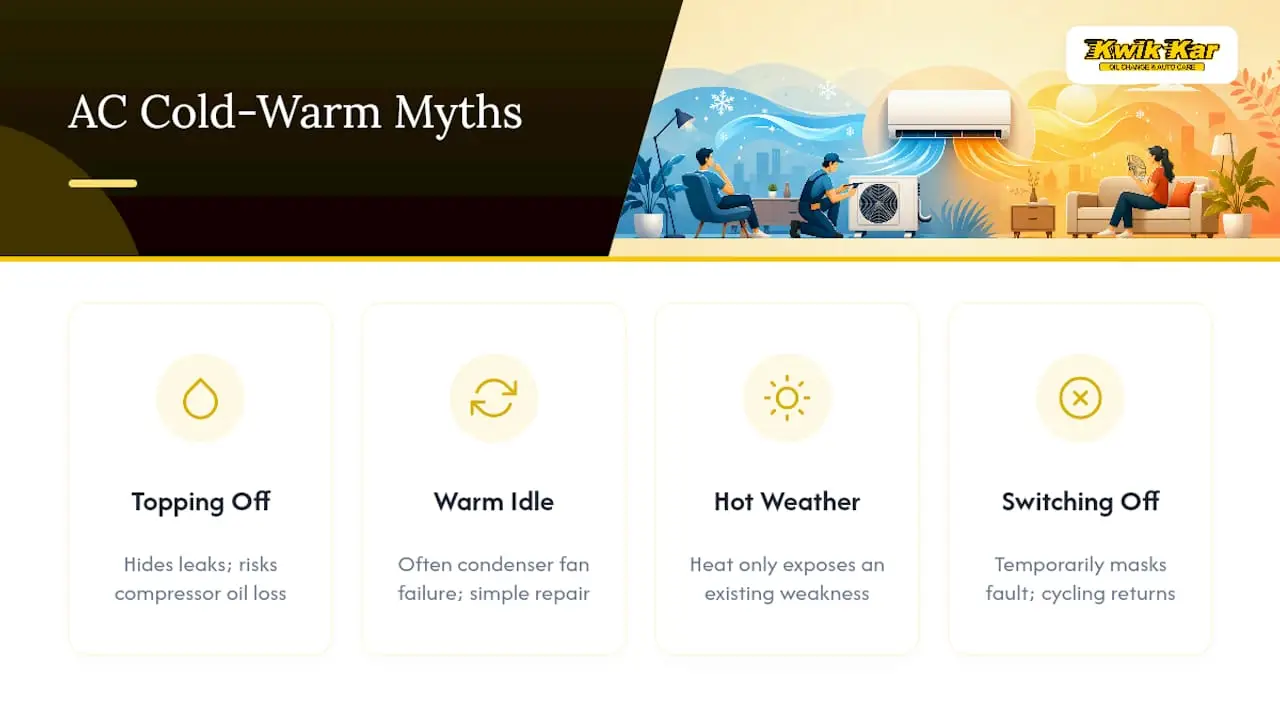
Myth: adding refrigerant always fixes cold-then-warm cycling. Topping off a system that’s leaking only hides the problem temporarily, and it can lead to repeat trips and eventual compressor damage from running low on lubricant, since refrigerant carries the oil that keeps the compressor alive.
Myth: warm air at idle means the whole system is dying. Often it just means the condenser fan isn’t spinning. That’s a contained, usually affordable repair, not a sign the compressor or evaporator has failed.
Myth: hot weather alone explains the fluctuation. Ambient temperature and direct sun exposure do make any existing weakness in the system more obvious, since the compressor and condenser have to work harder. But a healthy AC system shouldn’t swing between cold and warm just because it’s a 100 degree day in Texas. If it does, something underneath is already struggling.
Myth: turning the AC off resets the problem. Cycling the system off and on might mask cycling behavior temporarily, but it doesn’t address low charge, a failing clutch, or a dead fan. The pattern will return.
Why a Measured Diagnosis Beats a Guessing Game
Kwik Kar of Van Alstyne watches compressor and clutch behavior alongside system pressures before recommending any repair, because guessing at a refrigerant top-off can hide a leak and shorten the compressor’s life. That approach, backed by ASE-certified technicians and digital vehicle inspections with real-time photos, means you see exactly what’s wrong before paying for a fix.
Simple checks like a filter swap or a visual fan inspection are safe for most owners to try. But if you hear grinding, smell burning rubber, or notice the engine running hot with the AC on, stop driving and have it looked at. A slipping belt or an overheating clutch can cause damage well beyond the AC system if ignored.
— Kwik Kar
Get Your AC Diagnosed the Right Way
Guesswork fixes and store-bought refrigerant cans only delay the real answer. An AC diagnostic appointment at Kwik Kar of Van Alstyne includes a visual inspection, pressure testing, and a digital vehicle inspection with photos, so you see the actual pressure readings and component condition instead of taking someone’s word for it.

We back completed repairs with a 2-year/24,000-mile warranty, and we know AC problems rarely happen at a convenient time. That’s why we offer after-hours drop-off, free local rides around Van Alstyne and nearby communities, and a comfortable waiting area if you’d rather stick around while we work. If your system is already showing the cold-then-warm pattern, browse our AC repair services or head to our auto repair page to see how we handle diagnostics. Call (903) 712-5945 or request an appointment online to get a straight answer before the Texas heat makes it worse.
Sources
- AC Blows Cold Then Warm: Here’s What’s Wrong — Ricks Free Auto Repair Advice
- Car AC Not Working? How to Fix Common Air Conditioning Problems – AutoZone
- Car AC Blows Cold Then Warm? Causes, Fixes and Repair Cost – TheFixCar
- Change your HVAC system filter — EPA blog
FAQ
What Are the Signs of AC Compressor Failure?
Loud grinding or squealing when the AC is on, a compressor clutch that won’t engage, visible oil residue near the compressor, and warm air that never turns cold again are all common signs of compressor failure.
Should I Turn Off My AC if It’s Blowing Hot Air?
Yes, especially if you hear unusual noises, smell burning, or notice the engine temperature climbing. Running a struggling compressor or an overheating clutch can cause more expensive damage the longer it continues.
Why Did My AC Stop Cooling and Then Start Again?
This pattern often points to evaporator icing from low refrigerant or restricted airflow. The ice temporarily blocks airflow, then melts enough to let cool air through again, only to freeze once more.
What Should I Check if My AC Blows Cold but Won’t Cool the House or Car?
Start with the air filter and check whether the condenser or outdoor fan is actually spinning while the system runs. If both look fine, the issue is likely low refrigerant or a control fault that needs a pressure check from a technician like the team at Kwik Kar of Van Alstyne.
Can Hot Weather Alone Cause My AC to Blow Warm Air Intermittently?
Extreme heat and direct sun exposure make an already weak system work harder and can expose a marginal fan or low charge, but a properly functioning AC system shouldn’t cycle between cold and warm from heat alone.