



Follow your owner’s manual first. When it’s not handy, a safe default is every 2 to 3 years, and closer to 2 years if you tow, do track days, or drive a lot in a hot, humid climate. If your pedal feels soft or the fluid looks dark, don’t wait for the calendar. Check the manual, or ask a shop to run a quick moisture or boiling-point test to see where your fluid actually stands.
TL;DR:
- Brake fluid should be tested every 2 to 3 years, especially if towing, doing track days, or driving in humid climates, rather than relying solely on the manual schedule.
- Moisture absorption in glycol-based brake fluid can significantly lower its boiling point, increasing the risk of vapor lock and brake failure during hard braking.
- Signs of degraded brake fluid include a soft pedal, increased pedal travel, inconsistent feel, or dark, murky fluid, requiring prompt inspection and possibly a full flush.
- Moisture test strips and boiling-point testers provide accurate data to determine whether a full hydraulic flush is necessary, particularly after major repairs or environmental exposure.
- Regular testing and using proper DOT specifications ensure brake fluid remains effective, with full flushes recommended when moisture levels are high or boiling points fall below safe thresholds.
Table of Contents
- How Often to Change Brake Fluid, According to Manufacturers
- Why Brake Fluid Wears Out Even When It Looks Fine
- Warning Signs Your Brake Fluid Needs Attention
- How to Test Brake Fluid Instead of Guessing
- What a Proper Brake Fluid Service Actually Involves
- Balancing the Manual With Real-World Driving
- Book a Brake Fluid Check With Kwik Kar of Van Alstyne
- Sources
- FAQ
How Often to Change Brake Fluid, According to Manufacturers
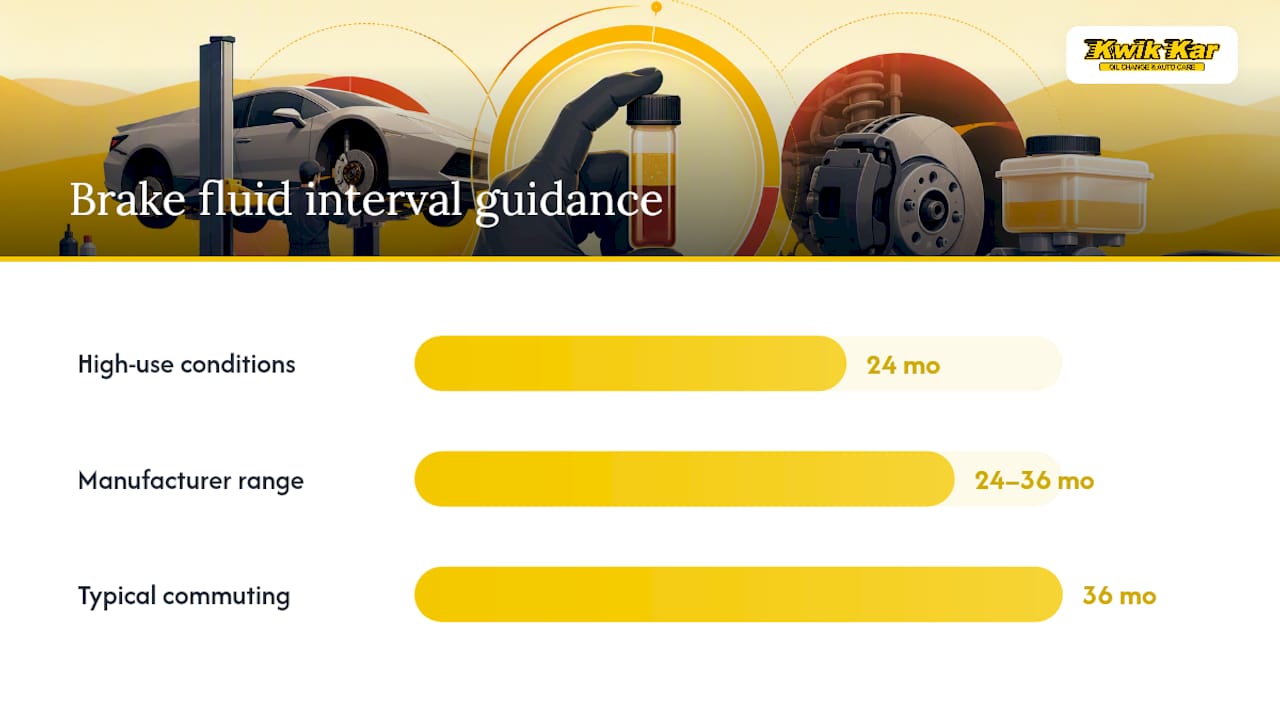
Most owner’s manuals list a brake fluid service interval typically between 24 and 36 months, though specifics vary by brand. Some recommend fixed intervals, while others use inspection-based criteria to determine when replacement is needed.
That spread exists because brake systems, climates, and driving patterns aren’t the same across every vehicle. A 24 month interval is common enough that it’s treated as an industry baseline, but plenty of automakers push that out to 30 or 36 months for vehicles that see lighter use.
Certain conditions such as towing, track days, driving in humid or coastal climates, or frequent stop-and-go commuting can accelerate brake fluid degradation and may require more frequent changes than typical intervals.
If you can’t find your service schedule, treat 2 years as the safe number for anyone who tows, tracks, or drives in a humid region, and 3 years for typical commuting. Kwik Kar of Van Alstyne can also look up your factory-recommended interval during a routine visit if the manual has gone missing.
Why Brake Fluid Wears Out Even When It Looks Fine
Most brake fluid on the road is glycol based, and glycol has one defining quirk: it’s hygroscopic, meaning it pulls moisture out of the air through microscopic pores in rubber hoses, seals, and even the reservoir cap. You can’t see this happening, and the fluid can still look clear while it’s already absorbing water.
That moisture matters because it directly attacks the fluid’s boiling point. Brake fluid has to survive extreme heat at the caliper without turning to vapor, and water lowers that ceiling fast.
A few percent of water can undo most of the fluid’s heat resistance. SAE J1706 documents that 3 to 4% water by weight can drop the wet boiling point by more than 100°C, and lab testing on DOT 4 and DOT 5.1 fluids backs this up: rising moisture content steadily reduces boiling point while increasing bubble formation inside the fluid, which is exactly the setup for vapor lock.
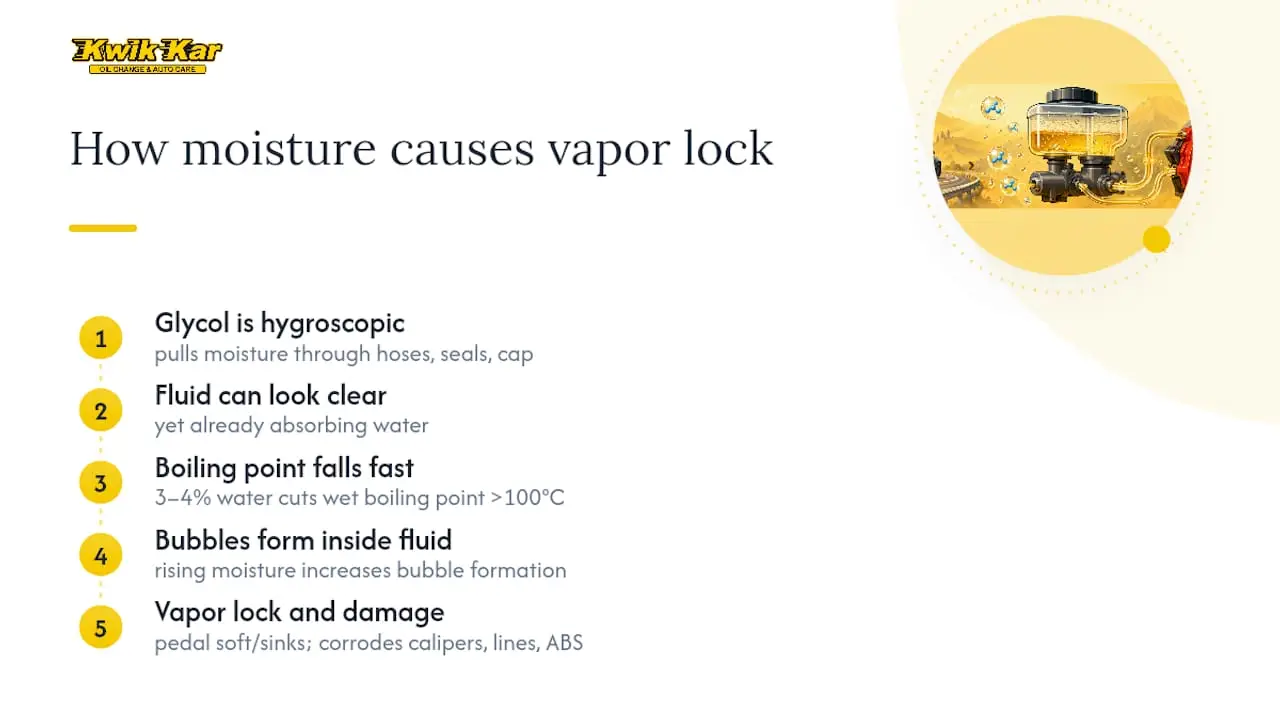
Once boiling point drops far enough, hard braking can flash the fluid into vapor inside the lines. Vapor compresses, unlike liquid, so the pedal goes soft or sinks to the floor right when you need it most. Contaminated fluid also corrodes calipers, brake lines, and ABS components from the inside, which turns a cheap fluid service into an expensive repair if it’s ignored long enough.
Warning Signs Your Brake Fluid Needs Attention
Your brakes usually tell you something’s wrong before a test strip ever confirms it. Here’s what to watch for, in rough order of how urgent it is:
- A spongy or soft pedal. This is the most common tell. If the pedal sinks lower than usual or feels mushy instead of firm, moisture-laden fluid is likely compressing under heat.
- Increased pedal travel. You have to press further to get the same stopping power you used to get with a light tap.
- Inconsistent brake feel. The pedal feels fine one stop and soft the next, especially after several hard stops in a row.
- Unusual ABS behavior. The ABS activating too aggressively, at odd times, or feeling rougher than normal can point to degraded fluid moving through the module.
- Dark or discolored fluid. Fresh fluid is a pale, clear straw color. Fluid that looks brown, cloudy, or murky in the reservoir has likely absorbed moisture and picked up contaminants.
If your pedal suddenly drops toward the floor or brakes feel unreliable at speed, that’s not a “schedule it for next week” situation. Pull over safely and have the vehicle towed or inspected immediately. Discoloration or mild sponginess, on the other hand, is a solid reason to book a brake fluid flush in the next week or two, not an emergency.
Pro Tip: Check your fluid color the next time you’re under the hood for a wiper fluid top-off. It takes ten seconds and it’s the easiest early warning sign you have.
How to Test Brake Fluid Instead of Guessing
Two tools give you real data instead of a guess: moisture test strips and wet boiling-point testing.
- Moisture test strips get dipped into the reservoir and change color based on water content by percentage. Readings above roughly 3% water generally mean it’s time to replace the fluid, since that’s the range where boiling point starts dropping sharply.
- Wet boiling-point testing uses a small handheld tester that heats a fluid sample and reads the actual temperature at which it boils, giving a direct number instead of an estimate.
- Shop diagnostics go further on ABS-equipped vehicles, since a full flush often means cycling the ABS valves to push old fluid out of the module. That’s a step most driveway kits can’t replicate, since the trapped fluid inside an ABS unit doesn’t move with a simple pedal-pump bleed.
Moisture readings can drop fast once a seal starts to age. Testing under MDPI research shows one sample’s wet boiling point falling from around 208°C to about 148°C after just 72 hours of environmental exposure, which shows how quickly exposed or aging fluid can lose its margin of safety.
Pro Tip: If a shop offers a free moisture check during an oil change or inspection, take it. It costs you nothing and tells you exactly where your fluid stands instead of relying on a calendar guess.
What a Proper Brake Fluid Service Actually Involves
There’s a real difference between a partial drain-and-fill and a full hydraulic flush, and it matters which one your vehicle needs.
A drain-and-fill only replaces fluid in the reservoir and upper lines, leaving older fluid deeper in the system. A full flush pushes fresh fluid through every line, caliper, and the ABS module, clearing out moisture-laden fluid completely. If a moisture test or boiling-point reading comes back on the low end, a full flush is the right call, not a top-off.
A few things worth confirming with your technician:
- The correct DOT specification. DOT 3, DOT 4, and DOT 5.1 aren’t interchangeable, and using the wrong spec can affect boiling point and seal compatibility.
- ABS-module cycling, if your vehicle has ABS and the shop is doing a full flush, since this is the only reliable way to clear trapped fluid from the module.
- A full exchange after major brake repairs. Anytime calipers, hoses, or the master cylinder get replaced, a complete fluid exchange with proper bleeding matters more than topping off, a point echoed in technical guidance on prioritizing full exchanges after major component work.
Pro Tip: Ask for the service date and DOT spec in writing, and keep it with your maintenance records. A digital vehicle inspection with photos, timestamped and saved, makes it easy to prove exactly what was done and when the next service is due.
Balancing the Manual With Real-World Driving
The owner’s manual is the right starting point, full stop. But a strict calendar interval doesn’t account for the driver who tows a trailer every weekend versus the one who drives five miles to work and back.
That’s where testing earns its place. A moisture check or boiling-point test gives you actual evidence instead of a guess, and it can justify stretching an interval safely or catching a problem the calendar would have missed entirely. Heavy use, towing, track days, and humid climates all deserve a shorter leash, regardless of what the manual says for typical driving.
— Kwik Kar
Book a Brake Fluid Check With Kwik Kar of Van Alstyne
Kwik Kar of Van Alstyne gives you a real answer instead of a guess. Our ASE-certified technicians can run a moisture or boiling-point check on your brake fluid and show you the exact reading, backed by a digital vehicle inspection with photos so you see precisely what’s happening in your system before any work begins.

If your fluid comes back contaminated, the shop can handle full hydraulic flushes with the correct DOT-spec fluid and ABS-module cycling where needed. Customers may have access to conveniences like after-hours drop-off, free local rides, and a comfortable lobby with WiFi and coffee. Explore our brake repair services or browse the full auto repair and maintenance lineup to see what’s included. Call (903) 712-5945 or visit kwikkarvanalstyne.com to schedule your brake fluid check today.
Sources
The boiling-point figures in this article come from SAE J1706, the industry standard covering brake fluid handling and specifications, along with peer-reviewed lab testing on moisture’s effect on DOT 4 and 5.1 boiling points and wet boiling-point measurements under environmental exposure. Manufacturer interval patterns are drawn from a summary of OEM brake fluid schedules.
- SAE J1706™ JUN2017 — Production, Handling, and Dispensing of SAE J1703 Motor Vehicle Brake Fluids and J1704 Borate Ester Based Brake Fluids
- Effect of moisture percentage on boiling point and bubble formation of DOT 4 and 5.1 brake fluids — Automotive Experiences (2026-07-19)
- Wet boiling point measurements and exposure effects on brake fluids — MDPI (2025-07-10)
- When (and why) to flush brake fluid · ownerspecs
FAQ
How often does brake fluid really need to be changed?
Most owner’s manuals call for a change every 24 to 36 months, and 2 to 3 years is a safe default when the manual isn’t available or the vehicle sees heavy use.
Is it necessary to change brake fluid every 2 years?
For many vehicles, yes, especially those that tow, see track use, or operate in humid climates, though some automakers allow up to 36 months for typical light driving.
What happens if I don’t change brake fluid?
Moisture builds up over time, lowering the fluid’s boiling point and raising the risk of vapor lock, brake fade, and corrosion inside calipers, lines, and ABS components.
Can brake fluid last 5 years?
It’s possible on a lightly driven vehicle with a sealed system, but testing is the only way to know for sure. Kwik Kar of Van Alstyne can check moisture content and boiling point rather than leaving it to chance.