




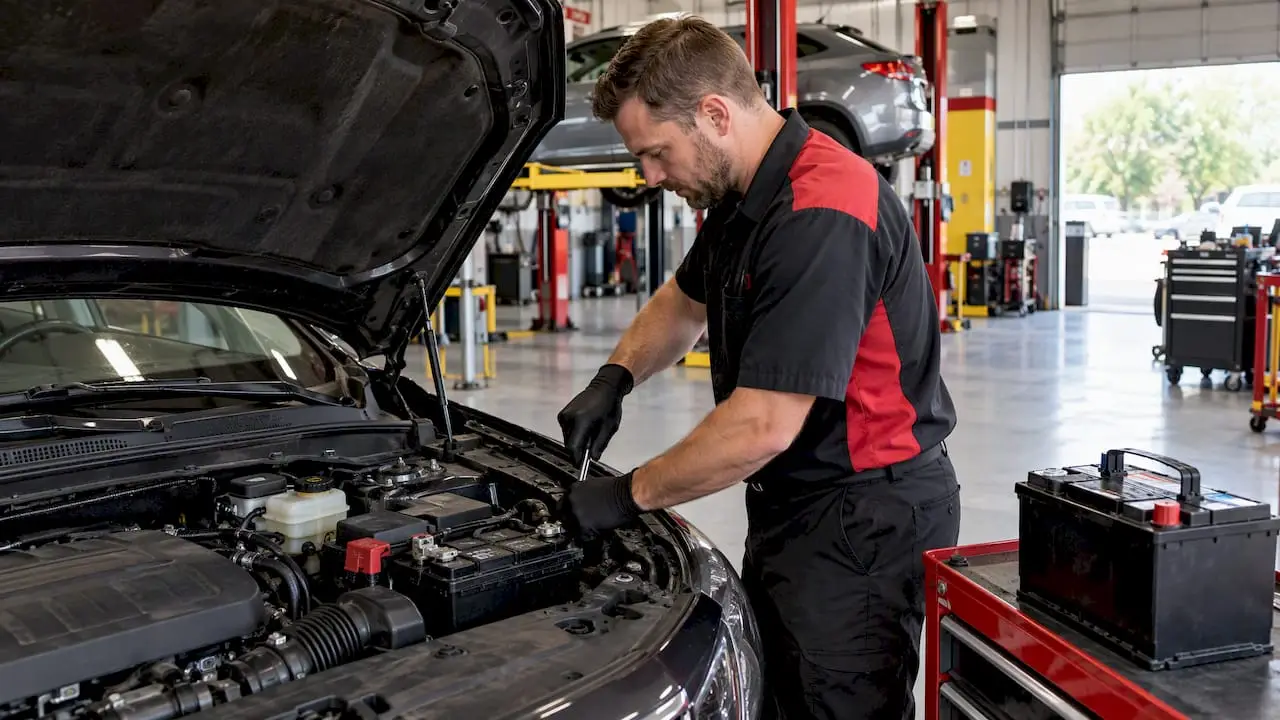
If your car battery is failing, you can get a safe replacement with warranty by calling for a diagnostic and same-day replacement when stock allows. Technicians are ASE-certified, and every visit includes a Digital Vehicle Inspection with photos so you know exactly what your vehicle needs before any work begins.
TL;DR:
- A typical replacement cost ranges from $100 to $350, with AGM and stop-start batteries usually at the higher end due to their complexity.
- A load test offers a more accurate assessment of battery health than a simple voltage check, especially if the battery continues to fail after charging.
- Choosing a new battery requires matching group size, terminal layout, and CCA ratings, while also considering the vehicle’s registration needs and manufacturing date for optimal performance.
- Shops that provide documented diagnostics, photos, and clear warranty terms offer the best assurance, particularly when replacing complex or location-embedded batteries.
- Testing and replacing a vehicle battery generally take under an hour at a professional shop, with extra time needed for registration, programming, or difficult-to-access batteries.
Table of Contents
- Quick options: mobile service, repair shop, or parts store install
- How much a replacement typically costs and what changes the price
- How shops diagnose battery problems: tests and warning signs
- Choosing the right battery: fit, ratings, and freshness
- DIY versus professional replacement: safety and when to call a shop
- Average time required for a battery replacement
- Local service providers and how to choose the best one
- What affects battery replacement costs in Van Alstyne
- Questions to ask when choosing a battery or service
- Compatibility issues common in the Van Alstyne area
- Why documented diagnostics matter when choosing where to go
- Kwik Kar of Van Alstyne: testing, replacement, and how to schedule
- FAQ
- Sources
Quick options: mobile service, repair shop, or parts store install
A slow crank in a parking lot calls for a different fix than a battery that is simply getting old. Here is how the three common paths compare.
- Mobile or roadside service: fast and convenient for an emergency, but the technician often lacks the shop tools needed for battery registration or a full charging-system check.
- Full repair shop visit: includes a load test, an alternator and charging-system check, and post-install programming when your vehicle requires it.
- Parts store install: usually quick and inexpensive, but the service may skip deeper diagnostics and carry a shorter or more limited warranty.
Before picking one, weigh how urgent the problem is, how complex your vehicle’s electrical system is, and whether you want documentation and a warranty behind the work. A ten-year-old pickup with a simple flooded battery is a different job than a late-model sedan with a stop-start system that needs registration after installation.
How much a replacement typically costs and what changes the price
Replacement costs swing based on battery type, labor, and what else your vehicle needs. A standard flooded battery sits at the lower end of the range, while premium or AGM batteries cost more because they handle heavier electrical loads and stop-start technology.
A typical U.S. car battery replacement runs $100 to $350 depending on battery type and vehicle requirements. AGM batteries, battery registration on newer vehicles, hard-to-reach battery locations, and any related alternator or starter work can all push an estimate higher.
- Ask for a written estimate that lists parts, labor, and any core charge separately.
- Confirm the warranty length in writing before you approve the work.
- Check the battery’s manufacture date: a fresher battery holds more of its rated life.
Warranty terms and manufacture date matter as much as the price tag itself. A cheaper battery that is already a year old on the shelf may cost you more in the long run than a slightly pricier, fresher one.
How shops diagnose battery problems: tests and warning signs
A slow crank, dim headlights, or electronics that flicker on and off can point to a weak battery, but they can also point to a failing alternator or a loose connection. That is why a proper diagnosis goes beyond a quick glance under the hood.
- Voltage check: a simple resting-voltage reading tells you the battery’s charge level but not its actual capacity.
- Load test: this measures how the battery performs under real demand, which is a much better indicator of its remaining health.
- Charging-system check: if a battery keeps failing load tests even after charging, the alternator and charging circuit need to be checked too.
- Battery registration: some newer vehicles require the replacement battery to be registered with the vehicle’s computer so the charging system knows it is working with a new unit.
Pro Tip: Ask the shop to show you the load test result, not just tell you the battery “failed,” so you understand exactly why a replacement is recommended.
Choosing the right battery: fit, ratings, and freshness
Getting a battery that physically fits and electrically matches your vehicle is just as important as the price you pay.
- Confirm the group size and terminal layout match your vehicle’s specifications so the battery sits and connects correctly.
- Match or exceed the OEM cold cranking amps (CCA) and amp-hour (Ah) rating, especially if you live somewhere with hot summers and cold snaps.
- Consider an AGM battery if your vehicle has a stop-start system or heavy electrical demands, but confirm compatibility first since not every vehicle is built for one.
- Buy a fresh battery, ideally under six months old based on the manufacture code stamped on the case, and ask about the warranty length before you commit.
A battery that is technically the right size but a year old on the shelf will not deliver the same service life as a fresh one with the same specifications.
DIY versus professional replacement: safety and when to call a shop
Swapping a battery yourself is possible with basic tools, but it carries real risk if you skip steps.
- Gear up first: gloves and eye protection matter because battery acid can burn skin and damage clothing.
- Disconnect the negative terminal first, then the positive, to avoid a short circuit.
- Know the risks: incorrect fit, lost radio presets or ECU settings, and the need for a memory-saver tool are common DIY pitfalls.
- Call a professional if your vehicle uses an AGM battery, requires registration after installation, or if repeated battery failures suggest a charging-system problem rather than a bad battery.
If you are at all unsure about your vehicle’s requirements, a shop visit protects both your safety and your electronics.
Average time required for a battery replacement
A standard battery swap on most vehicles takes well under an hour once a technician has the right battery in hand, since the physical job is mostly disconnecting cables, swapping the unit, and reconnecting terminals. The time adds up around the edges: a load test and charging-system check before the swap, and confirmation afterward that the new battery is charging and holding properly.
Vehicles that require battery registration or computer programming after installation take a bit longer, since the technician has to confirm the vehicle’s electrical system recognizes the new unit. Hard-to-reach battery locations, which are common on some newer vehicles where the battery sits under a seat or in the trunk rather than the engine bay, can also add time.
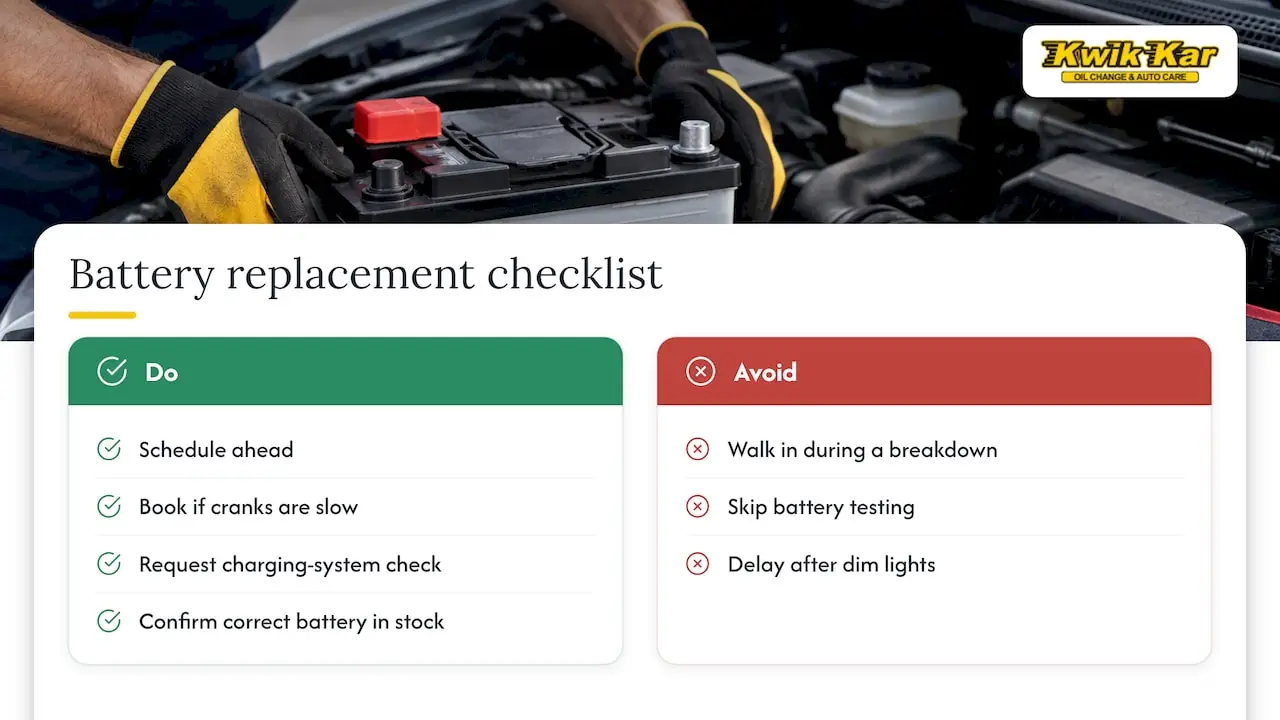
Scheduling ahead rather than walking in during a breakdown gives a shop time to confirm the right battery is in stock for your specific make and model, which keeps your visit as short as possible. If you are already noticing slow cranks or dim lights, getting ahead of a full failure means you can book a convenient appointment instead of dealing with a no-start morning. Our auto repair services include battery testing and replacement alongside the charging-system checks that make sure the new battery is the actual fix, not just a guess.
Local service providers and how to choose the best one
Van Alstyne and the surrounding communities of Anna, Howe, Melissa, and Gunter have a handful of options for battery service: dealerships, parts stores, and independent repair shops. Each has tradeoffs worth understanding before you decide where to go.
Dealerships know your specific make well but often carry higher labor rates. Parts stores offer a fast, low-cost install but typically do not perform a full charging-system diagnosis or document their findings. An independent shop that handles general repair work, not just batteries, tends to catch related issues such as a weak alternator or a corroded terminal that a quick parts-store swap would miss.
When comparing options, look for a few concrete signals of quality:
- ASE-certified technicians performing the diagnostic and installation work.
- Documented inspection results, ideally with photos, rather than a verbal “it needs a new battery.”
- A written warranty that spells out the coverage period and what it includes.
- Convenience features like after-hours drop-off or a ride home if your repair takes longer than expected.
This process is built around those exact signals: every visit includes a Digital Vehicle Inspection with photos, warranty-backed work, and offers after-hours drop-off and local rides for drivers who cannot wait around the shop.
What affects battery replacement costs in Van Alstyne
A few factors tend to move the price of a battery replacement up or down regardless of where you go.
Battery type is the biggest driver: a standard flooded battery costs less than an AGM unit built for stop-start systems or heavy accessory loads. Vehicle complexity matters too. A battery tucked under a seat or behind a wheel well takes longer to access than one sitting in an open engine bay, and that labor time shows up on the invoice.
Dealership pricing often runs higher than an independent local shop because of overhead and brand-specific parts markups, though a dealership may be the right call for a vehicle still under factory warranty for unrelated work. Local independent shops can usually offer more competitive labor rates while still using quality batteries that meet or exceed OEM specifications.
Finally, any additional work the inspection turns up, such as a corroded terminal, a worn battery cable, or a charging system that is not keeping up, adds to the total. That is exactly why a written, itemized estimate matters: it tells you which part of the cost is the battery itself and which part is labor or additional repairs. Asking for that breakdown before you approve the work is one of the simplest ways to avoid surprise charges.
Questions to ask when choosing a battery or service
A few direct questions can save you money and frustration before you commit to a replacement.
- “What group size and CCA rating does my vehicle need, and does this battery meet or exceed it?”
- “How old is this battery?” A fresher unit, ideally under six months from its manufacture date, holds its rated performance longer.
- “Does my vehicle need battery registration or programming after installation?”
- “What does the warranty cover, and for how long?”
- “Will you check the charging system, not just the battery, before I leave?”
Asking these questions upfront tells you quickly whether a shop is doing a thorough job or a quick swap. A shop that answers clearly and shows you the actual test results, rather than just a recommendation, is one you can trust with the rest of your vehicle’s electrical health.
Compatibility issues common in the Van Alstyne area
Vehicle compatibility issues usually come down to two things: physical fit and electrical requirements. Getting either one wrong can mean a battery that will not sit securely, will not connect properly, or will not satisfy a vehicle’s charging system.
Group size and terminal layout vary across makes and even across trim levels within the same model year, so a battery that fits a neighbor’s truck will not necessarily fit yours. Newer vehicles, particularly those with stop-start technology or advanced driver-assistance systems, often require an AGM battery rather than a standard flooded one, and some require the replacement to be registered with the vehicle’s computer afterward. Skipping that step on a vehicle that needs it can trigger warning lights or cause the charging system to undercharge the new battery.
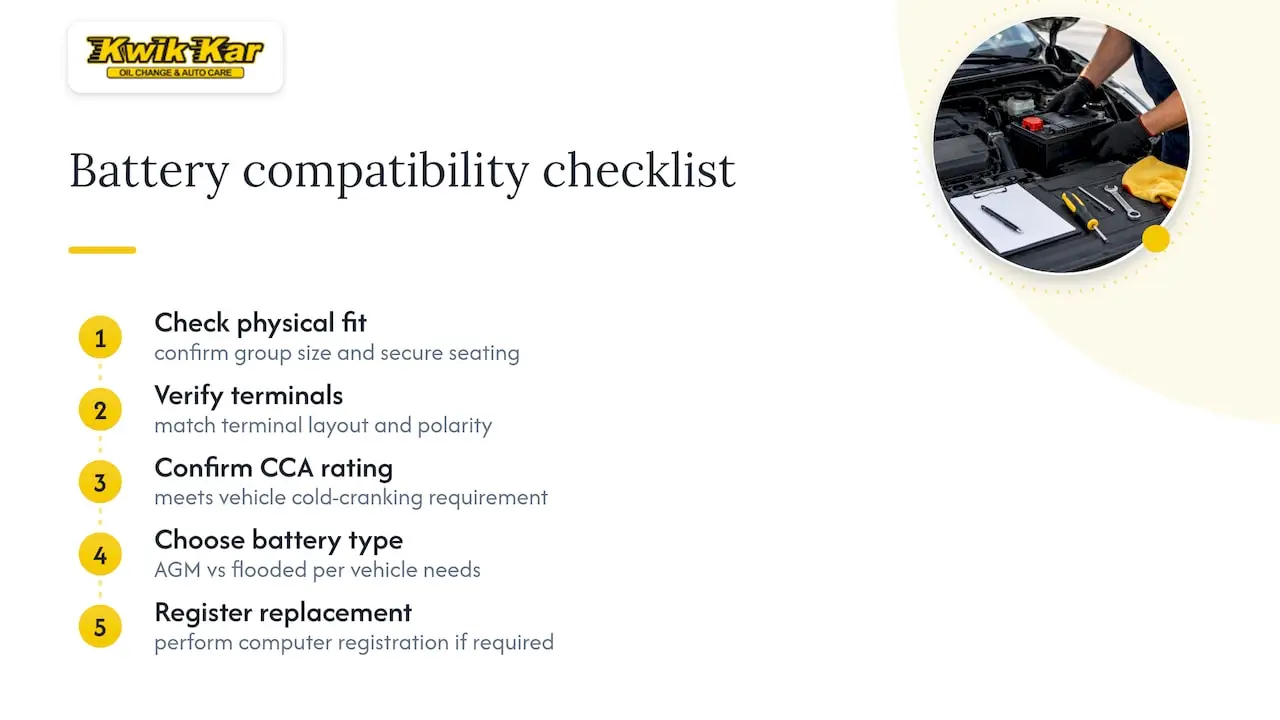
European vehicles in particular tend to have specific battery and registration requirements that differ from many domestic models. If you drive a vehicle in that category, our European auto repair service is built around those make-specific procedures. Whatever you drive, confirming group size, CCA rating, and registration requirements before the battery goes in prevents a return trip.
Why documented diagnostics matter when choosing where to go
A battery recommendation means more when you can see why it was made. Photos from a Digital Vehicle Inspection, a documented load test result, and a written warranty turn a verbal “you need a new battery” into something you can actually evaluate. ASE-certified technicians and clear terms are not just reassuring. They give you a way to check the work.
— Kwik Kar
Kwik Kar of Van Alstyne: testing, replacement, and how to schedule
When a battery is the problem, or when you just want to rule it out, we handle the testing, the charging-system check, and the replacement in one visit. Every job includes a Digital Vehicle Inspection with photos, so you see the actual load test and charging results instead of just a recommendation, with warranty coverage backing the work.

- Battery testing and replacement, plus charging-system and starter diagnostics when a battery keeps failing.
- ASE-certified technicians on every job, with results documented in your inspection report.
- After-hours drop-off and free local rides so a dead battery does not derail your whole day.
If your car has been slow to start or your dashboard lights have been acting up, do not wait for a morning when it will not start at all. Call us at (903) 712-5945 or schedule a visit through our auto repair services page and we will get you back on the road with a battery you can trust.
FAQ
How much should replacing a car battery cost?
A typical U.S. replacement runs $100 to $350, depending on whether you need a standard flooded battery or a premium AGM unit. Labor, any battery registration required by your vehicle, and added repairs like a corroded cable can move the total within that range.
Will AutoZone replace a battery for me?
Parts stores commonly offer battery installation, and it is often quick and inexpensive. These installs typically do not include a full charging-system check or the kind of documented inspection a repair shop provides, so a battery that keeps failing after a parts-store swap may need a shop visit to find the real cause.
Is $200 expensive for a car battery?
A replacement cost falls within the typical $100 to $350 range for U.S. battery replacements, so it is not unusual, especially for a mid-range or AGM battery. The fairer question is whether that price includes a load test, a charging-system check, and a warranty, not just the battery itself.
What kills car batteries quickly?
Heat is one of the biggest factors: summer heat accelerates fluid evaporation and internal wear, shortening a battery’s usable life more than cold weather does. Frequent short trips that do not let the battery fully recharge, parasitic electrical drains, and a faulty voltage regulator that overcharges the battery are also common culprits.
How often should I get my car battery tested?
Consumer Reports recommends annual testing once a battery reaches two years old in warmer climates, or four years old in colder climates. If you are noticing a slow crank or dim electronics before then, it is worth getting it tested sooner rather than waiting for a no-start morning.
Sources
- Best car battery buying guide | Consumer Reports
- Summer heat takes a toll on your car’s battery | Car Care Council