




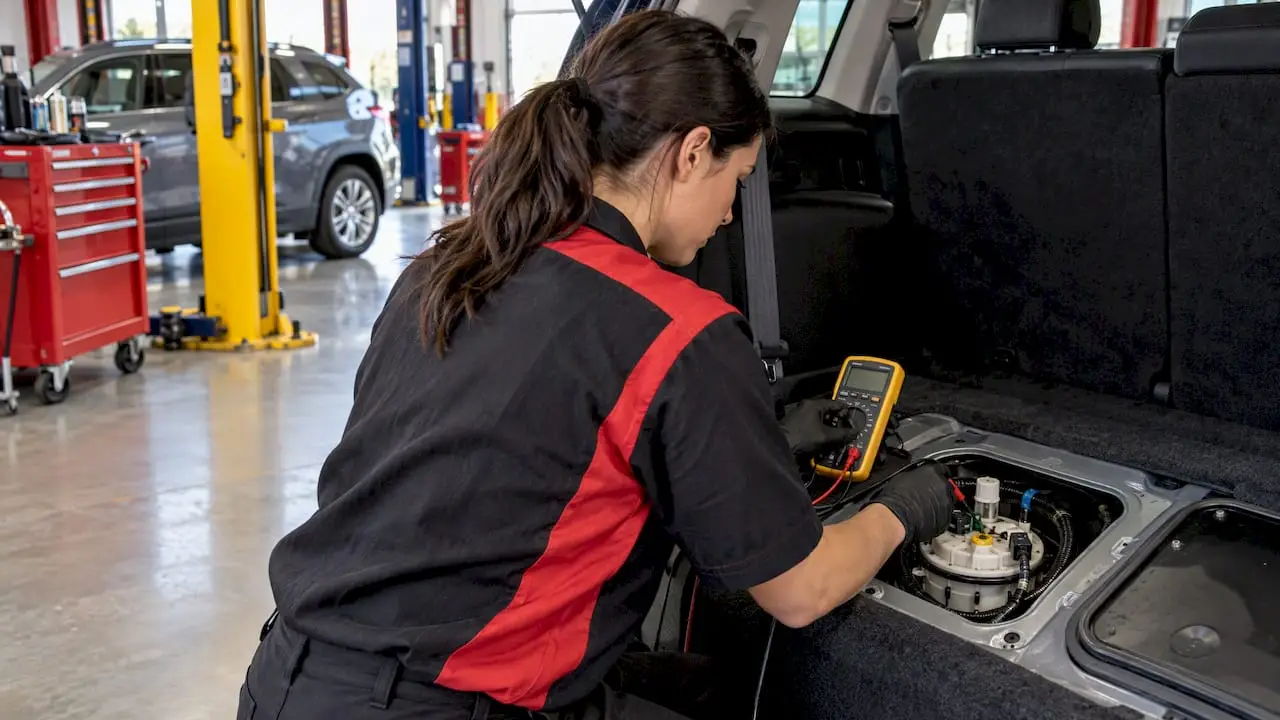
If your engine sputters at highway speed, struggles to accelerate, or makes a whining noise near the fuel tank, it usually points to a weak fuel pump or a problem with its electrical supply. Short trips may be fine, but repeated stalling or hard starts mean you should stop relying on the car and get a fuel pressure and electrical test to confirm what’s wrong.
TL;DR:
- Fuel pump symptoms, such as sputtering at speed, loss of power, and whining noises, often indicate early failure but can also result from electrical or fuel system issues.
- Contaminated fuel, clogged filters, faulty relays, or bad sensors can mimic pump failure, so thorough inspection of the fuel tank and electrical supply is essential before replacement.
- Diagnostic checks like listening for priming sounds, measuring fuel pressure, and testing electrical voltage help confirm if the pump itself is faulty.
- Avoid driving with worsening symptoms, keep the fuel tank above a quarter full, and refrain from heavy loads until a professional diagnosis is completed.
- A full system inspection by an ASE-certified technician involves pressure testing, wiring checks, and tank inspection, with a focus on preventing unnecessary pump replacements.
Table of Contents
- 1. Recognize the common symptoms of fuel pump failure
- 2. Understand what actually causes fuel pump problems
- 3. Know which diagnostic checks confirm a bad fuel pump
- 4. Decide whether it’s safe to keep driving
- 5. See how a professional shop confirms the diagnosis
- 6. A mechanic’s take on catching fuel pump trouble early
- Get a fuel system diagnostic at Kwik Kar of Van Alstyne
- FAQ
- Sources
1. Recognize the common symptoms of fuel pump failure
A fuel pump in trouble rarely fails without warning. Most drivers notice a pattern of small annoyances before the car leaves them stranded, and knowing what each one means helps you describe the problem accurately when you call a shop.
- Engine sputters at highway speeds because the pump can’t keep up with the fuel demand of sustained high RPM.
- Loss of power when accelerating or climbing hills happens when fuel delivery drops right as the engine needs more.
- Hard starts or long cranking times point to low fuel pressure building too slowly at startup.
- Frequent stalling or the engine dying while driving suggests the pump is cutting in and out.
- The engine starts, then dies immediately often means the pump isn’t holding pressure after the initial prime.
- Whining or buzzing from the fuel tank area usually signals mechanical wear or debris inside the pump.
- Reduced fuel economy can occur when inconsistent pressure forces the engine to run lean.
- Sudden surges or an inconsistent throttle feel reflect unstable fuel delivery under load.
- A check engine light with fuel pressure or injector performance codes is often the first measurable clue.
- A pump that runs hot after long drives may be struggling because a low fuel level left it without enough fluid to stay cool.
- Intermittent trouble that shows up only when the engine is hot often traces back to failing electrical connectors rather than the pump itself.
- A complete no-start with every other electrical system working fine can mean the pump or its sealed connector has failed outright.
According to AAA’s guide to fuel pump costs, common symptoms include hard starts, sputtering at speed, power loss under load, reduced fuel economy, and whining from the tank. AAA also notes that ignoring early sputtering can let the problem cascade into clogged injectors or internal engine wear from running lean under heat, which is one more reason to get symptoms checked early rather than waiting for a full breakdown.
2. Understand what actually causes fuel pump problems
Not every symptom on that list means the pump itself has failed. Plenty of cars get a brand new pump installed when the real problem was something cheaper and easier to fix.
- Contaminated fuel, rust, and sediment damage the inlet strainer and starve the pump of clean fuel.
- A clogged fuel filter or a pinched line can choke delivery and produce symptoms that look identical to a dying pump.
- Blown fuses, a failing relay, or corroded connectors can create voltage drops that make a healthy pump act weak.
- A faulty pressure regulator or a sensor feeding bad data to the ECU can mimic pump failure without the pump being at fault.
The Tomorrow’s Technician bulletin on in-tank pump failures identifies contaminated fuel and rust as leading causes, and recommends replacing the inlet strainer and inspecting the tank whenever a pump is replaced. Skipping that step is a common reason the same symptoms return a few months later.
Pro Tip: Ask your shop to check the electrical supply and inspect for tank contamination before authorizing a new pump, since a bad connector or dirty tank will just damage the replacement too.
3. Know which diagnostic checks confirm a bad fuel pump
Some checks are safe to try yourself. Others need equipment and training you shouldn’t attempt in a driveway.
- Listen at key ON. Turn the key to the “on” position without starting the engine and listen for a brief whirring sound from the tank area, which is the pump priming the fuel system.
- Check for obvious issues. Look and smell for fuel odor, loose wiring near the tank, or visible damage, but never open the fuel tank yourself.
- Measure fuel pressure. A technician connects a gauge to the Schrader valve on the fuel rail and compares the reading to the manufacturer’s specification.
- Test pump power with a multimeter. Checking voltage and ground at the pump connector can reveal a wiring fault, but this step calls for an experienced hand and the right safety precautions around a fuel system.
- Leave flow and amperage testing to a shop. Measuring actual fuel flow or current draw usually requires dropping the tank or accessing the pump module directly.
The FCP Euro diagnostic primer describes this exact sequence: listen for the prime, measure pressure and flow, and test pump amperage and voltage before replacing anything. Fuel pumps typically draw a few amperes of current when new, and measuring this can help detect issues., according to Brake & Frontend’s technical feature on repeat pump failures, and a reading well outside that range can point to a worn motor or a restricted fuel return line.
4. Decide whether it’s safe to keep driving
A pump on its way out can leave you stranded without warning, so the smart move is to treat the symptoms as a signal to act rather than wait them out.
- Avoid driving if the engine has stalled in traffic or shown signs of losing power on the highway, since that risk only grows.
- Short, low-speed trips may be reasonable if symptoms are mild and infrequent, but don’t push it.
- Keep the fuel tank above a quarter full, since very low fuel levels add stress to a pump that’s already struggling and reduce its cooling.
- Skip towing or hauling heavy loads until the system has been checked, since extra demand is exactly what a weak pump can’t handle.
- Replace the fuel filter on schedule and avoid stations with a history of contaminated fuel to protect the pump long term.
5. See how a professional shop confirms the diagnosis
An ASE-certified technician follows a structured process instead of guessing from symptoms alone. The sequence typically includes:
- Scanning for stored codes related to fuel pressure, injector performance, or pump circuits.
- Measuring fuel pressure and flow against the manufacturer’s specification.
- Checking pump voltage and current draw to catch a weak motor or a wiring problem.
- Inspecting the tank strainer, wiring harness, and connectors for contamination or corrosion.
We document each step with a digital vehicle inspection, which includes real-time photos so you can see exactly what the technician found before any work begins. A pump that looks fine on the outside can still be the problem, and a pump that seems weak can sometimes be a wiring issue instead, so a full inspection is the only way to know for certain. We do not recommend a replacement without testing the system first.
6. A mechanic’s take on catching fuel pump trouble early
Write down when the symptoms happen: cold starts versus a hot engine, idling versus highway speed, and any dashboard codes that pop up. If you can capture a short video or audio clip of a whine or buzz from the tank, bring it along. That kind of detail speeds up an accurate diagnosis.

Get a fuel system diagnostic at Kwik Kar of Van Alstyne
Sputtering, stalling, and hard starts deserve a real test, not a guess. We run fuel pressure and electrical checks with ASE-certified technicians and back every finding with a digital vehicle inspection complete with photos, so you see exactly what’s happening under the hood before anything gets replaced.

- We offer diagnostic testing to confirm whether the pump, wiring, or fuel filter is the real issue.
- We also handle broader auto repair services if the inspection points to a related fuel system or electrical fault.
- Bring notes on when symptoms happen, since that detail helps our technicians narrow things down faster.
| What to bring | Why it helps |
|---|---|
| Symptom timing (hot, cold, idle, highway) | Narrows down pump versus electrical causes |
| Dashboard codes or warning lights | Points technicians toward the right test |
| Video or audio of unusual noises | Helps confirm pump wear before teardown |
Call us at (903) 712-5945 or visit our appointments page to schedule a diagnostic before a weak pump leaves you stranded.
FAQ
How does a car act when a fuel pump is going out?
A failing pump typically causes sputtering at highway speed, loss of power when accelerating, hard starts, and occasional stalling. You may also hear a whine from the fuel tank area or notice reduced fuel economy as the symptoms progress.
How do you temporarily fix a fuel pump?
There’s no reliable temporary fix for a failing fuel pump, but keeping the tank above a quarter full and avoiding heavy loads or high speeds can reduce strain on a weak pump until it’s inspected. These steps only buy time. They don’t replace a proper diagnostic test.
Does the fuel pump give warning before going out?
Yes, most pumps show warning signs like sputtering, hard starts, or a whine from the tank before failing completely. Catching these early and getting a fuel pressure test can prevent a sudden breakdown.
Can a fuel pump run but still be bad?
Yes, a pump can still spin and build some pressure while being too weak to meet demand under load, which is why symptoms often appear only at highway speed or while accelerating. A fuel pressure and flow test is the only reliable way to confirm pump condition rather than fuel supply or wiring problems. If your vehicle uses a high-pressure diesel system, a technical overview of HPFP failure covers how those pumps differ from standard electric fuel pumps.
Sources
- How Much Does a Fuel Pump Replacement Cost? | AAA Automotive
- How to diagnose a bad fuel pump — FCP Euro blog
- Tech Feature: Diagnosing repeat fuel pump failures — Brake & Frontend
- Common causes of electric in-tank fuel pump failures — Tomorrow’s Technician (TEC bulletin)