




R-1234yf and R-134a are two different car AC refrigerants, and they cannot be swapped. Your vehicle’s AC system is built for one of them, and it has to be serviced with that one. Cars built since the mid-2010s increasingly use R-1234yf, while older cars use R-134a. Cooling performance is very similar when each refrigerant sits in the system designed for it. The real differences show up in cost, service equipment and fittings. We service both types here in Van Alstyne, so you never have to guess which one your car needs.
TL;DR
- R-134a has been the most common car AC refrigerant in the US since 1994. R-1234yf began replacing it in light-duty vehicles in 2012 and is now used in the majority of them, according to the EPA.
- You cannot mix them or convert a system from one to the other. Using R-134a in a system designed for R-1234yf is illegal under the Clean Air Act.
- Each refrigerant has its own service fittings, so the wrong one physically will not connect.
- R-1234yf has a global warming potential of 4, versus 1,430 for R-134a. It is mildly flammable, and AC systems built for it account for that.
- The refrigerant label under the hood or your owner’s manual tells you which one your car uses.
Table of Contents
- What R-134a and R-1234yf are
- Can you use one in place of the other?
- Different fittings keep them apart
- How they compare on cooling performance
- Why R-1234yf costs more
- Environmental impact and safety
- Which refrigerant does your car use?
- Signs your AC needs attention
- AC service at Kwik Kar of Van Alstyne
- Our perspective
- FAQ
- Sources
What R-134a and R-1234yf are
R-134a is the refrigerant most of us grew up with. The EPA says it has been the most common motor vehicle AC refrigerant in the US since 1994. It replaced the older CFC-12, which damaged the ozone layer.
R-1234yf is its successor. Automakers began moving to lower-impact refrigerants like it in light-duty vehicles in 2012. The driver behind the change is climate impact, not ozone, since neither refrigerant depletes the ozone layer.
Your AC works the same way with either one. The refrigerant circulates through the compressor, condenser, expansion valve and evaporator, absorbing heat from the cabin and releasing it outside. What changes is the chemistry and the parts built around it.
Can you use one in place of the other?
No. This is the question that matters most, and the answer is firm.
Honeywell’s Opteon YF guide for shops says to use only the refrigerant a system was designed for. It also says:
- Putting R-134a into a vehicle designed for R-1234yf is illegal under the federal Clean Air Act, with civil penalties of up to $45,268 per vehicle.
- There is currently no approved way in the US to retrofit an R-134a system to R-1234yf.
- Mixing refrigerants hurts system performance and safety.
The manufacturer of R-1234yf adds that mixing the two can reduce cooling, damage the compressor and cause recovery machines to shut down. Replacing R-1234yf with a higher-impact refrigerant is also treated as tampering with an emissions-related component.
The industry’s 609 training manual makes the same point: R-1234yf is not a drop-in replacement. EPA approved it only for new vehicles whose components were designed for it, not as a conversion for existing systems.
What this means for an older car
If you drive an older R-134a car, you do not have to worry about a ban. The EPA’s fact sheet on its 2023 rule says existing vehicle AC systems may keep being serviced and repaired, including component replacement, throughout their useful life. Your system stays an R-134a system for its whole life.
Different fittings keep them apart
The EPA does not leave this to chance. It requires a unique fitting set for each approved refrigerant on the vehicle, the recovery equipment and the refrigerant containers. Adapters that convert one fitting to another are not allowed.
Here is how they differ:
| R-134a | R-1234yf | |
|---|---|---|
| Service ports | Quick-connect couplers | SAE J639 (2020) quick-connects, 17 mm high side and 14 mm low side |
| Container threads | Right-hand | Left-hand |
| Used in | Older vehicles, since 1994 | Newer vehicles, since 2012 |
The practical result is that the service port on your car matches only the correct equipment. It is a built-in safeguard against cross-contamination.
How they compare on cooling performance
Drivers often ask whether the newer refrigerant cools as well. In a system designed for it, the answer is yes for everyday driving. Honeywell reports that with an internal heat exchanger and optimized operating conditions, R-1234yf has very similar cooling performance to an R-134a system. Its boiling point is also 3 to 4 degrees lower.
An internal heat exchanger (also called a suction line heat exchanger) is a part that lets the cold refrigerant leaving the evaporator pre-cool the refrigerant heading into it. It helps the system use the refrigerant efficiently. A 2023 study in Heat Transfer Engineering found a passenger-vehicle system with a suction line heat exchanger using R-1234yf had a 12% better coefficient of performance and 8% higher exergy efficiency than the same setup on R-134a. Coefficient of performance is simply how much cooling you get per unit of energy put in.
The ASE 609 Program Book adds another engineering point. R-1234yf’s pressure and temperature behavior closely resembles R-134a’s, which let automakers adapt existing designs, and running the AC on it takes less fuel, so the engine emits less CO2.
What this means for you: a healthy AC system blows cold with either refrigerant. If yours does not, the refrigerant type is rarely the explanation. A leak, a failing compressor, a clogged part or an electrical fault is much more likely. Our guide on what to record when your AC isn’t blowing cold helps you describe the symptoms so the diagnosis goes faster.

Why R-1234yf costs more
R-1234yf is the pricier refrigerant per pound, and service on those systems can cost more than on R-134a systems. Several things drive that:
- The refrigerant itself. It is a newer product made in smaller volumes than R-134a.
- Dedicated equipment. A shop needs a recovery, recycling and recharge machine made for R-1234yf. Honeywell estimates a shop recoups the cost of that machine by servicing roughly 15 to 20 R-1234yf vehicles, which shows how significant the investment is.
- More careful procedures. Trade reporting notes that R-1234yf recovery and recycling takes more time and involves more sophisticated leak and purity checks, plus a dedicated leak detector.
These checks are what keep your system clean and your cooling reliable. For a clearer picture of AC recharge costs and timing in general, there is a helpful overview of AC recharge cost and when to act.
One more point: a recharge is not a fix by itself. If the system lost refrigerant, something let it out. Finding that leak is what keeps you from paying for the same refrigerant twice.
Environmental impact and safety
The EPA lists the numbers side by side. R-134a has a global warming potential (GWP) of 1,430 and makes up an estimated 24% of global HFC consumption. R-1234yf has a GWP of 4. GWP compares how much heat a gas traps against carbon dioxide, which is 1. Neither refrigerant harms the ozone layer.
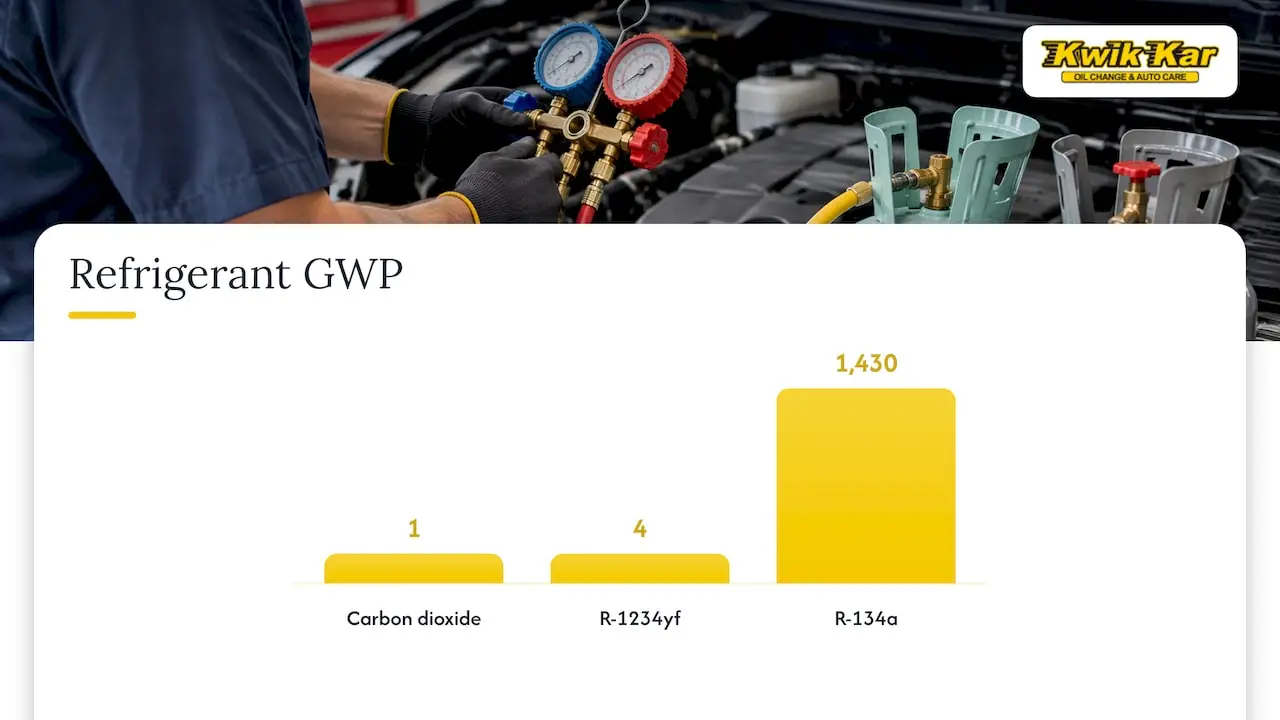
That gap is why the rules changed. Under the EPA’s October 2023 Technology Transitions rule, refrigerants with a GWP of 150 or more, like R-134a, are restricted in newly built light-duty passenger vehicles starting with model year 2025. Medium-duty passenger vehicles, heavy-duty pickups and complete heavy-duty vans follow from model year 2028.
Is R-1234yf safe?
R-1234yf is classed by ASHRAE as A2L, meaning mildly flammable. The EPA says it can be used safely under the required conditions. The 609 training manual notes it was tested by manufacturers, independent laboratories, vehicle makers and government agencies for exposure risk, toxicity, flammability, environmental damage and vehicle suitability before approval. Systems built for it include components designed around that property.
The safe-use takeaway is simple: refrigerant work belongs in a shop with the right equipment and trained technicians. Refrigerant should be recovered, never vented into the air.
Which refrigerant does your car use?
You can find out in about a minute:
- Look under the hood. A label near the radiator support or on the underside of the hood names the refrigerant and often the charge amount.
- Check the owner’s manual. The AC specifications list the refrigerant type.
- Use the model year as a clue. Most vehicles built from the mid-2010s on use R-1234yf, but automakers switched at different times, so the label is the reliable answer.
Honeywell’s guide recommends this same approach: check the label or manual and use only the refrigerant that was originally in the system.
If you cannot find the label or it is unreadable, bring the car in. We confirm the refrigerant type as part of the AC visit, so you do not have to sort it out in a parking lot.
Signs your AC needs attention
Whichever refrigerant your car uses, the warning signs look alike:
- Air that is cool but not cold, especially at idle or in Texas afternoon heat
- A compressor that cycles on and off rapidly, or does not engage
- Hissing, rattling or grinding when the AC runs
- Weak airflow from the vents
- A musty smell when you first switch the fan on
A noisy or struggling compressor deserves quick attention, since a failing one can send debris through the system. Our page on AC compressor failure symptoms walks through what to watch for. Ahead of summer, getting your car’s AC ready for warm weather helps you catch problems before the first 100-degree day.
We cannot name a cause without inspecting your vehicle. A diagnosis starts with the car in the bay, not with a guess over the phone.
AC service at Kwik Kar of Van Alstyne
When your AC needs work, our AC repair service covers R-134a and R-1234yf vehicles alike. All work is performed by ASE-certified technicians, and repairs carry a 2-year/24,000-mile warranty.
You also see what we see. Our Digital Vehicle Inspection sends real-time updates and photos, so you know what your vehicle needs before you approve anything. You can read how a digital vehicle inspection works if you want the details.
Busy schedule? After-hours drop-off and free local rides keep you moving, and the waiting area has WiFi and coffee if you would rather stay.

If the AC is already underperforming, start with our diagnostics service. Call (903) 712-5945 to book.
Our perspective
Most AC questions we hear start the same way: “Can’t you just top it off?” With a system built for R-1234yf or R-134a, the honest answer begins with the label under the hood, not with a can of refrigerant.
Your system was designed around one refrigerant. Its fittings, its parts and its service procedure all follow from that. That is why we want to see the vehicle first, confirm what it uses, and look for the reason it is low before we recommend anything.
That is also why we put photos and real-time updates from our Digital Vehicle Inspection in your hands. You see what we see, and you decide with clear information and no surprise costs. When the work is done by ASE-certified technicians and backed by a 2-year/24,000-mile warranty on repairs, you can drive to Sherman, Anna or Lake Texoma knowing the AC is sorted.
If you are a parent shuttling kids to practice in August or a commuter on Highway 5, a cold cabin is part of getting there safely and comfortably. We would like to be the shop that keeps it that way.
Kwik Kar
FAQ
Is R-1234yf compatible with R-134a?
No. The two refrigerants cannot be mixed, and no approved retrofit exists in the US to convert an R-134a system to R-1234yf. Using R-134a in a vehicle designed for R-1234yf is illegal under the Clean Air Act. Service always uses the refrigerant the system was built for.
Will R-134a be phased out of older cars?
Existing vehicles can keep being serviced with R-134a. The EPA’s 2023 rule restricts it in newly manufactured light-duty passenger vehicles from model year 2025, but it does not stop repair and service of existing systems. If your car came with R-134a, it stays an R-134a car.
Why is R-1234yf more expensive?
The refrigerant is newer and costs more per pound. Servicing it also requires dedicated recovery equipment and more thorough leak and purity checks. Actual pricing depends on your vehicle and what the inspection finds, so we quote after we look at the car.
Does R-1234yf cool as well as R-134a?
In a system designed for it, performance is very similar. Honeywell states that with an internal heat exchanger and optimized operating conditions, R-1234yf matches R-134a’s cooling closely. If your AC is weak, the cause is usually a leak or a failing part, not the refrigerant type.
How do I know which refrigerant my car uses?
Check the label under the hood or the AC specifications in your owner’s manual. If you cannot find either, bring the vehicle to us at Kwik Kar of Van Alstyne and we will confirm it during your AC visit.
Sources
- EPA: Acceptable Refrigerants and their Impacts
- EPA: Unique Fittings and Label Colors
- EPA: Technology Transitions Program fact sheet
- Opteon YF Shop Owner’s Guide
- Opteon YF: R-1234yf refrigerant
- MACS 609 Certification Training Manual
- ASE 609 Program Book
- Thermodynamic Analysis of Air Conditioning System, Heat Transfer Engineering (2023)
- Vehicle Service Pros: A look at alternative refrigerants to R-134a