



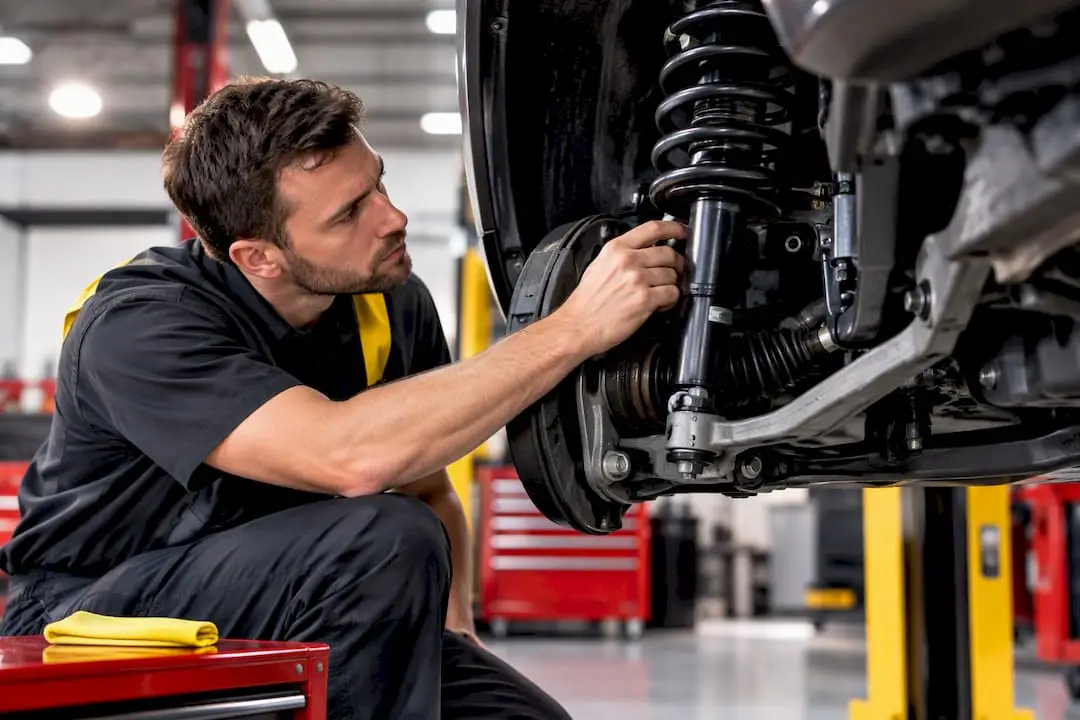
Struts are structural suspension members that also damp motion, while shocks only damp motion and let another part of the suspension carry the vehicle’s weight. Depending on the model, your car might use shocks at one axle and struts at the other, and both parts affect ride comfort and safety the same way. Most shocks and struts start showing wear between 50,000 and 100,000 miles, which makes that range a helpful idea for when to have them checked.
TL;DR:
- Shocks typically last between 50,000 and 100,000 miles before showing wear, and their replacement is generally a bolt-on task for most vehicles.
- Struts bear structural loads, affect alignment, and often require a wheel alignment after replacement, making their service more complex and costly.
- Worn shocks cause excessive bouncing and instability, while failing struts can lead to uneven tire wear, steering issues, and handling problems.
- Replacement costs usually range from $1,119 to $1,328 for a full set, with added costs for alignments and choosing loaded assemblies for easier installation.
- Regular inspections, especially after noticing bouncing or tire wear, help prevent safety risks related to compromised suspension components.
Table of Contents
- What a Shock Absorber Does Under Your Car
- What a Strut Actually Is and Why It Matters More
- Shocks or Struts: How to Tell What Your Car Has
- Signs Your Shocks or Struts Are Wearing Out
- Replacing Shocks and Struts: Costs and What to Expect
- How Kwik Kar of Van Alstyne Diagnoses Shocks and Struts
- When Comfort Becomes a Safety Issue
- Getting Your Suspension Checked at Kwik Kar
- Sources
- FAQ
What a Shock Absorber Does Under Your Car
A shock absorber slows down suspension movement using hydraulic or gas-charged fluid that resists flow as the wheel moves up and down. The faster the suspension tries to move, the more resistance the shock creates, which is why engineers call it velocity-sensitive damping. Shocks do not hold up the weight of your vehicle; that job belongs to springs or, on many front-wheel setups, to the strut assembly itself.
Two common shock designs show up on most passenger vehicles:
- Twin-tube shocks use an inner working tube and an outer reserve tube, offering a smoother ride suited to daily commuting.
- Monotube shocks use a single tube with a larger piston, which tends to respond faster and stay cooler under repeated hard use.
Worn shocks lose their ability to control spring bounce, so the car feels loose over bumps and can porpoise on rough highways long before the tires or springs show any obvious damage.
What a Strut Actually Is and Why It Matters More
A strut combines a damper insert with real structural duty; that second role is what separates it from a plain shock. A typical strut includes the outer housing, the damper insert inside it, the coil spring, an upper mount, a protective boot, and a bump stop that limits travel.
Because a strut carries the coil spring and often takes the place of the upper control arm and upper ball joint, it directly affects wheel alignment and steering feel, not just ride comfort. Key points to know:
- Struts bear side loads from cornering and braking, which shocks are never asked to handle.
- A worn strut can shift camber or toe angles enough that the vehicle pulls or wears tires unevenly.
- Replacing a strut almost always calls for a wheel alignment afterward, since the mounting geometry changes slightly with new parts.
- Shops choose between a full loaded assembly or a bare strut depending on spring condition and whether a spring compressor is available.
Shocks or Struts: How to Tell What Your Car Has
The easiest way to know which system you’re dealing with is to think about your vehicle’s front suspension design. Most modern unibody cars and crossovers use struts up front, while many trucks, SUVs, and rear axles on passenger cars rely on separate shocks paired with springs or a solid axle.
A quick side-by-side comparison helps clarify the practical differences:
- Function: shocks only damp motion, while struts damp motion and support structural load.
- Service complexity: shock replacement is usually a bolt-off, bolt-on job, while strut replacement may require a spring compressor, specialized tools, and a follow-up alignment.
- Symptom overlap: both parts produce similar bouncing, clunking, and uneven tire wear when worn, which is why a technician inspection matters more than guesswork.
Coilovers, common on performance and some aftermarket setups, fall into the strut category functionally, since they also combine a damper with a spring and mounting point in one structural unit. A local shop explainer walks through similar visual checks for drivers trying to identify parts before a repair conversation.
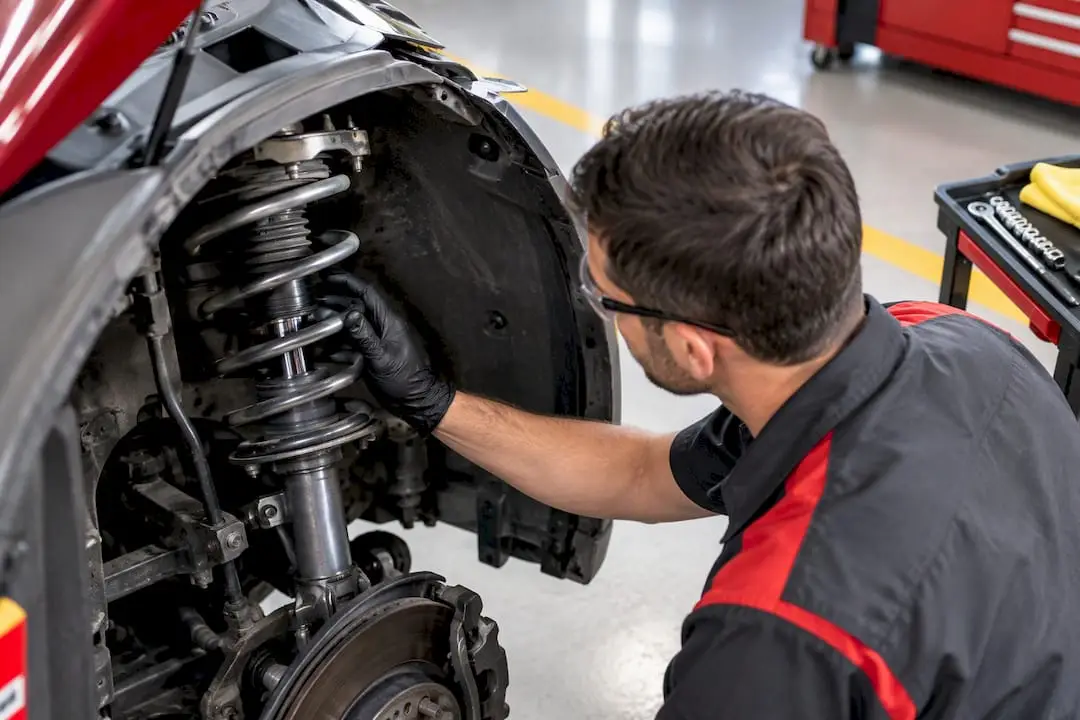
Pro Tip: Pop the hood and look at the front suspension; if you see a spring wrapped around a shaft leading to the top of the wheel well, you’re almost certainly looking at a strut, not a shock.
Signs Your Shocks or Struts Are Wearing Out
Worn shocks or struts rarely fail all at once, but the symptoms build steadily and are easy to notice if you know what to watch for.
- Excessive bouncing after hitting a bump, or a nose dive when braking hard.
- Body roll or sway that feels more pronounced than it used to during turns.
- Clunking noises over bumps, along with visible fluid leaks or a torn boot around the strut.
- Cupped or scalloped tire wear, a classic sign that damping control has weakened.
A simple bounce test, pressing down hard on a corner of the car and watching how quickly it settles, gives a quick clue, but a full road test and inspection catch problems a driveway check will miss. If you notice a sudden clunk, leaking fluid, or a dramatic change in handling, get the car looked at right away rather than waiting for a scheduled visit; gradual bouncing or minor noise can usually wait for your next planned inspection.
Replacing Shocks and Struts: Costs and What to Expect
Cost depends heavily on whether you’re replacing one corner or a pair, the vehicle type, labor rates, and whether an alignment is needed afterward. Consumer estimates commonly land between roughly $500 and $1,000 per corner for mainstream vehicles using quality aftermarket parts, with luxury models running higher.
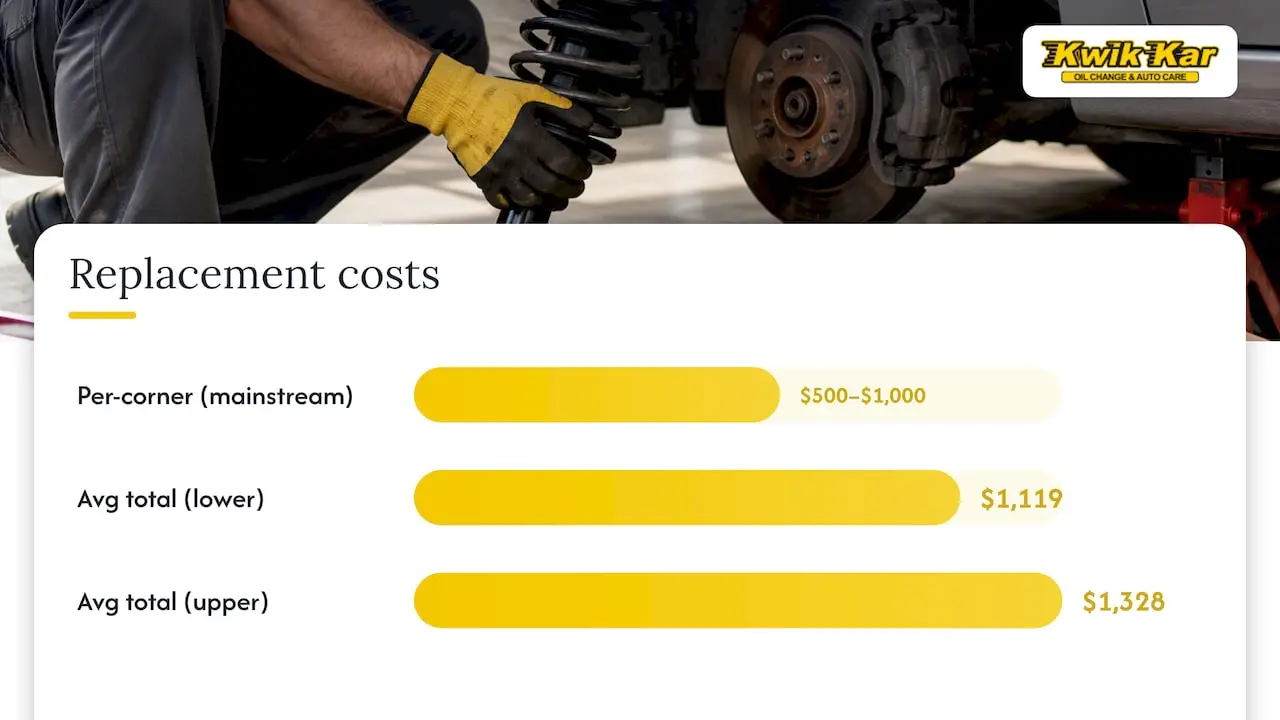
Average total replacement costs for a shock or strut job run around $1,119 to $1,328, though the exact figure depends heavily on the vehicle and local labor rates.
A few decisions shape that final number:
- Loaded strut assembly: includes the mount, spring, boot, and bumper preinstalled, which skips the need for a spring compressor and often shortens labor time.
- Bare strut: costs less for parts but requires reusing the existing spring and mount, along with the tools to compress and transfer them safely.
- Alignment: strongly recommended after strut work since ride height and geometry shift slightly with new components.
Replacing shocks or struts in left and right pairs keeps damping rates matched and avoids the uneven handling that comes from mixing old and new parts on the same axle. DIY repair is possible for confident home mechanics, but the upper strut shaft nut needs a torque wrench, not an impact gun, since over-torquing can damage internal seals and cause early failure. Spring compressors also carry real injury risk if used incorrectly, which is one reason many owners leave this job to a shop.
How Kwik Kar of Van Alstyne Diagnoses Shocks and Struts
Every suspension visit starts with a Digital Vehicle Inspection, so you see photos and notes documenting exactly what the ASE-certified technicians found, not just a verbal summary. That transparency matters most on suspension work, where a worn boot or a leaking strut isn’t always obvious from the driver’s seat.
Here’s what the process generally looks like:
- A full inspection identifies which corners are worn and whether shocks, struts, or both need attention.
- You receive quoted options, including loaded assembly versus bare strut, before any work begins.
- Repairs are completed, followed by a wheel alignment when strut work affects ride geometry.
- Post-service checks confirm the fix, backed by our 2-year/24,000-mile warranty on the repair.
When Comfort Becomes a Safety Issue
Worn shocks and struts are not just a comfort problem. When tires lose consistent contact with the road, anti-lock brakes and stability control systems can’t do their job as effectively, which matters most in an emergency stop or a sudden swerve.
Replace in pairs whenever possible to keep both sides of an axle damping evenly, and lean toward a loaded strut assembly on common passenger vehicles since it often shortens repair time without sacrificing quality.
— Kwik Kar
Getting Your Suspension Checked at Kwik Kar
If your car is bouncing more than it used to or pulling to one side, our steering and suspension repair team can take a look and walk you through exactly what your vehicle needs.

Every inspection includes a Digital Vehicle Inspection with photos, so you can see the worn boot, leaking strut, or cupped tire wear for yourself before agreeing to any repair. Our ASE-certified technicians back suspension repairs with a 2-year/24,000-mile warranty, and we handle the wheel alignment that typically follows strut replacement in-house.
- Steering and suspension diagnosis with a full Digital Vehicle Inspection.
- Quoted repair options explained before any work starts.
- Alignment service scheduled right alongside strut replacement when needed.
Call us at (903) 712-5945 or book an appointment at our Van Alstyne shop, and we’ll get your suspension sorted before that next bump turns into a bigger repair.
Sources
- Struts vs Shocks | Universal Technical Institute (UTI)
- Strut assembly vs Bare strut | Monroe
- How much does it cost to replace your shocks or struts? | Car Talk
- Suspension shock or strut replacement cost estimate | RepairPal
- Tech tip: Always use a torque wrench for the upper strut shaft mounting nut | KYB
FAQ
How Do I Tell if I Need Shocks or Struts?
Watch for excessive bouncing, nose diving when braking, sway during turns, clunking noises, or cupped tire wear, since these signs point to worn shocks or struts. A technician inspection confirms which parts are affected and whether replacement is needed now or can wait.
How Much Does It Usually Cost to Replace Shocks and Struts?
Consumer estimates typically run $500 to $1,000 per corner for mainstream vehicles, with average total jobs landing around $1,119 to $1,328 depending on the vehicle and labor rates. Luxury vehicles and OEM parts tend to push costs higher.
Can You Just Replace Shocks and Not Struts?
Yes, shocks and struts are separate components, so you can replace shocks without touching struts, and vice versa, if only one system shows wear. Since struts also affect alignment, a strut replacement should be paired with an alignment check even if the shocks elsewhere are fine.
What Are the Symptoms of a Bad Strut?
A failing strut often causes clunking noises, a leaking or torn boot, cupped tire wear, and a change in steering feel or alignment. You may also notice the car pulling to one side or bouncing longer than normal after hitting a bump.