



A plug fills the hole from the outside. A patch seals the inside of the tire. Industry groups say a proper permanent repair needs both, installed with the tire off the wheel, and only for a small puncture in the tread. A plug alone or a patch alone is not considered an acceptable repair. If you picked up a nail on US-75 or a county road near Van Alstyne, here is how to tell what your tire needs and what to do next.
TL;DR
- A plug fills the puncture channel. A patch seals the inner liner. The Tire Industry Association says neither is acceptable by itself.
- A tire can only be repaired properly when it comes off the rim for an inside inspection. A plug pushed in while the tire is on the car is a temporary fix at best.
- Repairable punctures sit in the tread, not the shoulder or sidewall, and are no larger than 1/4 inch (6 mm).
- Worn tread, sidewall damage or a large hole means replacement, not repair.
- Bring a flat to us and we will inspect it and tell you what it needs before any work starts.
Table of Contents
- Plug vs. patch: what each one does
- Quick comparison
- Why the tire has to come off the wheel
- When a tire can be repaired
- When the answer is a new tire
- Is a tire plug safe?
- How long does a patched tire last?
- What to do when you find a flat or a nail
- Our perspective
- Get your tire looked at in Van Alstyne
- Prevent the next flat
- FAQ
- Sources
Plug vs. patch: what each one does
The two repairs do different jobs, and that is why they belong together.
A plug (also called a stem) is a piece of rubber that fills the hole the nail or screw made. It keeps the injury channel closed so water and road grime cannot work their way in. A patch is a sealed layer bonded to the inside of the tire. It covers the inner liner, the thin rubber layer that holds the air in.
The Tire Industry Association puts the problem with each one simply. A plug alone does not permanently seal the inner liner. A patch alone does not fill the hole left by the object. In both cases, moisture can reach the steel belts and corrode them over time.
The U.S. Tire Manufacturers Association (USTMA) describes the accepted method the same way: a rubber stem fills the puncture injury, and a patch seals the inner liner. It also calls a plug alone an unacceptable repair.

The combination plug-patch
Many shops use a one-piece unit with a stem and a patch joined together. You pull the stem through the hole from the inside, and the patch seats against the liner. The federal National Highway Traffic Safety Administration (NHTSA) describes proper repair as a plug for the hole and a patch for the area inside the tire around it.
For punctures that run at a steep angle, Goodyear’s service bulletin recommends two-piece components: a separate stem and a separate patch. Either way, the principle is the same. Fill the hole, seal the liner.
Quick comparison
| Plug only | Patch only | Plug and patch together | |
|---|---|---|---|
| What it does | Fills the puncture channel | Seals the inner liner | Fills the channel and seals the liner |
| Stops water reaching the steel belts | Partly | No, the hole stays open | Yes, when installed correctly |
| Needs the tire off the wheel | Not if done from outside, which is the problem | Yes | Yes |
| Industry view | Not an acceptable repair on its own | Not an acceptable repair on its own | The accepted method |
| Best use | Temporary roadside fix to get to a shop | None as a standalone fix | Permanent repair of a qualifying tread puncture |
Why the tire has to come off the wheel
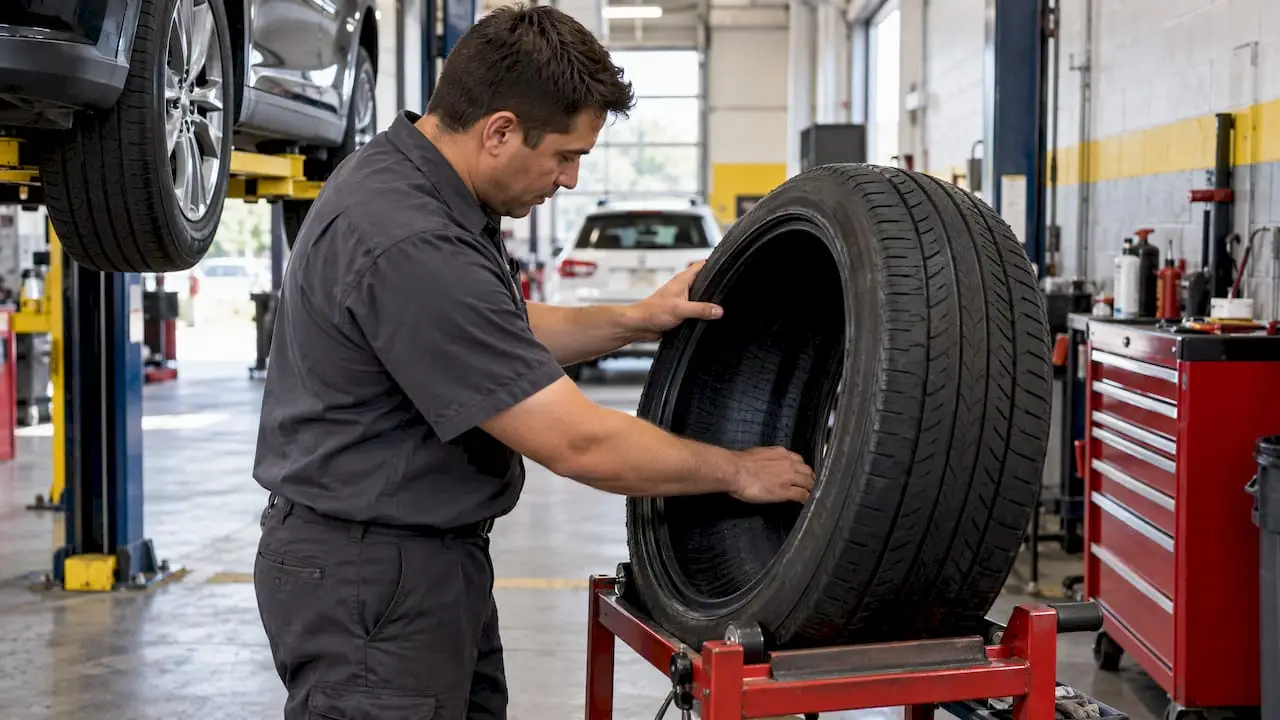
This is the part most drivers do not know. A nail you can see in the tread is not the whole story. The Tire Industry Association explains that even a simple nail can cause serious sidewall damage that you cannot see from the outside. The only way to find it is to remove the tire from the rim and look at the inside.
Michelin says a plug inserted through the tread while the tire is still mounted is an improper repair that can lead to an accident. Goodyear’s bulletin also lists repairing a tire without demounting it for inspection as something never to do.
That is why a string plug shoved in from the outside, the kind found in roadside kits, is considered temporary. It can get you off the shoulder and to a shop. It is not a finished repair.
What the shop looks for inside
Once the tire is off, a technician checks for things you cannot see from the driveway:
- Scuffed or darkened rubber inside, which can mean the tire was driven flat
- Broken or exposed cords
- Damage near the shoulder or sidewall
- Previous repairs too close to the new one
- Whether the puncture channel is clean and straight
This is also where a Digital Vehicle Inspection helps. When we inspect your vehicle, we can send photos and real-time updates, so you see what we see before you approve anything. You can read how that works on our Digital Vehicle Inspection page.
When a tire can be repaired
Manufacturers and industry groups agree on the basics. All of the following must be true:
- The puncture is in the tread area. Michelin lists tread-only as one of three conditions. The Tire Industry Association says puncture repairs are limited to the center of the tread area.
- The hole is no larger than 1/4 inch (6 mm). The Tire Industry Association says a tread puncture larger than that should never be repaired. Bridgestone’s maintenance manual uses the same limit.
- The tire has enough tread left. Goodyear’s bulletin says never to repair a tire worn to the treadwear indicators or down to 2/32 inch of tread.
- The inside inspection is clean. No hidden damage, no run-flat damage.
NHTSA says tires are not safe and should be replaced when tread wears to 1/16 inch. Built-in treadwear indicators show you when you have reached that point.
What a 1/4-inch limit looks like
That is about the width of a standard pencil. A typical roofing nail or drywall screw is well under it. A gash from road debris, a bolt or a blowout fragment is not.
When the answer is a new tire
Some damage cannot be fixed, and trying is the risky choice. Replace instead of repair when:
- The puncture is in the sidewall or the shoulder. NHTSA says sidewall punctures should not be repaired.
- The hole is bigger than 1/4 inch.
- The tread is at or near the wear bars.
- The inside shows damage from driving on the tire while flat.
- The tire has been plugged from the outside only and has been driven on for a long time.
Goodyear’s bulletin warns that an improperly repaired tire can fail in service, including tread and belt separation, which can cause an accident with serious injury. That is the real reason this question matters. A flat at a gas station is an inconvenience. A failure at highway speed is not.
Separate from repairs, a tire can also fail because of how it was made rather than how it was fixed. If that ever happens, tire defect attorneys handle those claims. Keep the tire and note the details. For a puncture, though, the question is simply repair or replace.
If you are replacing, we handle that too. See our tire services for new tires, repair and related work.
Is a tire plug safe?
A plug used as a short-term emergency measure can get you to a shop. A plug used as the only repair, from the outside, is not what the tire industry recommends.
The Tire Industry Association says on-the-wheel repairs such as string plugs are not recommended and should be treated as temporary. USTMA’s care and service guidance says never to repair a tire on the wheel and never to use only a plug.
So the safe way to use a plug is as part of a plug-patch repair, done with the tire off the rim.
Continental also makes a point worth knowing. Its repair guidance says consumers should not repair a damaged tire themselves. Only a trained tire specialist, after a thorough inspection of the specific tire, can say whether it is suitable for repair.

How long does a patched tire last?
A correctly repaired tire is not on a countdown. USTMA’s guidance says tire service life is not set by age alone, and that the association knows of no scientific data that establishes a specific minimum or maximum service life for passenger and light truck tires. It also notes that overall condition and how the vehicle is used matter, and that tires can need replacing long before the tread is gone.
In practice, that means a properly repaired tire is judged the way any other tire is:
- How much tread is left
- Whether it wears evenly
- Whether it has bulges, cracks or vibration
- Whether it holds pressure between checks
If the repair was done right, the repair is not the weak point. The tire’s overall condition is. Check pressure monthly, and watch for a slow leak coming back. If it does, bring it in.
What to do when you find a flat or a nail
- Do not pull the nail out. It may be slowing the leak.
- Check the pressure with a gauge if you can do it safely.
- Stop driving on a tire that is flat. Driving on it can destroy the inside of the sidewall, and that can turn a repairable tire into a scrap tire.
- Use the spare or call for help if the tire is losing air fast.
- Get it to a shop soon so the tire can be taken off the wheel and inspected.
What about sealant kits?
Many newer cars ship with a sealant and inflator kit instead of a spare. Those are temporary too. Hyundai’s owner’s manual says that after using its Tire Mobility Kit, you can drive cautiously up to 120 miles at no more than 50 mph to reach a service station or tire dealer. Slime says its emergency sealant is a temporary formula that should be removed within 3 days or 100 miles. Check your own owner’s manual for your vehicle’s limit, then plan the shop visit right away.
Our perspective
We see a lot of flats, and most drivers ask the same thing: can you just plug it?
Our answer is that a tire is the only thing between your family and the road, so the repair should be one you can trust. A puncture is not just the hole you can see. It is also what is happening on the inside of the tire, and the only way to know is to look.
That is why we like to inspect first. Our ASE-certified technicians look the tire over, and our Digital Vehicle Inspection lets us send you photos and real-time updates, so you can see the tire and the reason behind our recommendation. You decide with clear information and without surprise costs.
If a tire can be repaired, we will tell you. If it should be replaced, we will tell you that too, and why. Our repairs carry a 2-year/24,000-mile warranty. And if you need to drop the car off after hours or want a ride while we work, we offer both.
Kwik Kar
Get your tire looked at in Van Alstyne
If you have a nail in a tire, a slow leak or a tire light that keeps coming on, we can take a look. We serve drivers in Van Alstyne, Anna, Howe, Melissa, Gunter and nearby communities. Drop off after hours if your day is packed, and ask about a free local ride. The waiting area has WiFi and coffee if you prefer to stay.

See our tire services page or our full list of auto repair services, then call us at (903) 712-5945 to set up a time.
Prevent the next flat
You cannot dodge every nail, but you can lower the odds that a small problem becomes a big one.
- Check pressure monthly. Under-inflated tires run hotter and wear faster. The door jamb sticker lists the right pressure for your vehicle.
- Look at your tread. If it is near the wear bars, replacement is the safer move than another repair.
- Walk around the car before long drives. Look for bulges, cuts and objects in the tread.
- Rotate and align on schedule so tires wear evenly.
- Be careful in summer heat. Our post on tire blowouts on US-75 covers what hot pavement does to tires.
If you notice a hum or growl that changes with speed, it may not be the tire at all. Our guide to wheel bearing noise explains the difference.
FAQ
Is a tire plug or a patch better?
Neither one is better alone. The industry-accepted repair uses both: a plug to fill the hole and a patch to seal the inside. A plug alone or a patch alone is not considered acceptable by USTMA. The tire also has to be taken off the wheel for an inside inspection.
How big a hole in a tire can be repaired?
A tread puncture of 1/4 inch (6 mm) or less, according to the Tire Industry Association. It also has to be in the tread area, not the shoulder or sidewall. Anything larger or outside the tread means a new tire.
Can you plug a tire while it is still on the car?
It is not recommended. Michelin says a plug installed with the tire still mounted is an improper repair. It can be used as a temporary measure to reach a shop, but the tire should be removed and inspected inside.
How long does a patched tire last?
When the repair is done correctly on a tire that qualifies, the tire is judged by its overall condition and tread, like any other tire. USTMA says it knows of no data that sets a fixed service life for passenger tires. Keep checking pressure and tread, and bring it in if it loses air again.
How long can you drive on a plugged tire?
If it is only a roadside plug or sealant, treat it as temporary and get to a shop right away. Sealant kit limits vary by vehicle, so check your owner’s manual. A permanent plug-patch repair done at a shop has no such limit as long as the tire stays in good condition.
Sources
- Tire Repair Basics, USTMA
- Tire Repair, Tire Industry Association
- Product Service Bulletin 2022-11, Goodyear
- Tire Safety: Everything Rides on It, NHTSA
- Can my car tire be repaired?, Michelin USA
- Maintenance and Safety Manual, Bridgestone
- Tire Repair for Passenger Car and Light Truck Tires, Continental
- Care and Service of Passenger and Light Truck Tires, USTMA
- If You Have a Flat Tire, Hyundai owner’s manual
- Emergency Tire Sealant, Slime
- Tire Defect Attorneys