




The most common signs of a failing car AC compressor are air that slowly stops getting cold, grinding, rattling or squealing noises when the AC is on, a compressor clutch that won’t engage, and an AC that cycles on and off. AutoZone lists unusual noises or vibrations, weak or uneven cooling, refrigerant leaks and excessive cycling among the classic signs. But several of those symptoms can also come from a blown fuse, a bad relay or low refrigerant, so the compressor shouldn’t be blamed until someone has tested the system. If your AC is acting up around Van Alstyne, Anna, Howe, Melissa or Gunter, here is how to read the signs before you spend money.
TL;DR
- A failing compressor usually shows up as weaker cooling, new noises when the AC runs, a clutch that doesn’t engage, or an AC that keeps switching on and off.
- A non-engaging clutch does not prove the compressor is bad. Fuses, relays, wiring, low refrigerant and clutch parts can all be the cause.
- Replacement quotes in one national sample ran from $1,319 to $2,515 depending on the vehicle, region and parts, so a proper diagnosis before any big repair matters.
- Turn the AC off and get it checked if you hear grinding or loud rattling, since a damaged compressor can make a bigger repair out of a smaller one.
- We can inspect your AC, show you photos of what we find and explain your options before any work starts.
Table of Contents
- What the AC compressor does
- The main AC compressor failure symptoms
- Why the same symptom can mean different things
- What to check before you assume the compressor is bad
- What happens if you keep driving with a failing compressor
- How a technician confirms compressor failure
- AC compressor replacement cost: what to expect
- Our perspective: diagnose first, then decide
- Preventing AC compressor trouble
- Get your AC checked in Van Alstyne
- FAQ
- Sources
What the AC compressor does
The compressor is the pump at the heart of your car’s air conditioning. It is driven by the engine’s belt and pressurizes the refrigerant so the system can pull heat out of the cabin. Without it moving refrigerant, nothing else in the system can do its job.
Most compressors have a clutch on the front. When you press the AC button, the clutch locks the compressor pulley to the shaft so it starts pumping. When you turn the AC off, the clutch lets go. That on-and-off action is why you sometimes hear a soft click and notice a tiny change in engine sound when the AC starts.
Because the compressor is both mechanical and electrically controlled, trouble can start in a few different places. That is the reason symptoms overlap so much, and why we treat “it’s the compressor” as a conclusion to reach by testing, not by guessing.
The main AC compressor failure symptoms
Here are the signs worth taking seriously, roughly in the order drivers tend to notice them.
Air that isn’t as cold as it used to be
This is usually the first clue. The AC still blows, but the air is only cool, or it takes longer to cool the cabin on a hot Texas afternoon. A weak compressor can’t build enough pressure to move heat out efficiently.
The catch: low refrigerant from a leak causes almost the same complaint. Kelley Blue Book notes that refrigerant loss from a leak limits cooling, and that an electrical issue can cause weak or intermittent airflow. So gradually worsening cooling is a reason to get the system checked, not proof that the compressor is done.
Noises when the AC is on
New sounds that appear when you press the AC button and go away when you turn it off point toward the AC system. Common descriptions include:
- Squealing: often a belt that is slipping, worn or misaligned, or a pulley problem.
- Grinding: can point to worn internal compressor parts, a bad bearing or a worn clutch.
- Rattling or clicking: may be a clutch that isn’t engaging smoothly, a loose mounting bolt, or a component near the compressor.
- Hissing: can be a refrigerant leak.
Notice that none of these sounds says “bad compressor” on its own. A squeal might be a $-level belt issue instead of a compressor job. A grinding noise is the one we’d least want you to keep driving with the AC running, because internal wear can get worse quickly. If you can, turn the AC off until it’s inspected.
A clutch that won’t engage
With the engine running and the AC on, the center plate on the front of the compressor should spin along with the pulley. If it stays still, the compressor isn’t pumping. Drivers searching for this often assume the compressor is dead, but the cause is frequently somewhere else.
According to Vehicle Service Pros, a clutch may not engage because of low refrigerant tripping a low-pressure cutout, a blown fuse, a faulty relay, wiring or control-module problems, a failed clutch coil, an excessive air gap, damaged clutch faces or a separated pulley. The takeaway is plain: a clutch that doesn’t engage doesn’t confirm compressor failure. The clutch circuit, the pressure inputs and the clutch itself all need to be tested.
An AC that cycles on and off too often
Some clutch cycling is normal. When it becomes rapid, or the compressor repeatedly kicks on and off, something is off. Delphi’s technical guidance lists intermittent compressor operation as a symptom that can accompany compressor trouble, while also noting that pressure, electrical and control faults need to be checked as well.
Short cycling often goes hand in hand with a system that is low on refrigerant, since the pressure switch shuts the compressor off to protect it. That is a good example of why a refrigerant leak and a compressor problem can look identical from the driver’s seat.
Air that goes cold, then warm
If your AC blows cold for a while and then turns warm, then cold again, you’re describing one of the most confusing AC complaints. We wrote a separate guide on the causes of AC blowing cold then warm and when each tends to happen. In short, a compressor clutch that drops out when it heats up is one possibility, but so are refrigerant level problems, electrical faults and airflow restrictions.
Visible damage, leaks or a stuck pulley
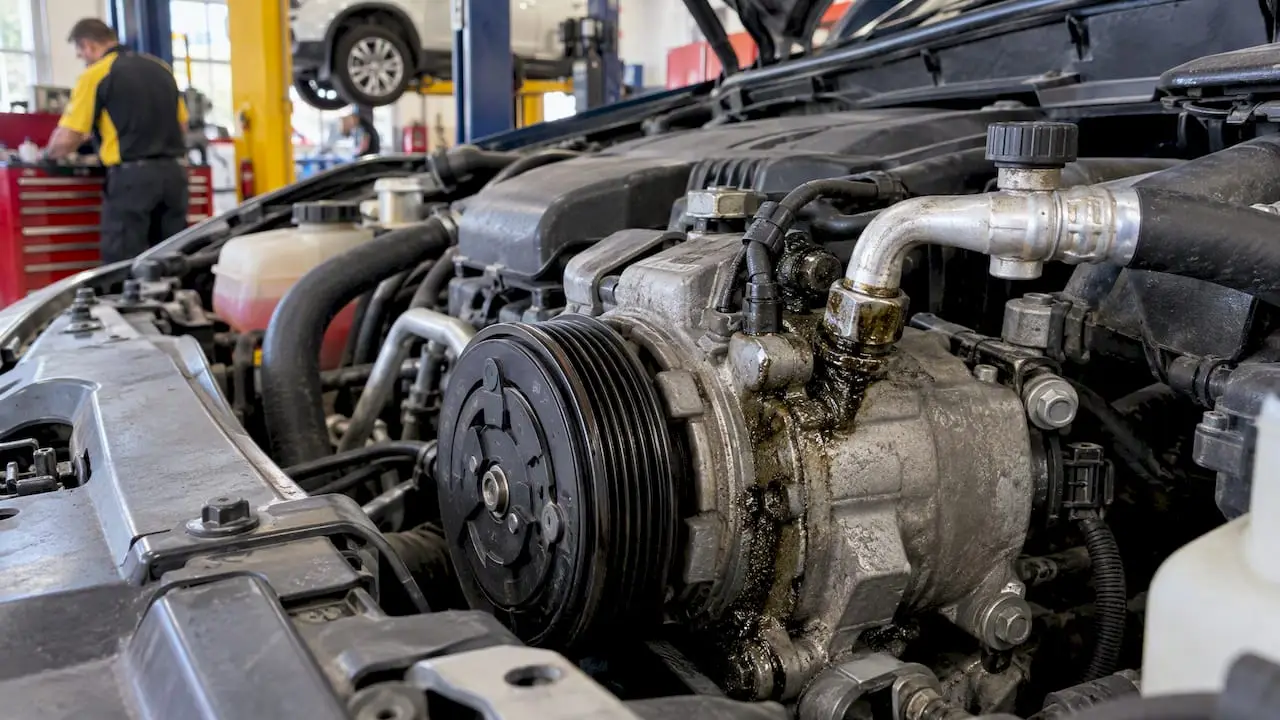
Oily residue around the compressor body or hose fittings can mean refrigerant and oil are leaking out. A wobbling pulley, or a pulley that makes noise even with the AC off, can mean a failing bearing. A seized compressor can also put strain on the belt, and in some vehicles the same belt runs other components, so a stuck pulley is worth addressing quickly.
Why the same symptom can mean different things
It helps to see how the symptoms line up against the likely causes. Use this as a guide to what to tell your technician, not as a diagnosis.
| What you notice | Could be the compressor | Could also be |
|---|---|---|
| Weak cooling | Worn internal parts, low output | Low refrigerant from a leak, clogged cabin filter, blend door or fan trouble |
| Clutch not spinning | Failed clutch or coil, seized compressor | Blown fuse, bad relay, wiring, control module, low-pressure cutout |
| Squeal | Bad pulley or bearing | Worn or loose serpentine belt, tensioner |
| Grinding | Worn bearings or internal damage | Failing clutch, debris, other belt-driven part |
| Cycling on and off | Clutch or internal problem | Low refrigerant, pressure switch, electrical fault |
| Cold, then warm | Clutch dropping out when hot | Refrigerant level, electrical faults, airflow problems |
That overlap is why one technician’s guess and another’s test can lead to very different invoices.
What to check before you assume the compressor is bad
A few simple checks can narrow things down. They don’t replace a professional diagnosis, but they give a technician a better starting point.
- Listen and look with the engine running. Turn the AC to max cold with the fan on high. Note whether you hear a click when it starts and whether the center of the compressor clutch is spinning. Keep hands, hair and clothing well clear of the belt and fans.
- Pay attention to timing. Does the problem appear right away, after 10 minutes, only in stop-and-go traffic or only on the highway? That detail is gold for a technician.
- Check airflow. If the fan is weak even on high, the problem may be a clogged cabin air filter or a blower issue, not the compressor. One compressor guide for a specific model suggests checking the AC fuse and relay and making sure the cabin air filter isn’t clogged before replacing a compressor.
- Record it. A short phone video of the noise or the clutch, plus notes on when it happens, speeds things up. Our guide on what to record when the AC isn’t blowing cold walks through it.
- Don’t add a refrigerant can and hope. Without knowing why the charge is low, you may only be masking a leak, and overcharging a system can cause its own problems.
What happens if you keep driving with a failing compressor
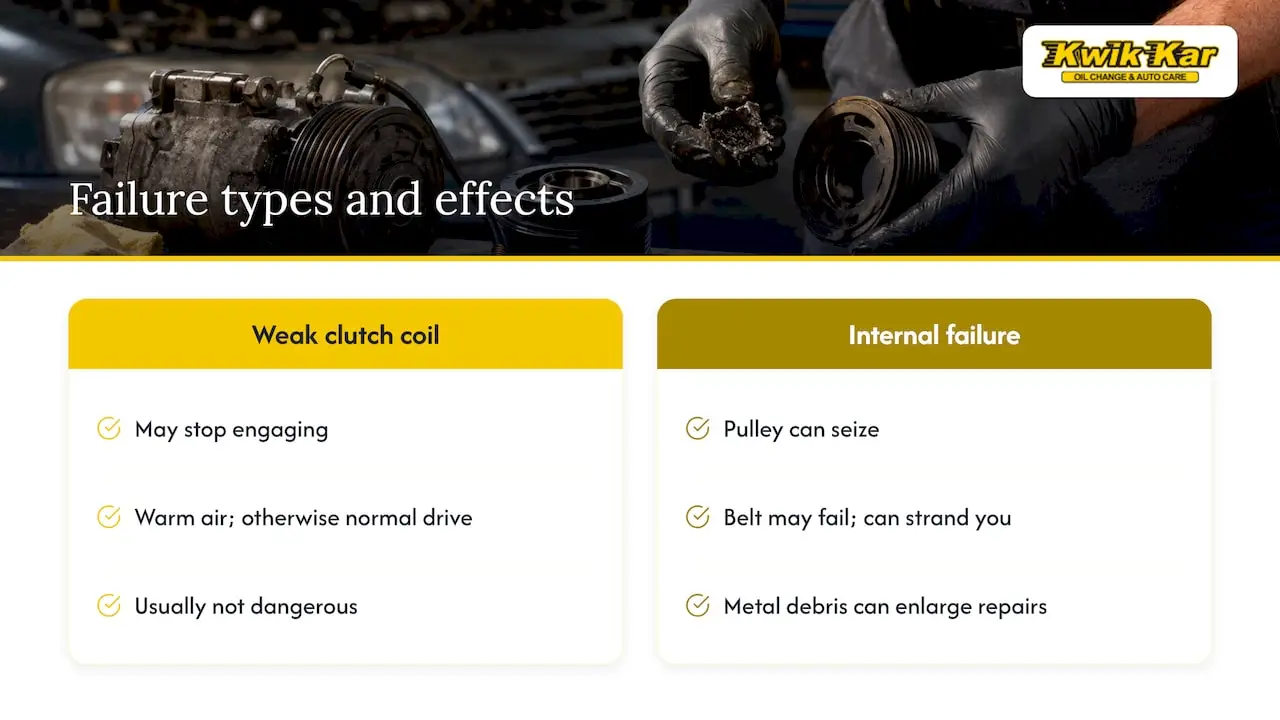
It depends on how it’s failing. A compressor with a weak clutch coil may simply stop engaging, leaving you with warm air but an otherwise normal drive. That is inconvenient but not usually dangerous.
A compressor that is seizing or breaking up internally is different. A seized pulley can stress or shred the drive belt, and depending on the vehicle that belt may also turn the alternator and water pump. A belt that fails can leave you stranded. If you hear grinding, see smoke or smell burning rubber, turn the AC off and have the car looked at before the next long drive.
Internal failure can also send metal debris through the AC system. When that happens, the repair is bigger than swapping the compressor: the lines and components generally need to be cleaned out or replaced so the new compressor doesn’t get damaged. That’s a major reason to catch problems early.
Can the AC still run with a bad compressor? The fan will still blow, but without a working compressor the air won’t be properly chilled. Depending on the failure, the system may produce only ambient-temperature air.
How a technician confirms compressor failure
Good diagnosis moves from simple to complex, and each step rules something out.
- Verify the complaint. We confirm the symptom, ask when it happens and take note of any noises.
- Visual inspection. The belt, pulley, compressor body, hose connections and condenser are checked for damage, oil residue and debris.
- Electrical checks. Fuse, relay, wiring and the clutch circuit are tested to see whether the clutch is getting power and a signal.
- Pressure readings. Gauges show whether the refrigerant charge and system pressures make sense. Low pressure may point to a leak, while abnormal readings on both sides can point to a compressor that isn’t pumping properly.
- Leak detection. If refrigerant is low, the leak has to be found, otherwise a recharge won’t last.
- Mechanical check of the clutch and compressor. Air gap, clutch faces, pulley bearing and compressor operation are evaluated.
Our digital vehicle inspection lets us send you real-time updates and photos of what we find, so you see the oily fitting or the worn belt yourself instead of taking our word for it. We never promise a diagnosis without inspecting the vehicle, and we don’t want to guess with your money either.
AC compressor replacement cost: what to expect
Cost is the question most drivers have after symptoms, and it’s the one with the widest range. ConsumerAffairs’ sample vehicles showed average compressor replacement quotes between $1,319 and $2,515. Costs vary with the vehicle’s make and model, your region, and whether OEM or aftermarket parts are used.
What moves the number on a real estimate:
- The vehicle. Some compressors are easy to reach, others require pulling other parts. European models often cost more in parts and labor.
- Parts choice. OEM, aftermarket and remanufactured parts are priced differently and may carry different warranty terms.
- Whether the system is contaminated. If the compressor failed internally, flushing and replacing related parts adds to the bill.
- Related parts. Many repairs call for a new receiver-drier or accumulator, an expansion valve or orifice tube, and fresh refrigerant and oil.
- Whether only the clutch is bad. On some vehicles a clutch or coil repair can be a smaller job than a full compressor replacement, though not on every design.
We don’t publish fixed prices for AC work, because the right number depends on what the inspection finds. What we do commit to is upfront pricing and honest recommendations before the work begins, and our repairs carry a 2-year/24,000-mile warranty.
Our perspective: diagnose first, then decide
We see the same story often. A driver is told the compressor is dead after a quick look, and a few hundred dollars into the job it turns out to be a relay, a wire or a slow leak. Other times, the compressor really has failed, and the earlier it’s caught, the less collateral damage there is.
That’s why we start with a Digital Vehicle Inspection. You get photos and real-time updates, you see what we see, and you decide what makes sense for your vehicle and your budget. Our ASE-certified technicians test the clutch circuit, check pressures and look for leaks before recommending parts.
Our goal isn’t to sell you the biggest repair. It’s to tell you what your car actually needs, quote it clearly, and stand behind the work with a 2-year/24,000-mile warranty.
Kwik Kar
Preventing AC compressor trouble
No one can promise a compressor will last forever, but a few habits reduce the strain on it.
- Run the AC regularly. Even in cooler months, running it for a few minutes now and then keeps seals lubricated. Our post on how often to service your car AC explains why.
- Fix small leaks early. A system that runs low on refrigerant also runs low on the oil that lubricates the compressor.
- Keep the front of the condenser clean. Bugs, leaves and road debris reduce heat rejection and make the system work harder.
- Replace the cabin air filter on schedule. A clogged filter reduces airflow and can mimic AC failure.
- Get belts and tensioners checked. A slipping belt hurts compressor performance and can create the squeal people mistake for a failed compressor.
- Don’t ignore the first noise. A squeal or rattle caught early is usually a much smaller job.
If you’re getting ready for hot weather, our guide to getting your car’s AC ready for warm weather is a good checklist.
Get your AC checked in Van Alstyne
If your AC is blowing warm, making noise or cycling strangely, our AC repair service starts with a proper inspection, not a guess. You get photos and updates along the way, and no work starts until you’ve approved it.

We also offer after-hours drop-off and free local rides, so you don’t have to rearrange your day around the repair. If you’d rather wait, our waiting area has WiFi and coffee. For other warning lights or drivability issues that show up alongside AC trouble, our diagnostics team can help. Check our coupons page for current offers.
Call us at (903) 712-5945 or visit our site to request an appointment. We serve drivers in Van Alstyne, Anna, Howe, Melissa, Gunter and nearby communities.
FAQ
What happens when an AC compressor fails?
The system loses its ability to pressurize and circulate refrigerant, so the air stops getting cold. You may also hear grinding or squealing, or notice the clutch no longer spins. If the compressor fails internally, debris can spread through the system and make the repair larger, so get it checked early.
Why is my AC clutch not engaging?
It may be the compressor, but often it isn’t. Vehicle Service Pros lists low refrigerant, a blown fuse, a bad relay, wiring or control faults, and clutch coil or air gap problems as possible causes. Testing the circuit and pressures is the only way to know which one you have.
Why does my AC blow cold and then warm?
Intermittent cooling can come from an electrical issue, a refrigerant leak, or a clutch that cuts out as it heats up. We cover the most common causes in our guide on AC blowing cold then warm. Noting when the change happens helps us find it faster.
How much does it cost to replace an AC compressor?
In ConsumerAffairs’ sample vehicles, average quotes ranged from $1,319 to $2,515, depending on make, model, region and parts. Your actual cost depends on what the inspection finds. We give you a clear estimate before any work begins.
Can I keep driving with a bad AC compressor?
If it’s only a warm-air problem, the car will usually drive normally. If you hear grinding, or the compressor pulley is seizing, turn the AC off and have it inspected soon, because a failing pulley can damage the belt that drives other parts of the engine.
Sources
- Signs of a Bad A/C Compressor, AutoZone
- DIY Automotive Air Conditioning Repair and Diagnostics, Kelley Blue Book
- Compressors: to spin or not to spin, Vehicle Service Pros
- How To Change a Car AC Compressor, Delphi Auto Parts
- Honda Civic AC Compressor: Common Problems, Replacement, and Cost
- Cost of Car AC Repair, ConsumerAffairs