



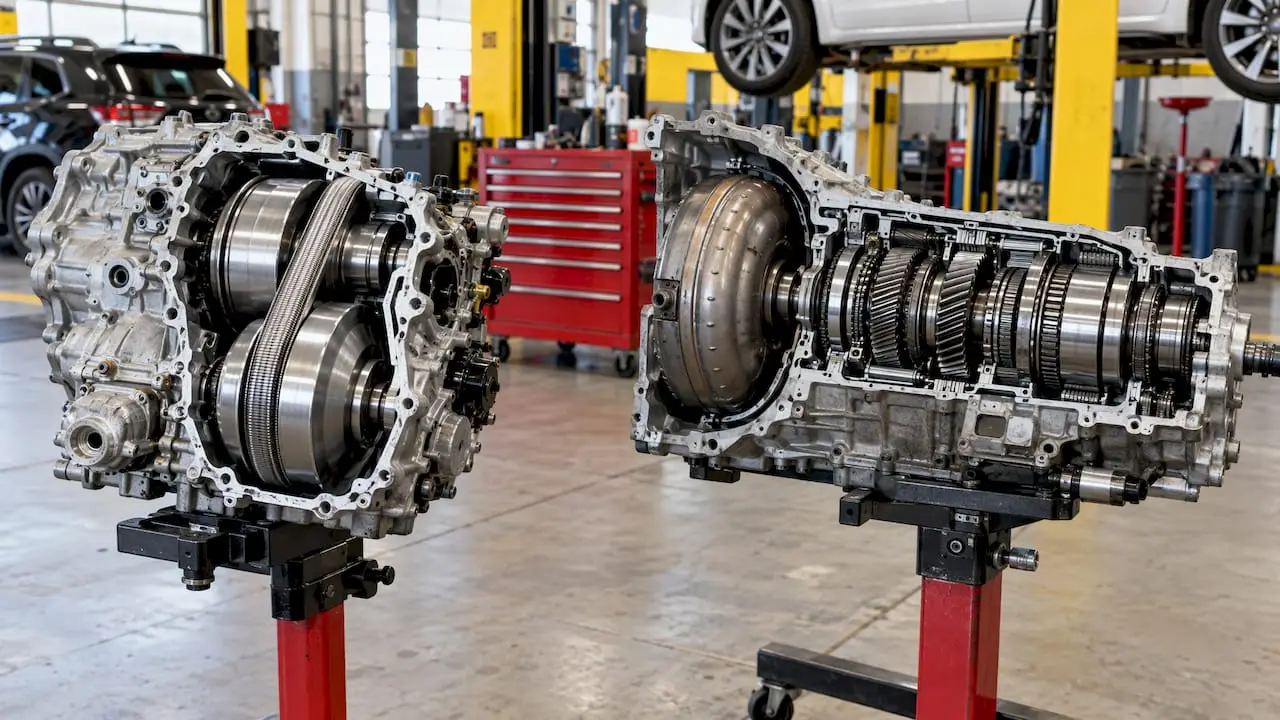
A CVT is a type of automatic transmission. The difference is inside: a traditional automatic shifts through a set number of fixed gears, while a CVT (continuously variable transmission) glides through an endless range of ratios with no shifts at all. For most Van Alstyne commuters, a CVT means smoother driving and better fuel economy. A traditional automatic is usually the stronger pick for towing and heavy loads. Either one lasts longest when its fluid is serviced on schedule.
This guide explains how each works, how they feel, what they cost to own, and how a dual-clutch transmission (DCT) compares. It also covers the warning signs to watch for.
TL;DR
- CVT: Uses two pulleys and a steel belt or chain instead of fixed gears. It feels smooth, with no shift points, and favors fuel economy in city and stop-and-go driving.
- Traditional automatic: Uses 4 to 9 fixed gears and a torque converter. It is the usual choice for trucks, SUVs and towing.
- DCT: Two clutches for quick, sporty shifts. It can feel less smooth when creeping in traffic.
- Upkeep matters more than type: Even when a maker calls the fluid “lifetime,” servicing it every 30,000 to 50,000 miles is the safer habit.
- Replacement is expensive: A transmission swap on a mainstream vehicle can run from about $2,500 to $7,500, so catching problems early pays.
Table of Contents
- What is the difference between a CVT and a traditional automatic?
- CVT vs. automatic: side-by-side
- Is a CVT better than an automatic?
- Where does a DCT fit in?
- Which one suits your driving?
- How long do transmissions last, and what shortens their life?
- Warning signs to take seriously
- What does a transmission repair or replacement cost?
- Our perspective on CVT vs. automatic
- Transmission help in Van Alstyne
- FAQ
- Sources
What is the difference between a CVT and a traditional automatic?
Both are “automatic” because you never press a clutch pedal. The difference is how the engine’s power reaches the wheels.
A traditional automatic uses a set of metal gears, typically 4 to 9 fixed gears. The transmission steps from one to the next as you speed up, and you feel (or hear) those shifts. A fluid coupling called a torque converter sits between the engine and the gears so the car can sit still at a red light without stalling.
A CVT has no fixed gears. According to the U.S. Department of Energy, it uses a pair of variable-diameter pulleys connected by a belt or chain, which produces an infinite number of ratios between engine speed and wheel speed. Think of a bicycle that could pick any gear size at all, instead of clicking between a handful.
Car and Driver describes the mechanism this way: the two halves of each pulley move closer together or farther apart, which changes the effective diameter the belt rides on and so changes the ratio. The engine can stay at its most efficient speed while the car accelerates.

What does a CVT feel like to drive?
Smooth. There is no shift jolt, because there are no shifts. In stop-and-go traffic on US-75 or around Main Street, that is a plus.
The unusual part is the sound. Because the engine can hold a steady speed while the car gains speed, some drivers notice a drone or a “rubber-band” feeling, where engine revs seem out of step with acceleration. Car and Driver notes some drivers find this disconcerting and others never notice it. To make the car feel more familiar, many modern CVTs are programmed with simulated shift points.
CVT vs. automatic: side-by-side
| CVT | Traditional automatic | Dual-clutch (DCT) | |
|---|---|---|---|
| How it works | Pulleys and a belt or chain | Fixed gears and a torque converter | Two clutches, one for odd gears and one for even |
| Feel | Seamless, no shifts | Familiar, noticeable shifts | Quick, crisp shifts |
| Best at | City driving, fuel economy | Towing, heavy loads, everyday use | Performance driving |
| Watch for | Drone, hesitation at low speed | Longer shift times | Hesitation when creeping in traffic |
| Common in | Compact cars, sedans, small SUVs, hybrids | Trucks and larger SUVs | Sporty hatchbacks and sedans |
The fit by vehicle type comes from CarGurus and Autoblog.
Is a CVT better than an automatic?
Neither is better across the board. Each is built for a different job, and your driving decides the winner.
Fuel economy
This is where CVTs earn their place. The Department of Energy lists a potential 3% to 4% efficiency improvement from a CVT, with the biggest benefit in stop-and-go driving. CarGurus points out that a CVT is especially fuel-efficient because it is always in the right ratio, which is why you see it in many high-mpg commuter cars and hybrids from Nissan, Honda and Subaru.
The gap is not huge, though. Torque-converter automatics lose a bit more energy through longer shift times and higher mechanical losses, but newer automatics with more gears have narrowed that difference.
Towing and heavy loads
Here the traditional automatic leads. Autoblog explains that a torque-converter automatic moves power through a fluid coupling with no friction surfaces to wear down, which makes it well suited to pulling heavy loads or sitting in long stop-and-go traffic. CarGurus adds that conventional automatics are particularly useful for large trucks and SUVs because they handle large amounts of horsepower and torque.
If you haul a boat to Lake Texoma or a trailer on weekends, check the tow rating in your owner’s manual and keep your transmission cooling and fluid in top shape. Our guide on what heat and heavy loads do to your transmission walks through it.
Smoothness and driving feel
A CVT wins for seamless, relaxed progress. A traditional automatic feels more like what most of us grew up driving. If you want a car that feels engaging, a DCT is the sporty one. Autoblog sums it up: there is no perfect transmission, and the right one lines up with how and where you drive.
Where does a DCT fit in?
A dual-clutch transmission is the third type you will see on dealer lots. It behaves like a manual gearbox that shifts itself. As Motor1 explains, one clutch handles odd gears and another handles even gears, and the next gear is pre-selected so a shift is just a swap between clutches. That is why DCTs show up in performance cars.
Compared with a CVT, a DCT gives crisper, more immediate shifts. In exchange, Autoblog notes it can feel jerky or hesitant when creeping in traffic, because it has no torque converter to cushion the takeoff. The Department of Energy says DCTs are generally not quite as smooth as regular torque-converter automatics.
DCTs also tend to cost more to maintain. CarGurus says they often need frequent fluid changes and their clutches are wear items that eventually need replacement. For a daily commute, a CVT or a traditional automatic is usually the easier companion. For a performance-minded driver, a DCT’s quick shifts are the draw.
Which one suits your driving?
Use your week as the guide, not a spec sheet.
- Commuting to Dallas or Plano on US-75, mostly solo or with one passenger: A CVT in a compact car, sedan or small SUV is a natural fit for smooth, efficient miles.
- Family hauling, school pickups, sports practice: Either works. What matters more is keeping up with fluid service and acting on early symptoms.
- Towing a boat, camper or trailer: A traditional automatic in a truck or larger SUV is the usual match, and your manual’s tow rating is the number to follow.
- You love a lively drive: A DCT or a conventional automatic will feel more engaging than a CVT.
If you are shopping for a used vehicle, find out which type it has and when the transmission fluid was last serviced. Our Digital Vehicle Inspection gives you photos and updates on what your vehicle needs, which makes condition easy to see.
How long do transmissions last, and what shortens their life?
There is no single number. Lifespan depends on the manufacturer, how the vehicle is driven and how well it is maintained. Autoblog notes that modern DCTs and CVTs are both capable of decades of dependable service, and that modern chain-driven CVTs have outlasted earlier belt-driven designs. Consumer Reports data on more than 1.1 million vehicles, as reported by Green Car Reports, suggested CVTs were among the most reliable automatic setups on the road.
What shortens any transmission’s life is familiar: heat, heavy loads, aggressive driving and old, worn fluid.
Fluid service is the habit that counts
Even when an automaker markets transmission fluid as “lifetime,” real-world experience suggests servicing the fluid every 30,000 to 50,000 miles in a CVT or DCT to prevent overheating and premature wear. Your owner’s manual gives the maker’s schedule, and the fluid has to meet the maker’s specification, because CVTs are built around specific fluids. We explain that in our guide to OEM-spec fluid at every CVT service.

Warning signs to take seriously
Whatever you drive, these symptoms deserve a prompt look:
- CVT: Shuddering, slipping, whining or hesitation at low speed.
- DCT: Shuddering on takeoff, harsh shifts or dropped gears, per the same source.
- Traditional automatic: Hard or delayed shifts, slipping, or a gear that will not engage. Our 5-step checklist for a hard-shifting automatic shows what to check first.
- Any type: A warning light, a burning smell, or fluid spots under the car.
A transmission that slips or will not go into gear can leave you stranded, and a family on the road is not where you want that to happen. If the car is behaving oddly, drive gently, avoid towing and have it inspected. We cannot name the cause without looking at the vehicle, since the same symptom can come from low fluid, a sensor, or an internal problem.
What does a transmission repair or replacement cost?
Costs vary by vehicle, so the best way to know is a real inspection. For a sense of scale, Car Talk reports that replacing an automatic transmission in a mainstream vehicle can run from about $2,500 to as much as $7,500 (August 2025), with both labor and parts costly. Fancy low-volume cars cost more.
That is why small, early steps matter. A fluid service or a diagnostic visit is a fraction of the price of a replacement. What moves the number:
- Whether the problem is external (a sensor, a leak, a solenoid) or internal.
- Your vehicle’s make, model and transmission type.
- Parts availability and labor hours.
- How long the symptom went unchecked.
We publish no flat price for transmission work because every vehicle is different. We inspect first, show you what we find, and give you the number before work starts.
Our perspective on CVT vs. automatic
We get this question from drivers who are about to buy a car, and from drivers who just bought one and are wondering what they got.
Our answer is the same either way: the type matters less than the care it gets. A CVT with fresh, correct fluid and a driver who responds to the first shudder is a better bet than any transmission that has been ignored. A traditional automatic behind a trailer needs the same attention, just more of it.
What we want is for you to see what is going on before you pay for anything. That is why every visit can include a Digital Vehicle Inspection with photos and real-time updates, so you decide with the facts in front of you. Our ASE-certified technicians do the work, and our repairs carry a 2-year/24,000-mile warranty.
If you are weighing two cars, bring the one you are considering. We would rather you know what is under it before you sign.
Kwik Kar
Transmission help in Van Alstyne
Whether your vehicle has a CVT, a traditional automatic or a DCT, our transmission service starts with a clear look at what your vehicle needs. Every visit can include a Digital Vehicle Inspection with real-time updates and photos, so you are never surprised by a bill. Our ASE-certified technicians do the work, and our repairs carry a 2-year/24,000-mile warranty.

Busy week? Use our after-hours drop-off, and ask about free local rides. If something feels off, start with a diagnostic visit. Call us at (903) 712-5945 or stop by to set up a time.
FAQ
Is a CVT the same as an automatic transmission?
A CVT is a kind of automatic, since neither needs a clutch pedal. The difference is that a traditional automatic uses fixed gears and a CVT uses pulleys and a belt or chain with no fixed gears. Many shoppers say “automatic” to mean the geared type, so it helps to ask which one a car has.
Does a CVT get better gas mileage than an automatic?
Usually, a little. The Department of Energy lists a potential 3% to 4% efficiency gain for CVTs, strongest in stop-and-go driving. Your results depend on the specific vehicle, so compare the EPA ratings for the exact models you are considering.
Can a CVT tow a trailer?
That depends on the vehicle’s tow rating, which you will find in the owner’s manual. Traditional automatics are generally the preferred choice for heavy, sustained loads, and CVT-equipped vehicles tend to be rated for lighter towing. Never exceed the rating, and keep the fluid fresh if you tow regularly.
How often should I change CVT fluid?
Check your owner’s manual first, then consider the real-world guidance of 30,000 to 50,000 miles, even if the fluid is marketed as lifetime. Use fluid that meets the manufacturer’s specification. We can look at your vehicle and tell you where it stands.
Is a CVT or a DCT better for daily driving?
For most daily commutes, a CVT is the smoother and simpler choice, especially in city traffic. A DCT gives crisper shifts but can feel hesitant when creeping in traffic. If you want a lively feel, the DCT may suit you.
Sources
- XTRONIC CVT Continuously Variable Transmission | Nissan USA
- Advanced Transmission Technologies | fueleconomy.gov
- What Is a Continuously Variable Automatic Transmission? | Car and Driver
- The Three Types of Automatic Transmissions | Motor1
- CVT vs Automatic vs Dual Clutch | CarGurus
- DCT vs CVT: Which Transmission Is Better for the Way You Drive | Autoblog
- Why There’s No Such Thing as the Perfect Transmission | Autoblog
- Why CVTs Won, Direct-Shift Gearboxes Lost Fuel-Economy Fight | Green Car Reports
- How Much Does It Cost to Replace a Transmission? | Car Talk