




Parasitic battery drain is power that leaves your battery after the key is off and the car should be asleep. A little draw is normal. A part that keeps pulling too much is what leaves you with a dead battery in the morning, even after a new battery or a long drive the day before. The fix is to find the one circuit that won’t shut down, and that takes methodical testing, not guessing.
If your car battery keeps dying, this guide covers the symptoms, the usual causes, how a proper test works, what you can safely check in your driveway, and when to hand it to a shop. We can’t diagnose your vehicle from an article, but we can help you walk into the conversation knowing what to ask.
TL;DR
- A parasitic draw is current that keeps flowing from the battery with the ignition off. Some is normal for clocks, radio memory and alarms.
- Sources commonly put normal draw at roughly 30 to 50 milliamps, and a draw that stays above about 50 to 70 milliamps can lead to a dead battery.
- Frequent culprits are aftermarket accessories, lights that stay on, and electronic modules that never go to sleep.
- Accurate testing means waiting for the car to fall asleep first, which can take from about 25 to 120 minutes.
- Replacing the battery alone often won’t solve it. Have the draw traced before you spend money on parts.
Table of Contents
- What parasitic draw actually is
- Signs your battery is being drained overnight
- Common causes of a parasitic battery drain
- Why testing it is harder than it looks
- How a proper parasitic draw test works
- What you can check yourself before you call
- What the repair looks like
- Our perspective: find it, show it, then fix it
- Bringing it to Kwik Kar of Van Alstyne
- Preventing a dead battery
- FAQ
- Ready to stop the dead-battery mornings?
- Sources
What parasitic draw actually is
When you shut your car off, it doesn’t go completely dead. The engine computer, alarm, clock and radio presets all keep a small amount of power. UTI’s automotive training blog explains that the battery keeps feeding these systems after shutdown, and that this is normal up to a point.
That same source describes the numbers this way: a small draw, often 30 to 50 milliamps, is normal. Anything consistently above 50 to 70 milliamps can lead to a dead battery, and a draw over 100 to 120 milliamps points to a deeper electrical problem.
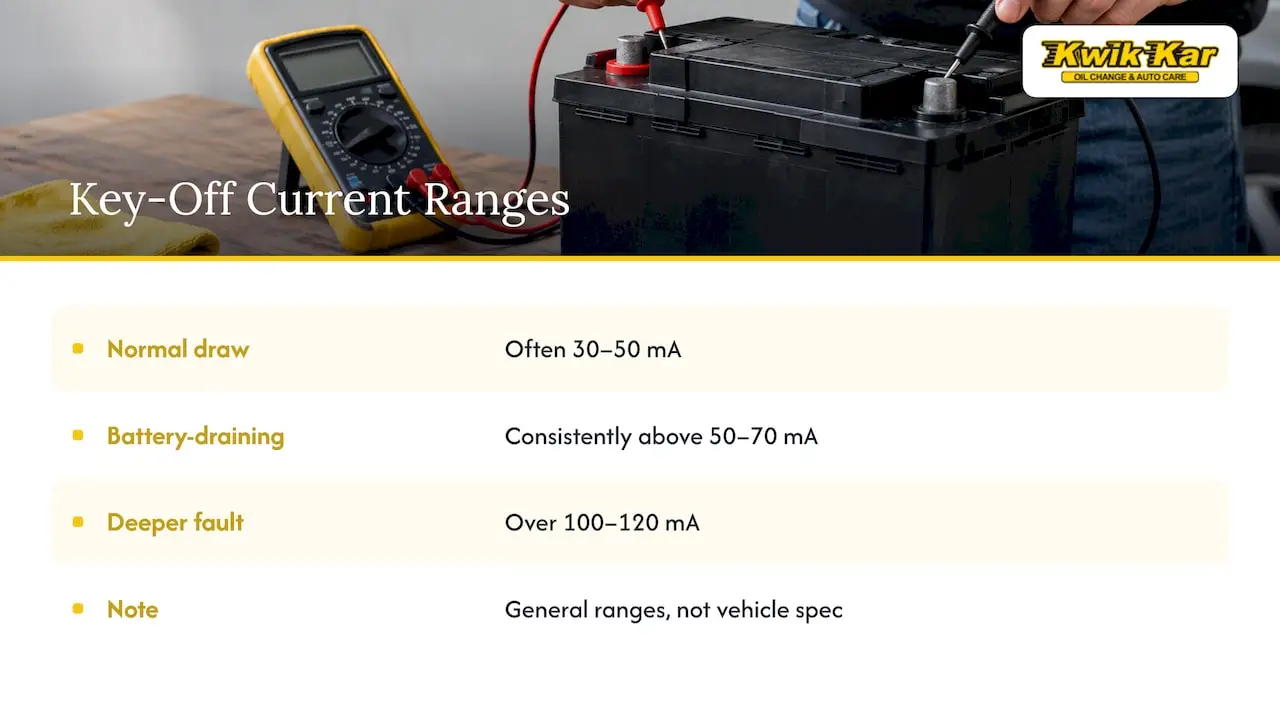
Those are general ranges, not a spec for your car. Vehicles with many modules, such as some European models, may naturally sit at the higher end of normal. The manufacturer’s service information is what a technician checks for your exact vehicle.
Why it’s called “parasitic”
The name fits. A component feeds on the battery while giving nothing back, because the alternator only recharges the battery while the engine runs. If the draw is big enough, short trips can’t keep up, and the battery loses ground every day.
Signs your battery is being drained overnight
Many drivers search “battery drains overnight” or “parasitic draw symptoms” after the same frustrating pattern. Here is what we see described most often:
- The car starts fine after a drive, then won’t start the next morning. This is the classic pattern.
- Slow, weak cranking after the car sits a day or two.
- A dead battery that returns soon after a jump-start or a battery replacement.
- Dim dash lights or clicking when you turn the key.
- Electronics that reset, like radio presets or the clock.
- A battery that tests weak even though the car is only a few years old.
None of these proves a parasitic draw. A worn-out battery, a bad alternator and a loose or corroded cable can look almost identical. Our guide on alternator versus battery symptoms walks through quick ways to tell them apart. That step matters, because there’s no point hunting for a draw if the real problem is a battery that can’t hold a charge.
Common causes of a parasitic battery drain
The UTI breakdown of common causes lines up with what most shops run into. Here are the usual suspects, roughly from the simplest to the hardest to find.
Aftermarket accessories
Dash cameras, GPS trackers, remote starters, aftermarket alarms, amplifiers and phone chargers wired to a constant power source are frequent offenders. If the problem began right after something was installed, that is the first place to look. A poorly wired accessory can pull power all night even when it looks switched off.
The wiring itself matters too. Lighting and accessory add-ons that are spliced in with poor connectors or the wrong gauge of wire can create their own problems. If you are working through lighting or accessory issues, this piece on common sources of LED and wiring trouble covers what to check on the electrical side.
Lights that stay on
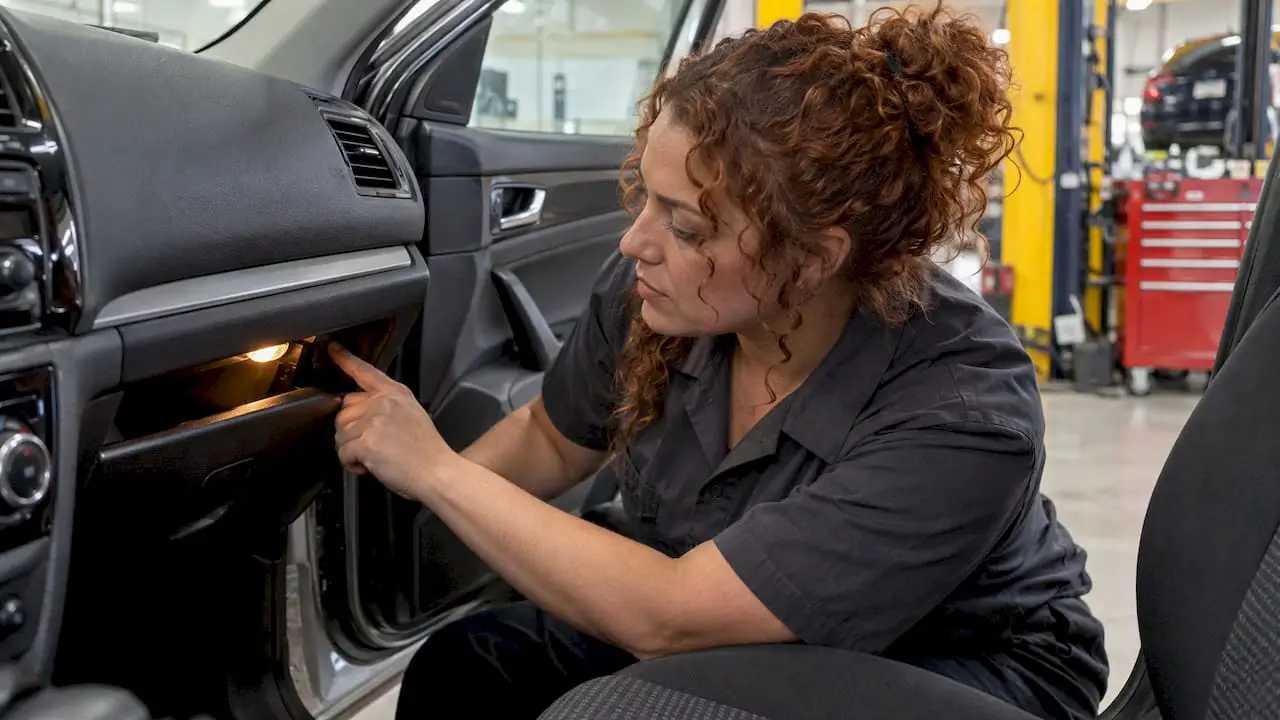
Glove box lights, trunk lights and vanity mirror lights are small, but a bulb that never turns off because of a bent switch or latch will drain a battery over a few days. If your trunk or glove box light stays lit when closed, that’s an easy fix and a good clue.
Modules that don’t go to sleep
Modern vehicles are rolling networks of computers. When a control module fails to enter sleep mode, it keeps drawing power and can keep other modules awake with it. Software faults, a failing module or a sticking relay can all cause this. This is the hardest type to find without the right tools, because the culprit is often not a part you can see.
A failing alternator diode
The UTI source also notes that a faulty alternator diode can create a path for electricity to leak out of the battery with the engine off. If you suspect the charging system, this explanation of alternator voltage drop testing shows how wiring faults can hide in the charging circuit.
Other causes
Stuck relays, a bad starter solenoid, a failing blower motor resistor or damaged wiring from a past repair or water intrusion can also keep current flowing. And sometimes the “drain” is simply a battery that is old and can’t hold a charge. That is why we test the battery first.
Why testing it is harder than it looks
A common belief is that you hook up a multimeter, read a number, and you’re done. ALLDATA’s guidance on parasitic draw testing makes the point that the job takes the right tools and a methodical approach. Modern systems are interconnected enough that a rushed test can damage test equipment or lead to a wrong diagnosis, which is how people end up replacing parts that were never broken.
The car has to fall asleep first
After you turn the car off, the modules don’t all shut down at once. According to the same ALLDATA source, you typically need to wait somewhere between 25 and 120 minutes for onboard computers to power down. Test too early and you’ll record the car’s normal shutdown activity as a “draw.” Another common mistake it flags is leaving a key fob or smart key near the vehicle, which can keep the car from ever reaching a true sleep state.
Pulling fuses can wake the car up
Pulling fuses one at a time is the traditional method. On newer vehicles, ALLDATA notes it can wake the modules and restart the sleep timer, so you wait again and the process drags on. Many professional technicians prefer measuring voltage drop across fuse terminals, which finds live circuits without disturbing the car.
How a proper parasitic draw test works
The exact steps depend on the vehicle and the tools, and a technician follows the manufacturer’s procedure. In general, the process looks like this:
- Check the battery and charging system first. A weak battery or a bad alternator can mimic a draw.
- Turn off every accessory, close the doors and trunk, and keep the key fob away from the car.
- Connect a meter or clamp rated for low DC current, set up so the car’s circuits aren’t interrupted at the wrong moment.
- Wait for the vehicle to sleep. Watch the reading settle instead of grabbing the first number.
- Compare the reading with the expected range for that vehicle.
- If it’s too high, isolate the circuit by checking fuses, usually with voltage drop readings, and following the circuit to the component.
- Repair or replace the faulty part, then repeat the test to confirm the draw is gone.
Step 7 is the one that gets skipped most often. A repair isn’t finished until the draw has been measured again and the number is back where it belongs.
This work is a recognized part of professional training. The ASE A6 electrical task list includes measuring and diagnosing the causes of abnormal key-off battery drain, which tells you it’s a skill technicians are expected to learn, not a guess.
What you can check yourself before you call
A few simple checks cost nothing and can save a trip. Do them safely, with the car off and nothing hot.
- Look at the lights. Open and close the trunk, glove box and doors. Do any interior lights stay on?
- Unplug add-ons. Remove phone chargers, dash cams, and anything in the power outlets or OBD port, then see whether the problem improves over a few days.
- Note when it started. Did it begin after a battery swap, a new stereo, an alarm install or a repair? Tell the shop. It’s the most useful clue you can give.
- Check the battery terminals. Corrosion or a loose clamp can cause starting trouble that feels like a drain.
- Keep your key fob away from the car if you’re testing overnight, and note how long the car sits before it fails to start.
We’d suggest you skip pulling fuses or disconnecting cables on a late-model vehicle at home. You can reset settings, trigger warning lights, or wake modules and muddy the results. If the car has airbags, driver-assist systems or a start-stop battery, leave the testing to a technician.
What the repair looks like
There’s no single fix, because there’s no single cause. Once the draw is traced, the repair is usually one of these:
- Removing or rewiring an aftermarket accessory.
- Replacing a bad switch, relay or light fixture.
- Repairing damaged or corroded wiring.
- Replacing a failing alternator or a faulty module.
- Updating module software where the manufacturer offers it.
- Replacing the battery if it has been deeply drained too many times to hold a charge.
That last one is important. Repeated deep discharges shorten a battery’s life. Even after you fix the draw, the battery may need to be tested or replaced. If it is, our same-day battery replacement page explains how we handle it.
We can’t tell you what a repair will cost without inspecting the car. The price depends on what’s drawing power and how hard it is to reach. A loose trunk switch is one thing. A module buried behind the dash is another.
Our perspective: find it, show it, then fix it
The most expensive way to handle a dead battery is to swap parts until the problem goes away. We see it too often: a new battery, then a new alternator, and the car still won’t start on Monday.
Our approach at Kwik Kar of Van Alstyne is to test first and show you what we find. Our ASE-certified technicians trace electrical problems with a methodical process, and our Digital Vehicle Inspections send you photos and real-time updates, so you can see what we see before you approve any work. You shouldn’t be surprised by a bill, and you shouldn’t be asked to pay for a part nobody has proven is bad.
We also know a dead battery lands at the worst times: before a commute, on a school-drop morning, or on the way to practice. That’s why we offer after-hours drop-off and free local rides, so a long diagnostic doesn’t wreck your week. Some draws only show up after the car has sat for hours, and we’d rather take the time to find the cause than hand the car back with a guess.
— Kwik Kar
Bringing it to Kwik Kar of Van Alstyne
If your battery keeps dying, we can start with our diagnostics service to check the battery, the charging system and the circuits that stay live after shutdown. Electrical faults that turn up can be handled through our electrical and starter repair work, and repairs come with our 2-year/24,000-mile warranty.
We serve drivers in Van Alstyne, Anna, Howe, Melissa, Gunter and nearby communities. Call us at (903) 712-5945 to talk through your symptoms.
Preventing a dead battery
You can’t prevent every electrical fault, but a few habits reduce the odds:
- Have accessories installed by someone who wires them correctly, and ask how they’re connected to the car’s power.
- Don’t ignore a slow crank. It’s often the first sign the battery is struggling.
- Test the battery before cold weather. Our post on keeping your electrical system running smoothly in winter explains why batteries get tested harder when temperatures drop.
- Watch for repeat jump-starts. If you need more than one, something is wrong.
- Mention changes. Any new accessory, repair or warning light is useful information for the technician.
- Drive regularly. A car that sits for long stretches gives even a normal draw time to run the battery down.
FAQ
How do I know if I have a parasitic drain?
The clearest sign is a car that starts fine after driving but is dead or weak after sitting overnight or for a few days, even with a good battery. Only a test can confirm it, because a worn battery or a charging problem can look the same. A technician measures the current with the car asleep and compares it to the expected range for your vehicle.
What is a normal parasitic draw?
General guidance puts normal draw at about 30 to 50 milliamps, with consistent readings above 50 to 70 milliamps raising concern, according to UTI. Your manufacturer’s specification is what counts, and some vehicles with many modules run higher. Readings are only valid after the car has fully gone to sleep.
Can a new battery fix a car battery that keeps dying?
Sometimes, if the old battery was simply worn out. But if something is pulling power while the car is off, a new battery will drain too, just more slowly at first. It’s best to have the battery and charging system tested and the draw measured before you buy one.
How long does it take to find a parasitic drain?
It depends on the vehicle and the cause. The car has to be given time to sleep, which can run from about 25 to 120 minutes, according to ALLDATA. After that, tracing the circuit can be quick for an obvious accessory and slower for an intermittent module fault. We’ll give you an honest estimate once we’ve looked at the car.
Is it safe to drive with a parasitic drain?
The bigger risk is getting stranded, especially at night, in bad weather or with kids in the car. A repeatedly drained battery can also fail early. If your car is struggling to start, get it checked soon rather than waiting for it to fail somewhere inconvenient.
Ready to stop the dead-battery mornings?
If your battery keeps dying, bring the car to Kwik Kar of Van Alstyne or call (903) 712-5945 to set up an appointment. We’ll test, show you what we find with photos, and explain your options before any repair begins. You can also see everything we do on our services page.
Sources
- How Parasitic Battery Drain Happens and What to Do About It (UTI)
- Parasitic Draw Test (ALLDATAdiy)
- Measure and diagnose abnormal key-off battery drain (ASE A6 lesson, MasterTechPrep)
- Alternator Voltage Drop: 8 Steps to Catch Wiring Faults First (Rebuild Masters)
- 6 Yard Checks to Fix LED Dimming on Fleets (All Star Truck Parts)