

A P0420 code means your car’s computer has decided the catalytic converter on Bank 1 is not cleaning the exhaust as well as it should. Bank 1 is the side of the engine that holds cylinder 1, and the full name is “Catalyst System Efficiency Below Threshold.” It usually comes with a check engine light. It does not always mean the converter itself is bad. A leak, a tired sensor or a misfire can set the same code, so the cause needs to be found before any part is replaced.
If the light just came on in your car around Van Alstyne, Anna, Howe, Melissa or Gunter, this guide explains what the code is saying, what usually causes it, what repairs cost and what to do next.
TL;DR
- P0420 is a generic code. It says catalyst efficiency on Bank 1 is below the threshold the computer expects.
- It is a test result, not proof the converter is bad. Exhaust leaks, worn oxygen sensors, misfires and fuel problems can all set it.
- Many cars feel normal with this code, but driving for long without a diagnosis is not recommended. A flashing check engine light is different: stop driving and call us.
- Repair costs range from about $100 for a small exhaust weld to more than $2,000 for a converter, so a proper diagnosis first can save real money.
- In Texas emissions counties, a stored code can fail the OBD-II emissions inspection.
Table of Contents
- What the P0420 code actually says
- Common causes of P0420
- Symptoms: what you may notice
- Can you drive with a P0420 code?
- How a P0420 is properly diagnosed
- What P0420 repairs cost
- P0420 and Texas inspections
- Our perspective
- Get it checked at Kwik Kar of Van Alstyne
- How to avoid P0420 in the first place
- FAQ
- Ready to find out what your check engine light means?
- Sources
What the P0420 code actually says
Every gasoline car and light truck built for the U.S. since the 1996 model year has an onboard diagnostic (OBD) system. EPA says it monitors the emission controls and stores information about malfunctions. P0420 is one of the codes it can store.
The catalytic converter turns harmful exhaust gases into less harmful ones. To check on it, your car uses two oxygen sensors: one before the converter (upstream) and one after (downstream). Ford’s OBD-II documentation explains the idea: the computer compares how the front and rear sensors switch. A healthy converter stores oxygen and calms the rear sensor’s signal. As the converter wears out, the rear sensor starts to act more like the front one.
When the rear sensor looks too much like the front one, the computer sets P0420.
In plain terms: the car thinks the converter is not doing its job. Whether that is true is the question a good diagnosis answers.
Why “Bank 1” matters
Bank 1 is the side of the engine with cylinder 1. On a four-cylinder there is only one bank, so P0420 is the only catalyst code you will see. On a V6 or V8, a similar code, P0430, points to the other bank. If you see both, the cause may be something shared by both sides, such as fuel delivery or software.
Common causes of P0420
The most common cause is a worn-out converter, but it is far from the only one. Common fault areas include the exhaust system, engine misfires, oxygen sensors, and fuel pressure or injectors. Here is how they break down.
A failing catalytic converter
Trade technicians describe three main ways a converter fails: the internal core overheats and melts or breaks, it gets poisoned by contaminants, or it suffers structural damage. Age and mileage play a part, but outside problems often cause the damage.
Exhaust leaks
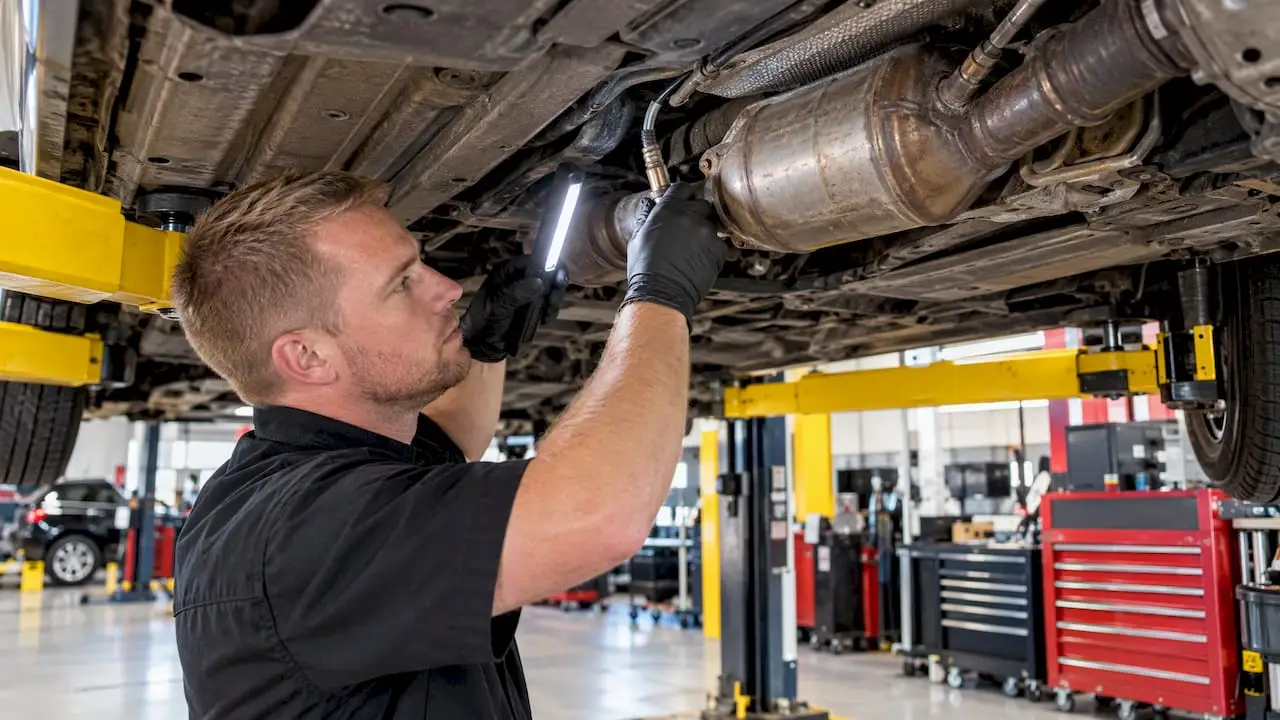
A leak near the sensors can fool the system. According to Vehicle Service Pros, a leak ahead of the front sensor can upset fuel control, and a leak before the rear sensor can let in false oxygen. Either one can make a working converter look like it is failing. Cracked manifolds and bad gaskets are common leak spots. If you hear ticking on a cold start, read our guide on exhaust manifold leaks and same-day safety checks.
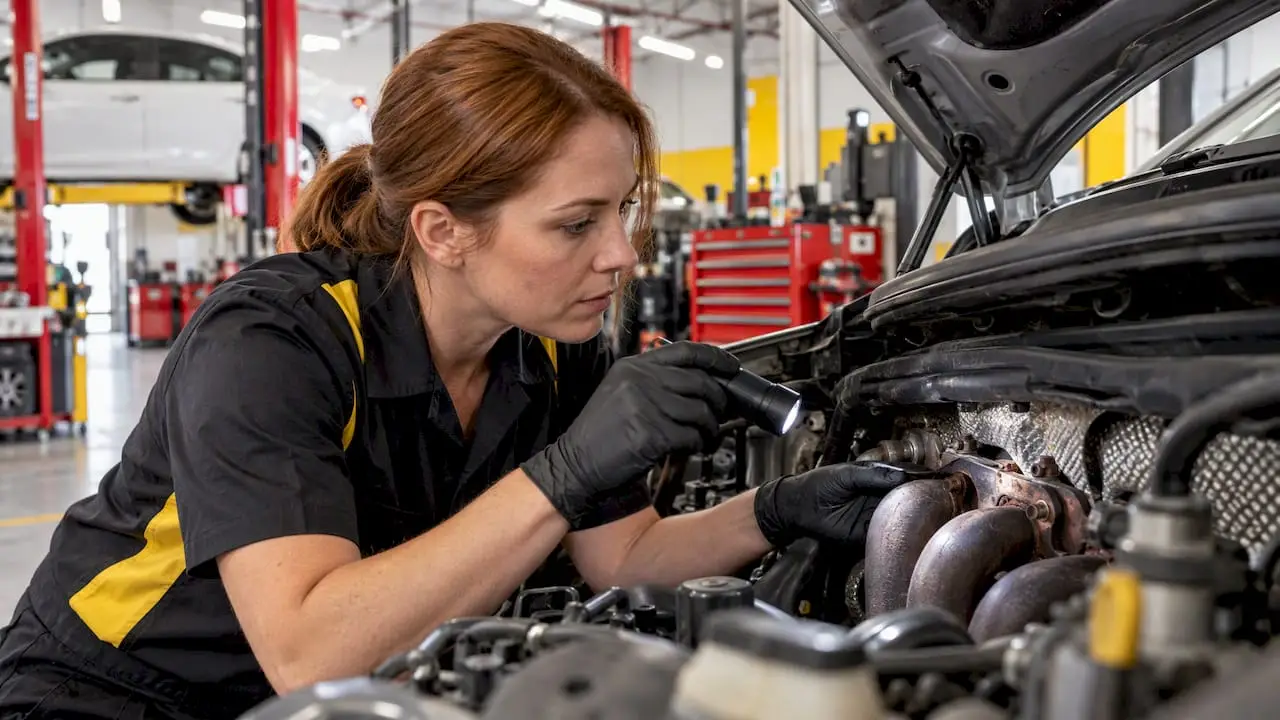
This also explains why owners who change exhaust parts sometimes see the light afterward. If you have modified your exhaust, a check engine light after a downpipe is a good example of how changes to the exhaust path can trigger catalyst-efficiency codes.
Oxygen sensors and wiring
The sensors are the car’s eyes. An aging front air-fuel sensor, a slow rear sensor or damaged wiring can send bad data. Kelley Blue Book also lists coolant temperature sensor problems and wiring faults among possible causes.
Misfires and fuel problems
Unburned fuel entering the exhaust can overheat a converter. Worn spark plugs, bad coils, leaking injectors and high fuel pressure are all on the list. Our post on signs your spark plugs need replacement covers the early warnings, and our P0300 diagnosis steps explain how misfire codes are tracked down.
Oil, coolant and other contamination
KBB’s list includes oil contamination and leaded fuel. Samarins warns that oil consumption, coolant intrusion, leaking injectors and lean running can destroy a replacement converter. Coolant getting into the exhaust can point to deeper engine trouble, such as the problems described in our head gasket failure tests.
Software
Occasionally the cause is the engine computer’s calibration. Technicians check for software updates and service bulletins for your model as part of a thorough diagnosis.
Symptoms: what you may notice
Many drivers notice nothing at all. A P0420 may cause no symptoms other than the check engine light. When there are symptoms, they can include:
- A sulfur or rotten-egg smell from the exhaust
- A rough idle or rough running
- Lower fuel economy
- A failed emissions inspection
If the symptom is a rough, shaking engine, the underlying problem may be a misfire, and that is more urgent than the code alone.
Can you drive with a P0420 code?
Short answer: for a short trip to a shop, usually yes, if the light is steady and the car runs normally. For long-term driving, it is not a good idea. O’Reilly’s guidance is that driving is not recommended until the problem is diagnosed, because it could get worse or damage other systems. Edmunds notes an unresolved P0420 can be linked to lower fuel economy, higher emissions and damage to other exhaust parts such as oxygen sensors.
Two situations change the answer:
- A flashing check engine light. That usually signals an active misfire that can overheat the converter quickly. Pull over safely and have the car looked at. Our article on why a flashing light can cook your catalytic converter explains what is happening.
- Strong rotten-egg smell, shaking or loss of power. Do not wait. Get it checked the same day.
Also, don’t clear the code and hope. The light will usually return, and clearing it also resets the car’s readiness monitors, which can cause problems at inspection time.
How a P0420 is properly diagnosed
The code tells us where to look. It does not tell us what to replace. Here is the kind of process a careful technician follows. According to Vehicle Service Pros, a thorough diagnosis reviews repair history, scans for codes, looks at freeze-frame data, checks software and bulletins, inspects for exhaust leaks and damage, evaluates fuel trims and compares upstream and downstream sensor behavior.
That breaks down into a few steps:
- Scan and record. Pull all stored codes and freeze-frame data. Other codes, especially misfire or fuel-trim codes, often explain P0420.
- Look and listen. Inspect the exhaust from manifold to tailpipe for leaks, cracks, damage or loose sensors.
- Check engine health. Confirm spark plugs, ignition, fuel delivery and fuel trims are in good shape.
- Watch the sensors live. Compare front and rear sensor readings on a scan tool. Manufacturers generally judge catalyst efficiency by either the oxygen sensor switch ratio or an oxygen-storage test, under set operating conditions.
- Check converter temperature. After warm-up, an outlet temperature at least 20 degrees hotter than the inlet suggests some conversion is happening.
- Decide on the repair. Only then is a part recommended, with the reason.
The key idea from the trade: P0420 is a test result, not proof that the converter is bad. A wrong air-fuel mix or an exhaust leak can make a good converter fail the monitor.
A free code read at a parts store is a fine first look, but it only gives you the code. We can’t tell you what is wrong with a vehicle before we inspect it, and the steps above are what turn a code into an answer.
What P0420 repairs cost
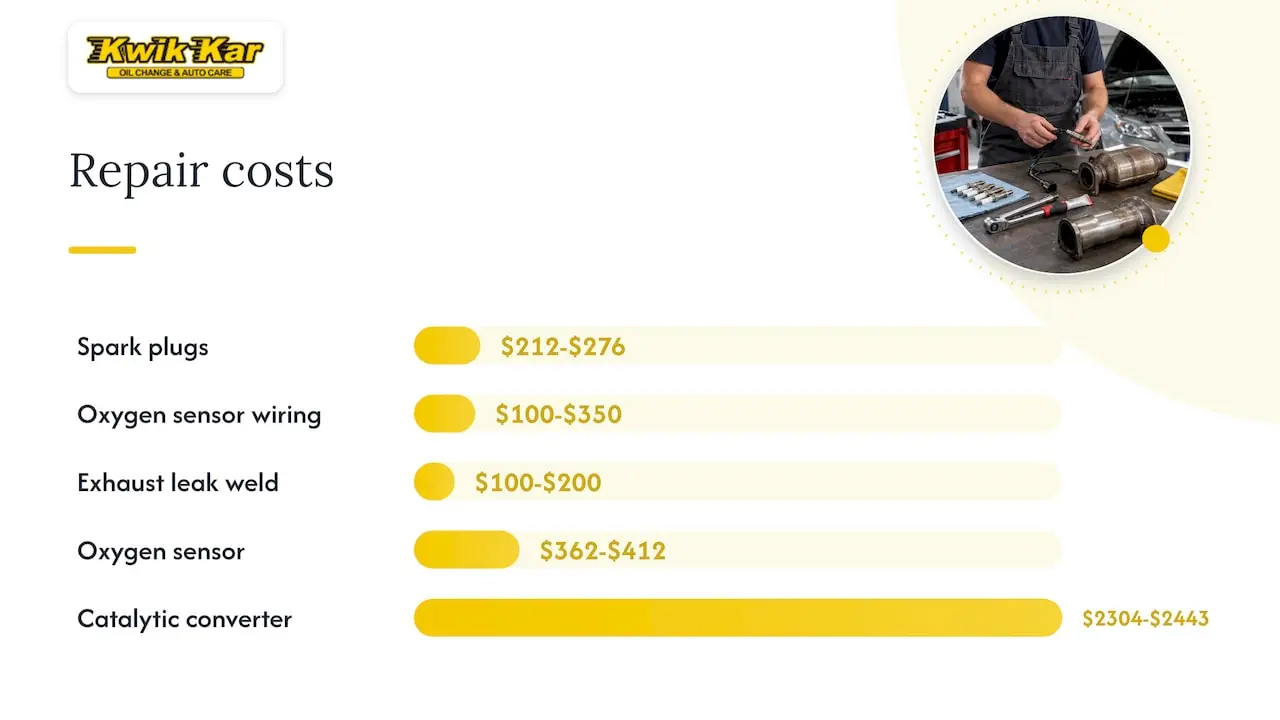
The range is wide because the causes are so different. One published U.S. repair-cost table reports mechanic totals of $212 to $276 for spark plugs, $100 to $350 for oxygen sensor wiring, $100 to $200 for welding an exhaust leak, $362 to $412 for an oxygen sensor and $2,304 to $2,443 for a catalytic converter. It notes that actual prices vary by vehicle and location.
| Likely cause | Typical U.S. mechanic total (2024 estimate) |
|---|---|
| Spark plugs | $212 to $276 |
| Oxygen sensor wiring | $100 to $350 |
| Exhaust leak weld | $100 to $200 |
| Oxygen sensor | $362 to $412 |
| Catalytic converter | $2,304 to $2,443 |
These are national estimates, not Kwik Kar prices. We don’t publish a price list for diagnostics or repairs, so we give you a written estimate after the inspection, before any work begins.
The pattern in the table is the point. EPA’s consumer guidance notes that a sound diagnosis can find inexpensive sensor or control repairs before they damage an expensive converter. And if the converter really is the problem, the cause still has to be fixed. Trainers point out that overheating is often a secondary result of misfire or a bad mixture, so replacing the converter without fixing the cause invites a repeat failure.
P0420 and Texas inspections
Texas ended the safety portion of its yearly vehicle inspection, but emissions testing continues in certain counties. The Texas Department of Public Safety says gasoline vehicles from 2 through 24 years old registered in the emissions counties get the OBD-II test, and the affected counties include Collin. Collin County covers Anna and Melissa. Grayson County, where much of Van Alstyne and Howe sit, is not on that list, but your registration county is what counts, so check yours. Our page on Van Alstyne vehicle inspection and OBD-II prep goes into more detail.
What does an OBD inspection look at? EPA guidance says it checks the warning lamp, the readiness status and any stored trouble codes with a scan tool. A stored P0420 can therefore be a reason for failure. EPA also explains that an OBD inspection can fail a vehicle that would pass a tailpipe sample, because it detects malfunctioning components early.
If you fail, EPA recommends professional diagnosis, repair and a retest, and asking for a written estimate and description of the repair.
Our perspective
We see P0420 a lot, and the biggest mistake is treating it like a parts order. A code is a clue. Before we recommend a converter, we want to know why the converter looks inefficient.
That is why we lean on our Digital Vehicle Inspection. You get photos and real-time updates, so you can see what our ASE-certified technicians see: the leak, the worn sensor, the plug condition. Nothing gets recommended without a reason you can look at.
Our goal is simple. Find the real cause, give you a clear estimate before work starts, and fix it right. Repairs we perform carry our 2-year/24,000-mile warranty.
Kwik Kar
Get it checked at Kwik Kar of Van Alstyne
If your check engine light is on, we can start with a diagnostics visit and share what we find through a Digital Vehicle Inspection, with photos and updates as the work progresses. All work is done by ASE-certified technicians.

Busy schedule? We offer after-hours drop-off, free local rides and a comfortable waiting area with WiFi and coffee. Exhaust problems that turn up during diagnosis can be handled through our exhaust system repair service, and our auto repair page lists everything else we do.
How to avoid P0420 in the first place
You can’t prevent every converter from aging, but you can avoid the things that most often shorten its life:
- Act on the check engine light early. A small misfire fixed this week is cheaper than a converter next year.
- Keep up with spark plugs and ignition parts on the schedule in your owner’s manual.
- Fix oil leaks and burning oil. Oil in the exhaust contaminates the converter. Regular oil changes help you notice oil consumption early.
- Repair exhaust leaks and cooling system problems promptly. Coolant in the exhaust can poison a converter.
- Use the right fuel. Leaded fuel is a known converter killer, so avoid additives or fuels that are not approved for your vehicle.
FAQ
What is the most common cause of a P0420 code?
A worn or damaged catalytic converter is the most common single cause, but exhaust leaks, oxygen sensor problems, misfires and fuel delivery issues can set the same code. That is why a diagnosis should come before a converter replacement. Which cause applies to your car can only be confirmed by inspecting it.
Can I clear a P0420 code myself?
You can clear it with a scan tool, but it will usually return if the cause is still there. Clearing also resets the car’s readiness monitors, which may leave your car not ready for an emissions inspection. Get the cause diagnosed first.
Will a P0420 code make me fail inspection?
In a Texas emissions county, a stored catalyst code can cause a failed OBD-II emissions test. The test checks the warning lamp, readiness status and stored codes. Check whether your county of registration requires emissions testing on the Texas DPS website.
How much does it cost to fix P0420?
It depends on the cause. National estimates run from roughly $100 for a small exhaust weld to well over $2,000 for a catalytic converter. We give you a written estimate after inspecting your vehicle, and you approve it before work begins.
Does P0420 mean I need a new catalytic converter?
Not necessarily. The code means the converter tested as inefficient. A leak, a sensor fault or an engine problem can cause that result even when the converter is fine. If the converter does need replacing, the underlying cause should be fixed too.
Ready to find out what your check engine light means?
Call Kwik Kar of Van Alstyne at (903) 712-5945, stop by the shop, or request an appointment through our website. We serve drivers in Van Alstyne, Anna, Howe, Melissa, Gunter and nearby communities, and we’ll show you what’s going on with your car before you decide anything.
Sources
- Edmunds: P0420 Catalyst System Efficiency Below Threshold (Bank 1)
- Ford OBD-II diagnostic documentation
- EPA: OBD Frequently Asked Questions
- O’Reilly Auto Parts: Check Engine Light Codes P0420 and P0430
- Vehicle Service Pros: The real cause of P0420/P0430 DTCs
- Vehicle Service Pros: Who killed the cat?
- Vehicle Service Pros: Cracking the code on catalyst efficiency
- Vehicle Service Pros: The Trainer #129
- Kelley Blue Book: P0420 Catalyst System Low Efficiency
- Samarins: Code P0420 Catalyst Efficiency Below Threshold
- FIXD: P0420 Engine Code
- EPA: Next Steps, Correcting Your Vehicle’s Emission Problems
- EPA: Performing Onboard Diagnostic System Checks
- Texas DPS: Inspection Criteria for Emission Inspection
- Check engine light after a downpipe checklist