




Most manufacturers call for a new engine air filter every 15,000 to 30,000 miles, and Ford gives that same range depending on the model. Your owner’s manual has the exact number for your vehicle. If you drive gravel roads, farm roads or construction zones around Van Alstyne, Anna, Howe, Melissa or Gunter, you may need to replace it sooner. The best habit is simple: look at the filter at every oil change and replace it when it is actually worn out, not just because the odometer says so.
TL;DR
- The typical engine air filter interval is 15,000 to 30,000 miles. Your owner’s manual is the final word for your vehicle.
- Dust, dirt roads and heavy stop-and-go traffic shorten that interval. A quick look at every oil change beats guessing.
- A dirty-looking filter is not automatically a bad one. Sluggish acceleration, a rough idle or debris in the airbox are better reasons to have it checked.
- A clogged filter mostly costs you power, not miles per gallon, on modern fuel-injected vehicles.
- We can check it for you during an oil change and show you a photo of what we find.
Table of Contents
- What the engine air filter does
- How often to change an engine air filter
- Check it at every oil change
- A dirty filter is not always a dead filter
- Signs the engine air filter may need attention
- Will a new air filter improve gas mileage?
- What dusty North Texas driving does to the interval
- Can you clean and reuse an air filter?
- Doing it yourself or having a shop do it
- Our perspective
- Fall is a good time to check
- Get your air filter checked in Van Alstyne
- FAQ
- Sources
What the engine air filter does
Your engine needs a lot of air to burn fuel. That air carries dust, pollen, sand and bits of road debris. The engine air filter sits in a plastic box under the hood and catches those particles before they reach the engine.
The reason it matters is wear. Fine, abrasive grit that gets past a worn or damaged filter can speed up wear inside the engine. That is slow, quiet damage you do not notice until it is expensive. A filter in good shape is cheap protection.
Do not confuse it with the cabin air filter. The cabin filter cleans the air that comes through your dash vents, and it has its own schedule. Ford recommends replacing the cabin filter every 15,000 to 20,000 miles, depending on the model. If the problem you are chasing is a musty smell inside the car, that is usually the cabin side, and this UK guide to finding the source of car odours is a useful read before you replace anything.
How often to change an engine air filter
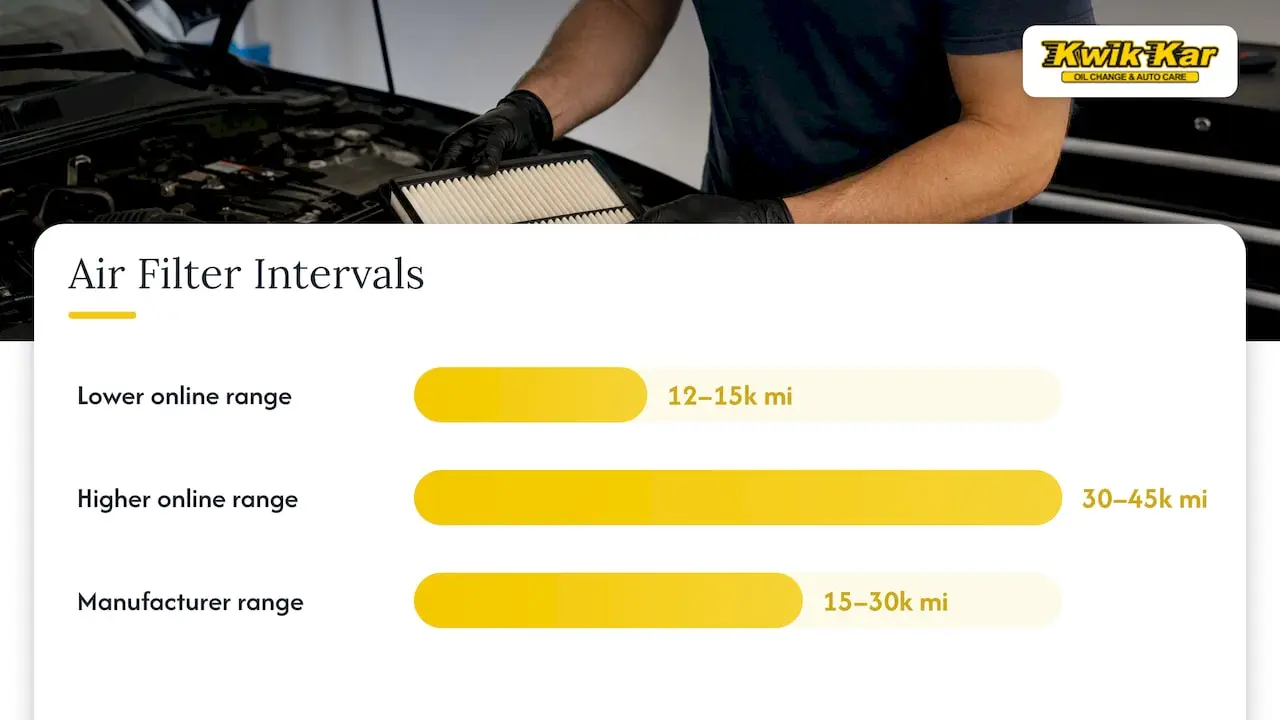
You will see several different numbers online. Some say 12,000 to 15,000 miles, others say 30,000 to 45,000. They are all guesses at an average, and the average does not drive your truck.
Here is what we can stand behind:
- Manufacturers typically say 15,000 to 30,000 miles. Ford’s guidance uses that range and points you to the maintenance section of your owner’s manual for your specific model.
- Your manual outranks any article. That includes this one. Different engines and airbox designs have different requirements.
- Conditions move the number. Dusty roads, heavy traffic and lots of short trips can all mean replacing sooner than the base figure.
If you want a rule of thumb, treat the manual’s mileage as the latest you should replace the filter, and use inspections to decide whether it needs to happen earlier.
Why the mileage number is only a starting point
Mileage tells us how far the car has gone. It says nothing about what the air was like along the way. Two vehicles with 25,000 miles on the same filter can look completely different: one spent its life on paved commuter routes, the other on county roads behind a line of trucks.
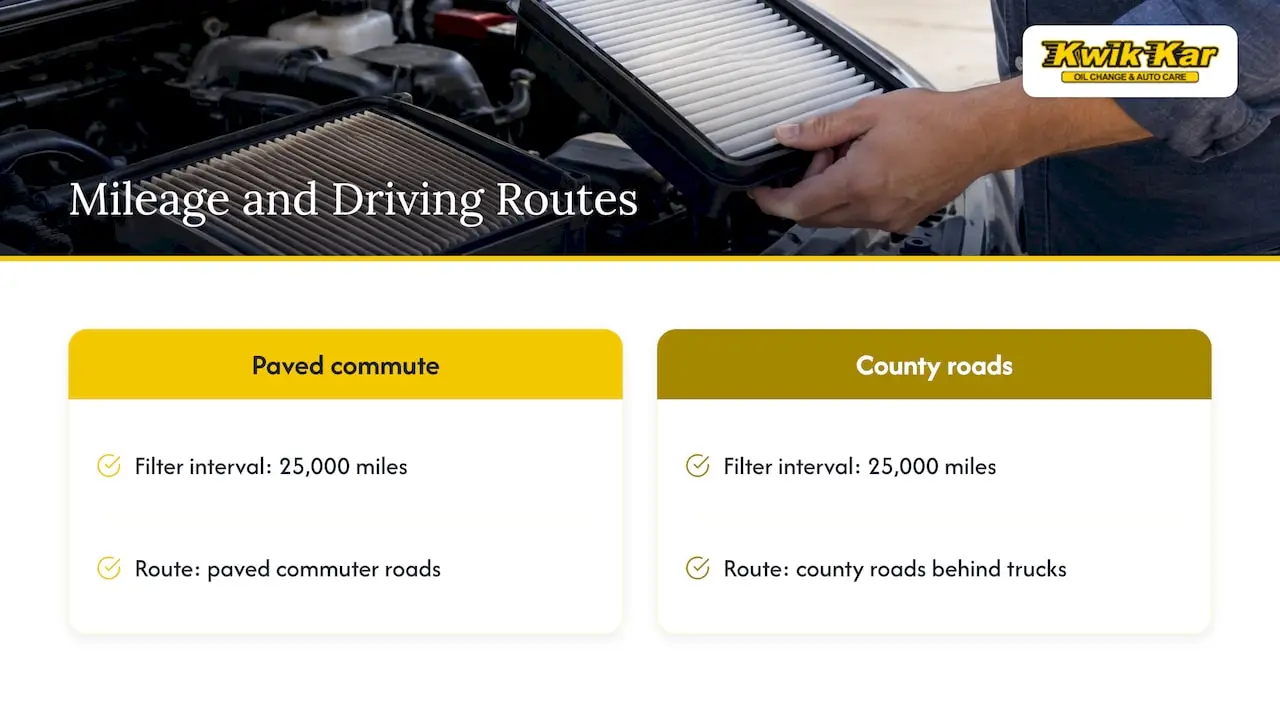
AAA’s Via magazine reports that manufacturer numbers fail to account for environmental variables, and that dusty driving is a real reason to replace earlier. That fits what we see in our area, where plenty of drivers leave pavement for part of every week.
Check it at every oil change
The most reliable approach is not a fixed replacement date. It is a regular look. AAA’s guidance points to inspecting the filter at each oil change, which typically comes every 5,000 to 7,500 miles. That catches a problem long before it affects how the vehicle drives.
If you are not sure how often your oil change should be, our oil change interval guide for Van Alstyne drivers explains how to find the right number for your engine and driving. You can also read whether Texas heat changes the schedule.
The light test
If you want to look yourself, AAA describes a simple check for paper filters. Pull the filter from the airbox and hold a bright light behind it. If less than half of the surface lets light through, it is time to replace it.
Two cautions:
- Some long-life, high-efficiency filters use dense material that blocks light even when brand new. For those, follow the owner’s manual.
- Make sure the airbox clips or screws are fully secured when you close it. A loose lid lets unfiltered air in, which defeats the purpose.
If you would rather not open the airbox yourself, that is completely fine. It is one of the quick checks we do while the vehicle is already in the bay.
Look for a service indicator
Some vehicles, especially pickup trucks, have a restriction indicator on the airbox. According to AAA, it measures the pressure drop across the filter while the engine runs. Rather than guessing from mileage, you check the indicator at each oil change and replace the filter when it signals that restriction has reached its limit. If your truck has one, use it.
A dirty filter is not always a dead filter
This surprises people. A gray, dusty filter looks like it needs to go in the trash. But a filter that has collected a thin layer of dust can actually trap fine particles better than a brand-new one, according to AAA’s explanation. What matters is whether airflow is restricted or the filter is damaged, not how it looks from across the garage.
That is why we focus on inspection over arbitrary replacement. Replacing a healthy filter early is just spending money for no benefit. Replacing a clogged one late can cost you performance and, over time, put the engine at greater risk.
Signs the engine air filter may need attention
Waiting for symptoms is not the plan. Inspections are. But if you notice any of the following, it is worth having someone look at the filter and the airbox:
- Sluggish acceleration. The engine feels slow to respond when you merge onto US-75 or pull away from a light.
- A rough idle. The engine shakes or hunts at a stoplight.
- Debris in the airbox. Leaves, dirt or bugs inside the housing. AAA’s guidance lists visible debris among the signs worth checking.
- A torn, collapsed or oil-soaked filter. Any physical damage means replace it, no light test needed.
A word of honesty: these symptoms also show up with other problems, like worn spark plugs, fuel delivery issues or sensor faults. A rough idle does not automatically mean the air filter. If the filter looks fine and the symptom continues, the next step is a proper diagnosis. Our guide to signs your spark plugs need replacement covers one common look-alike. We will not promise a cause before we have inspected the vehicle.
Will a new air filter improve gas mileage?
Probably not on a modern car, and this is where a lot of shops oversell. For years, technicians and the Environmental Protection Agency encouraged frequent changes for fuel economy. AAA says that advice applied to older carbureted engines, and that today’s fuel injection systems automatically compensate for the airflow change.
What a badly clogged filter can do is reduce maximum power. AAA’s guidance says it should not cost you miles per gallon in a fuel-injected vehicle. So if someone tells you a fresh filter will save you real money at the pump, ask questions. Replace the filter because it is worn, restricted or damaged, and expect it to protect the engine and keep power normal.
What dusty North Texas driving does to the interval
Van Alstyne sits among farmland, new construction and county roads. Many of our customers drive between those and US-75 in the same day. That mix matters for the air filter.
Shorten your check-and-replace cycle if any of these describe you:
- You regularly drive on gravel or dirt roads, including driveways and farm access roads.
- You pass through construction zones with a lot of dust in the air.
- You tow, haul or idle in heavy traffic often.
- You park outside under trees that shed pollen, seeds or leaves.
In those cases we would not wait for 30,000 miles. Look at the filter at each oil change, and replace when it is visibly loaded with dirt, fails the light test, or the manual’s severe-use schedule says so. Many manuals list a shorter interval for “severe” or dusty use, so check that section of yours.
Can you clean and reuse an air filter?
For a standard paper filter, no. Cleaning it with compressed air, tapping it on the ground or washing it can tear the fibers and let dirt through. AAA’s Via guidance says that for most daily drivers, attempting to clean a standard filter damages its structure and weakens its protection.
Some performance cold-air intake filters are designed to be serviced. That is a multi-step process with a specific cleaner, a thorough rinse, full drying and careful re-oiling. If you have an aftermarket intake like that, follow its maker’s instructions to the letter. If you are not sure what you have, ask us.
Doing it yourself or having a shop do it
Swapping a filter is one of the easier jobs under the hood on many vehicles. On others, the airbox is awkward, held by hidden clips, or tied to sensors you do not want to disturb. If you are comfortable and your manual shows the steps, go ahead.
The case for letting a shop handle it:
- The airbox is inspected while it is open, so a cracked housing or a loose intake hose gets noticed.
- You get the right part for your engine, not a near match.
- It is part of a bigger look at the vehicle, including fluids, belts, tires and brakes.
That last point is why we like to bundle it with an oil change. You are already in the shop, and the check takes a couple of minutes.
Our perspective
We see two mistakes with air filters, and they are opposites. Some drivers never look at the filter for years, and we find it packed with leaves and grit. Others get told to replace it at every visit, whether it needs it or not.
Our approach is to inspect first. That is what the Digital Vehicle Inspection is for: you get real-time updates and photos, so you can see the filter yourself and decide with us. If it is in good shape, we leave it alone and tell you when to check it again. If it is restricted or damaged, you will see why we recommend a replacement, with no surprise costs.
For drivers here, we also keep the local conditions in mind. A truck that works on gravel roads and a commuter sedan that stays on pavement should not be on the same schedule, and your factory maintenance schedule is still the baseline. Our page on factory scheduled maintenance in Van Alstyne explains how we start with your manual.
— Kwik Kar
Fall is a good time to check
After a dry Texas summer, filters can be loaded with dust and pollen. Fall is a natural point to check it along with your other fluids and filters. We cover the full list in essential fluids and filters to change for fall, so you can see what else is worth checking at the same visit.
Get your air filter checked in Van Alstyne
If you are not sure when your filter was last looked at, an oil change at Kwik Kar of Van Alstyne is an easy time to find out. Our ASE-certified technicians inspect the vehicle, and the Digital Vehicle Inspection sends you photos and updates as we go. If something else is bothering you, like a rough idle or slow acceleration, we can run diagnostics to find the actual cause before recommending any repair.
We offer after-hours drop-off, free local rides and a comfortable waiting area with WiFi and coffee, so it fits around a busy schedule. Repairs carry a 2-year/24,000-mile warranty.
Call us at (903) 712-5945 or stop by to set up a visit.
FAQ
How often should I change my engine air filter?
Most manufacturers recommend every 15,000 to 30,000 miles, and the exact figure for your vehicle is in your owner’s manual. Replace it sooner if you drive on dusty roads or in heavy traffic. Checking it at every oil change is the safest approach.
What are the symptoms of a bad engine air filter?
Sluggish acceleration, a rough idle and visible debris in the airbox are the usual signs. These can also come from other problems, so the filter should be inspected rather than assumed. A torn or oil-soaked filter should be replaced no matter how the car drives.
Will a new air filter make my car run better or save gas?
If the old filter was badly clogged, you may get your normal power back. AAA says modern fuel-injected vehicles do not lose fuel economy from a restricted filter, so do not expect better mileage. A fresh filter on an already healthy one changes very little.
Do I need to change my air filter every month?
No. That would be far more often than any manufacturer suggests. A look at each oil change and a replacement when the filter is restricted, damaged, or due by your manual is enough.
Can I clean my air filter instead of replacing it?
Not a standard paper filter. Cleaning it can damage the material and let dirt into the engine. Only filters designed to be serviced, such as some performance intake filters, should be cleaned, and only with the maker’s method.
Sources
- Ford: How often should I change the engine air filter?
- Ford: When should I change the cabin air filter?
- AAA: Changing Your Car’s Engine Air Filter
- AAA Via: Car Engine Air Filter Replacement, DIY or Pro Service?