




If your key won’t turn in the ignition, the cause is usually one of four things: a locked steering wheel, a shifter that isn’t fully in Park, a worn or wrong key, or a worn ignition cylinder. The first two you can often fix in under a minute. The last two need a closer look. Wiggle the steering wheel gently while you turn the key, confirm the shifter is seated in Park, and stop before you use force.
This guide walks through each cause in the order we’d check it, what’s safe to try in a parking lot or your driveway, what can make things worse, and when it’s time to call for help. If you’re stuck in Van Alstyne, Anna, Howe, Melissa, Gunter or anywhere nearby, we’re glad to help you sort it out.
TL;DR
- Most “key won’t turn” problems come from a locked steering wheel. Hold the wheel, rock it a few degrees each way, and turn the key at the same time.
- Check that an automatic is firmly in Park (or Neutral), and that a manual’s clutch pedal is fully pressed.
- Look at the key itself. A bent, worn or wrong key won’t turn, and debris in the lock can block it too.
- Never force the key. A broken key or damaged ignition costs far more than the original problem.
- If gentle steps fail, call us at (903) 712-5945 or get roadside help. We inspect first and never guess at a diagnosis.
Table of Contents
- Start with the steering wheel lock
- Make sure the shifter is really in Park
- Look closely at the key
- Debris and a worn ignition cylinder
- What not to do
- When the key won’t come out
- Push-button and twist-to-start cars
- Quick reference: symptom, likely cause, next step
- Could it be the battery or starter instead?
- When to stop and call for help
- What a repair visit looks like
- Our perspective: why we tell you to stop early
- Get it looked at in Van Alstyne
- Prevention: keep your key and ignition healthy
- FAQ
- Sources
Start with the steering wheel lock
When you turn a car off and take the key out, the steering column can lock. If someone leans on the wheel or the tires are turned against a curb as you park, the lock can bind against the ignition. The key then feels stuck solid, even though nothing is broken.
Toyota’s U.S. support guide says a key may not turn because the steering wheel is locked, and it recommends turning the wheel from side to side while turning the key, without using enough force to damage the steering mechanism. Mazda USA gives similar advice: if the steering wheel is locked, hold it firmly and rotate it a few degrees in either direction while gently turning the key.
Here is how that looks in practice:
- Sit upright with both hands on the wheel.
- Push the wheel gently in one direction until it stops. You’ll feel it take up the slack.
- Hold that light pressure and turn the key with your other hand.
- If nothing happens, try the opposite direction.
The word to remember is gently. You are taking pressure off a locking pin, not wrestling it. If the key still won’t budge after a few tries, stop and move on to the next check.
Make sure the shifter is really in Park
An automatic transmission has a safety interlock. The car is built so the key turns and the engine starts only when the shifter is in Park or Neutral. Honda’s owner guidance says an automatic must be in Park or Neutral, and a manual’s clutch fully depressed, before the starter will operate.
A shifter that looks like it’s in Park may be sitting a hair short of it. Try this:
- Press the brake, then move the lever out of Park and firmly back in.
- Try Neutral and turn the key there. (Only do this on level ground with the parking brake set.)
- In a manual, push the clutch all the way to the floor.
The same interlock can work in reverse, holding the key in the ignition. A manufacturer technical bulletin hosted by NHTSA describes some vehicles that can trap the key by design if the shifter has been in Park for more than 30 seconds without the key being turned fully off. The bulletin’s fix is to cycle the key off and on to release it. That is one specific manufacturer’s procedure, so check your owner’s manual for your own vehicle.
Look closely at the key
It sounds obvious, but it happens: the key belongs to another vehicle. Toyota lists a key for a different vehicle among the common reasons a key won’t turn. If you carry a ring of similar-looking keys, especially a family with several cars, check the one in your hand first.
Then inspect the key:
- Bent: Lay it on a flat surface. A key that rocks or curves has lost its shape.
- Worn: The cuts (the ridges and valleys) round off over years of use. A worn key may slide in but fail to lift the internal parts into position.
- Dirty: Lint, pocket grit and old debris can pack the grooves.
Mazda advises that to prevent a jammed ignition you should clean your keys and consider spare keys with fresh edges. If you have a spare, try it. If the spare turns smoothly and your everyday key doesn’t, the everyday key is worn and should be duplicated from the spare before it fails completely.
A useful side note for parents: teen drivers often carry a key with a heavy keychain. That weight hangs off the key inside the ignition and, over time, wears the cylinder. A lighter keychain is a free way to extend ignition life.
Debris and a worn ignition cylinder
Inside the ignition is a small lock cylinder with tiny wafers or pins that must line up exactly with the cuts on your key. When that fit is off, the key goes in but won’t rotate. Mazda lists damage to the key or ignition wafers, ignition-lock failure and a jammed column among the reasons a key will not turn.
Signs the problem is inside the cylinder rather than the key or the steering lock:
- The key turns only if you jiggle it, and it’s getting worse over weeks.
- A spare key shows the same stiffness.
- The key goes in rough or stops partway.
- The car has been through lots of starts with a heavy keychain or a worn key.
That pattern points to a cylinder that is wearing out, and it’s a repair for a technician, not a driveway fix.
A note on lubricants
It’s tempting to spray something in the lock. The Associated Locksmiths of America says automotive locks seldom need lubrication and generally need cleaning, and it cautions against using WD-40 as a default fix. If you suspect lint or grit, a professional can clean the cylinder properly.
What not to do
When a key won’t turn, frustration builds fast. These moves tend to turn a small problem into an expensive one:
- Don’t force it. Forcing the key until it snaps is the classic mistake. Toyota specifically says to turn the wheel without enough force to damage the steering mechanism.
- Don’t dig out a broken key. The Associated Locksmiths of America warns that if a key breaks off in a vehicle lock, you should not try to remove it yourself, because that may damage the lock mechanism and could mean replacing it.
- Don’t hammer or pry the key, the column or the ignition.
- Don’t keep trying for twenty minutes. If three or four careful attempts fail, the cause isn’t the one you’re fixing.
When the key won’t come out
Searches for a stuck ignition key are far more common than searches for a key that won’t turn. The two problems overlap, so here is the quick version for a key that’s in but won’t release:
- Confirm the shifter is fully in Park, and press the brake.
- Turn the wheel slightly while pulling the key out, in case the steering lock is binding.
- Turn the key to the off position and try again, then cycle it to on and back to off.
- Check the key for damage, and check the ignition for anything foreign in it.
A stuck key is a safety concern, not just an annoyance. If it’s a push-and-twist key that won’t release, don’t leave the car unattended in a public lot with the key hanging in the ignition. Sometimes the cause is on the transmission side. An NHTSA-hosted Subaru service bulletin attributes some keys-stuck-in-ignition complaints to contamination of the CVT shifter’s Park-range switch, and directs technicians to inspect the Park signal, wiring and shift-lever components. That’s diagnostic work: you can’t see a dirty switch from the driver’s seat.
The 2021 bulletin mentioned above adds that if a key remains locked for another reason, technicians should check the key-lock-solenoid voltage with the transmission in Park and at key-off. Again, that’s a shop task with the right equipment.
Push-button and twist-to-start cars
Many newer vehicles use a key fob and a start button or a twist-to-start knob. If your car shows a message about the key, the problem is recognition rather than a stuck lock. The Associated Locksmiths of America says a twist-to-start vehicle displaying messages like “Bad Key,” “No Key” or “Wrong Key” has a key-recognition problem, and that, unlike some push-button systems, it has no emergency-start procedure, so you should call a locksmith.
Try a spare fob first, and check the fob’s battery if your owner’s manual shows how. If a dead fob battery isn’t the cause, the key may need to be reprogrammed or replaced, which is outside what a repair shop’s mechanical diagnosis covers. In that case a locksmith or the dealer is the right call. We’ll tell you plainly if what we find is on the key side rather than the vehicle side.
Quick reference: symptom, likely cause, next step
| What you notice | Likely cause | What to try or who to call |
|---|---|---|
| Key goes in, wheel won’t move, key won’t turn | Steering lock binding | Rock the wheel gently while turning the key |
| Key won’t turn, shifter looks like Park | Shifter not fully seated | Re-seat in Park, press brake, try Neutral |
| Spare turns, everyday key doesn’t | Worn or bent key | Use the spare, get a new copy made |
| Both keys are stiff, getting worse | Worn ignition cylinder or debris | Stop and have it inspected |
| Key won’t come out of ignition | Shifter interlock, steering lock, or switch fault | Re-seat shifter, cycle key, then get it inspected |
| “Bad Key” or “No Key” message | Key recognition problem | Spare fob, then locksmith or dealer |
| Key snapped in the lock | Forced key | Stop, don’t dig, call a locksmith |
Could it be the battery or starter instead?
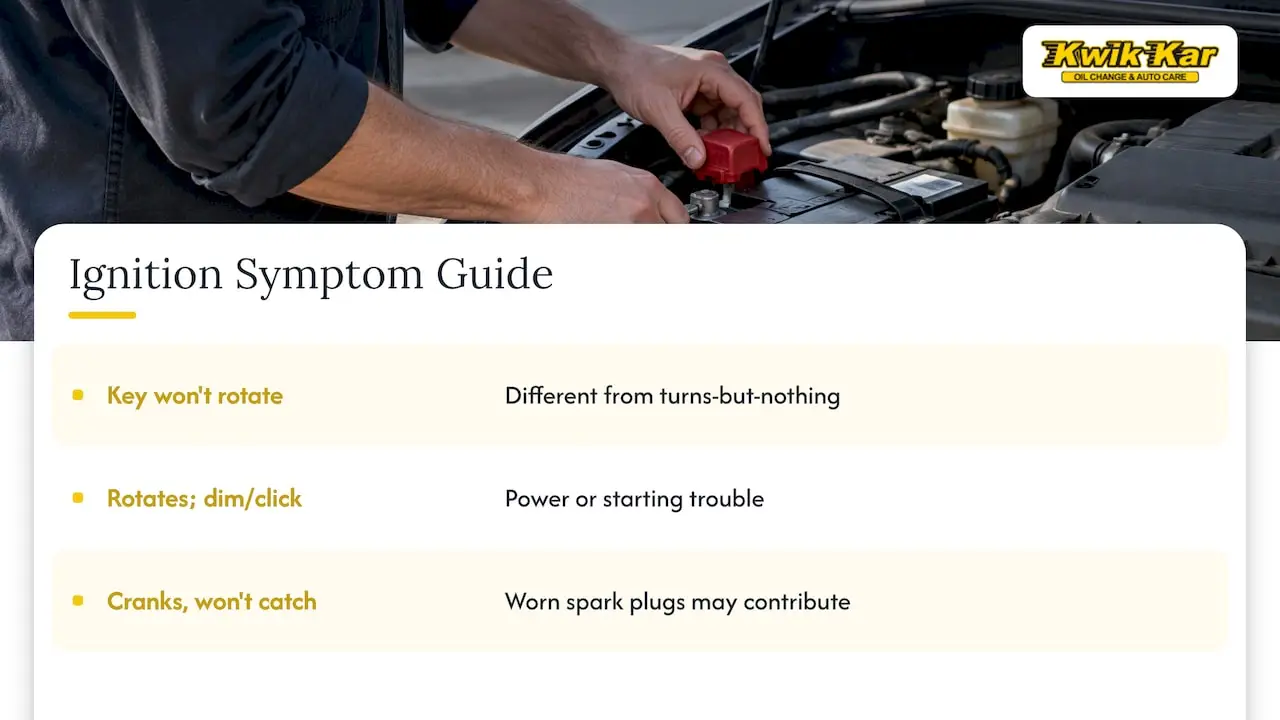
Sometimes drivers say the key “won’t turn” when it turns fine but nothing happens. That’s a different problem. If the key rotates, the dash lights dim, or you hear clicking, you’re likely looking at power or starting trouble. Our guide on alternator versus battery symptoms covers the quick tests that separate the two. If the engine cranks but won’t catch, worn spark plugs can play a part, and we cover the warning signs of worn spark plugs too.
If you’re not sure which situation you’re in, that’s fine. Describe it to us on the phone and we’ll tell you what we’d look at first.
When to stop and call for help
There’s a clear line between a fix you can do and a job for someone else. Stop troubleshooting when:
- The steering-wheel and shifter steps don’t work after a few gentle tries.
- Your spare key behaves the same as your usual key.
- The key is bent, cracked or partly broken.
- You see a key-recognition message on the dash.
- You’re in an unsafe spot, such as a roadside shoulder or a dark parking lot.
Mazda’s guidance draws the same line: a small, controlled steering-wheel movement may release the lock, but persistent failure warrants roadside assistance or professional inspection.
One practical point about roadside plans: coverage varies. As one example, Allstate Motor Club’s roadside terms for one plan say lockout service can be covered up to a stated limit, but labor to produce keys, replacement keys and mechanical failure of locks or the ignition system are excluded. Read your own plan so you know what a tow or a lockout call will and won’t include.
What a repair visit looks like
We don’t promise a diagnosis before we’ve seen the vehicle. A key that won’t turn can come from the key, the steering lock, the shifter interlock, the ignition cylinder or the electronics, and each one has a different repair and a different cost.
Here is how we approach it:
- Listen. When did it start? Does it happen every time or only sometimes? Did anything change, like a new key, a spill or a recent repair?
- Check the simple things. Key condition, steering lock, shifter position.
- Inspect the ignition and related parts. That includes the cylinder, the shifter linkage and the electrical side where relevant.
- Show you what we found. Our Digital Vehicle Inspection sends photos and real-time updates, so you can see the issue yourself.
- Quote before work. You approve the repair before we start.
Costs depend on the make and model, the type of key and security system, and whether the fix is a cleaning, a cylinder or a switch. Because we haven’t seen your vehicle, we won’t quote a number here. Once we’ve inspected it, you get a clear estimate with no surprises.
Our perspective: why we tell you to stop early
We see the same pattern often. A driver has a key that’s stiff for weeks, then one morning it won’t turn at all, and sometimes the key snaps from the effort. The small warning signs are easy to ignore because the car still starts most days.
Our advice is simple. If the key is getting harder to turn, take it seriously before it turns into a stranded car. Copy a worn key while it still works. Keep the keychain light. Don’t force a stuck key. And if the car won’t start in a way you can’t explain, let a technician look before you replace parts that may be fine.
Every technician at our shop is ASE-certified, and repairs carry a 2-year/24,000-mile warranty. We’d rather spend ten minutes checking the simple causes with you than sell a repair you don’t need. For families, that matters most: a car that fails to start on a school morning or a game night affects everyone, so we try to make the fix quick and the explanation clear.
— Kwik Kar
Get it looked at in Van Alstyne
If your key won’t turn, won’t come out, or has started to feel rough, we can inspect the ignition, steering lock and shifter interlock and tell you what’s going on. Our diagnostics service starts with an inspection, and you can see every auto repair service we offer if the problem turns out to be something else.

Busy week? Use our after-hours drop-off, and ask about a free local ride. We have a comfortable waiting area with WiFi and coffee if you’d rather stay. Call us at (903) 712-5945 to describe what’s happening.
Prevention: keep your key and ignition healthy
A few habits cut your chances of ever facing this problem:
- Lighten the keychain. Heavy fobs and bundles put constant load on the ignition.
- Keep keys clean. Wipe them down now and then and keep them out of lint-filled pockets.
- Copy a worn key early. A fresh copy from a good spare beats a copy of a worn copy.
- Straighten the wheels before you park. And avoid leaning on the steering wheel as you turn the car off.
- Seat the shifter firmly in Park before turning the car off.
- Don’t ignore stiffness. A key that’s getting harder to turn is telling you something.
Regular maintenance helps too, since a car that’s checked on schedule gets small problems found early. If your car is due, our services page lists what we handle.
FAQ
Why won’t my key turn in the ignition even though the steering wheel isn’t locked?
The next suspects are the shifter, the key and the cylinder. Make sure the shifter is fully in Park, try a spare key, and look for bends or heavy wear. If both keys are stiff, the ignition cylinder may be worn or have debris in it, and it needs inspection.
How do I unlock the steering wheel so the key will turn?
Hold the wheel and gently rotate it a few degrees in one direction while turning the key. If that fails, try the other direction. Use light pressure only. Toyota and Mazda both advise against forcing it, since too much force can damage the steering mechanism.
Is it safe to spray WD-40 into the ignition?
We wouldn’t. The Associated Locksmiths of America says automotive locks seldom need lubrication and generally need cleaning instead. If you think debris is the problem, have a professional clean the cylinder rather than adding spray that can attract more grit.
What should I do if my key broke off in the ignition?
Stop and don’t try to pull out the piece yourself. The Associated Locksmiths of America warns that doing so may damage the lock mechanism. Call a locksmith or a shop, and tell them exactly what happened so they can bring the right tools.
Can you tell me what’s wrong with my ignition over the phone?
Not reliably. A key that won’t turn has several possible causes, and we don’t diagnose a vehicle we haven’t inspected. We can talk you through the safe checks above, then look at it in person and show you what we find.
Sources
- Toyota Support: Why won’t my ignition key turn?
- Mazda USA: Car Won’t Start
- Honda owner guidance: If Your Engine Won’t Start
- NHTSA-hosted manufacturer technical bulletin, August 2021
- NHTSA-hosted Subaru service bulletin, revised 2022
- Associated Locksmiths of America: auto locks and key fobs
- Allstate Motor Club roadside assistance terms