




Road force balancing is a way of checking a tire and wheel while a heavy roller presses against the tire, the way the road does when you drive. A regular balancer only spins the wheel and tells the technician where to put weights. Road force testing also measures how stiff and how round the tire and wheel are under load, so it can find vibration causes that weights alone cannot fix. It is worth considering when you have a steering wheel or seat shake at highway speeds, especially if a standard balance did not cure it.
If you drive Highway 5 or US-75 around Van Alstyne, Anna, Howe, Melissa or Gunter, a vibration at 60 to 70 mph is one of the most common complaints we hear about. Here is what the process involves, what it can and cannot fix, and how to decide whether to pay for it.
TL;DR
- Road force balancing loads the tire with a roller to measure how it behaves on the road, not just how the weight is distributed.
- It helps most with highway-speed vibration, new tires that still shake, and low-profile or large-diameter wheels.
- The machine measures a problem. It does not repair a bent wheel, a damaged tire or worn suspension parts.
- If the vibration stays after balancing, the cause is often alignment, suspension or a damaged tire, and all of those need an inspection.
- Before you approve any add-on service, ask what reading the shop found and what it will do about it.
Table of Contents
- What road force balancing actually means
- How the process works, step by step
- Road force balance vs. a regular balance
- Is road force balancing worth it?
- What it costs and how long it takes
- What can still shake your car after balancing
- How to describe your vibration to a technician
- How we approach a vibration complaint
- Prevent vibration before it starts
- Get your vibration checked in Van Alstyne
- FAQ
- Sources
What road force balancing actually means
Every tire and wheel assembly has small imperfections. The tire may be a little stiffer in one spot. The wheel may be slightly out of round. When the tire is mounted, those high and low spots can line up or cancel each other out.
A standard balancer spins the assembly in the air and finds heavy spots. Weights fix that. A road force machine adds a load roller that presses on the tire while it turns. Technical service information that NHTSA hosts describes road force as the variation in force the tire applies to the suspension as it rolls, called road force variation, or RFV. The same material lists imbalance, radial runout and RFV as the three main contributors to tire and wheel vibration at highway speeds.
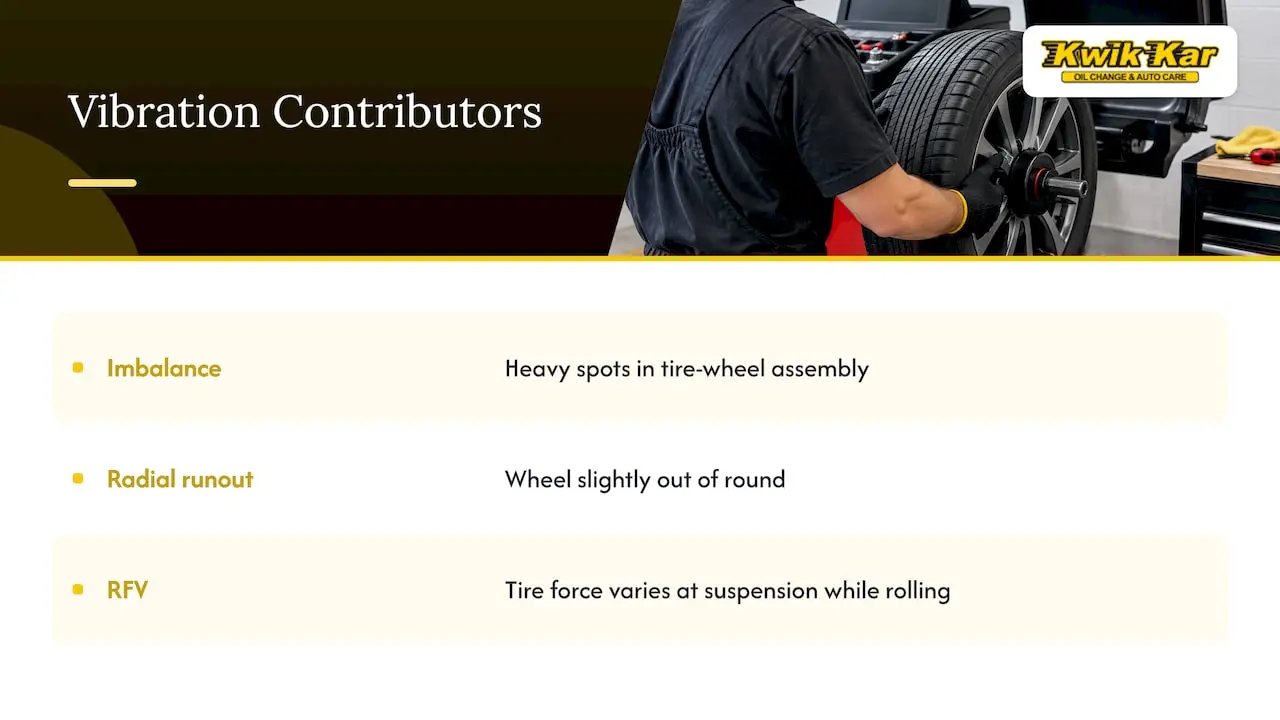
In plain terms: balance tells you where the weight is. Road force tells you how the assembly behaves with the weight of a car on it.
Why a tire can be balanced and still shake
A tire can be perfectly balanced and still be stiff in one section of the sidewall or slightly egg-shaped. OEM technical material says road force reflects both sidewall stiffness and how out of round the assembly is, and that incorrect mounting or poorly seated beads can also push the number up. That is why a car can feel smooth when the wheels are spinning on a balancer and shake once it is on the road.
How the process works, step by step
The exact steps vary by machine and by vehicle maker, but the logic is the same.
- Inspect and clean. The technician checks the tire for damage, removes old weights and checks that the wheel is clean and the tire is at the correct pressure.
- Mount on the machine. The wheel goes on the balancer and the roller presses against the tread while the assembly turns.
- Read the numbers. The machine reports imbalance and road force, and the technician compares road force to the limit for that tire or vehicle.
- Match-mount if needed. If the reading is above the limit, the technician marks the tire and wheel, deflates the tire, rotates it on the rim, reseats the beads and measures again. A NHTSA-hosted service bulletin describes this 180-degree rotation. Tesla’s 2025 U.S. service procedure follows the same pattern: measure, compare with the limit, match-mount if above it, then measure again before final weights go on.
- Place weights and verify. Once the reading is within spec, weights are applied and the assembly is checked once more.
If the number stays high after match-mounting, the tire itself may be the problem, or the wheel may be bent. At that point the honest answer is a new tire or a wheel repair or replacement, not more weights.
Road force balance vs. a regular balance
| Regular (spin) balance | Road force balance | |
|---|---|---|
| What it measures | Weight distribution | Weight distribution plus stiffness and roundness under load |
| Load on the tire | None | Roller simulates vehicle weight |
| Can find bent rim or tire uniformity issues | Not reliably | Yes, as a diagnostic screen |
| Can guide match-mounting | No | Yes |
| Typical use | Every new tire install, rotation vibration | Persistent vibration, premium or low-profile tires |
Hunter, a maker of these machines, says its road force balancer can identify tire uniformity problems, bent-rim runout, poor bead seating and tire pull that a conventional balancer may not detect. Treat that as a description of what the equipment is designed to do. It is a diagnostic screen, and what the technician does with the readings is what fixes the car.
Is road force balancing worth it?
It depends on your symptoms and your tires. Here is how we would sort it.
When it is usually worth considering
- You feel a vibration at highway speeds in the steering wheel, seat or floor, and a regular balance did not stop it.
- New tires feel rough right after installation, even though they were balanced.
- Your wheels are large or the tires are low profile. Less sidewall means less cushion to hide small imperfections, so they are easier to feel.
- You want to rule out the tires and wheels before paying for suspension or steering parts.
- The vehicle maker calls for it. Some manufacturers publish road force limits in their service procedures, as the Tesla example above shows.
When it probably is not
- Your car drives smoothly and you are simply mounting a new set. A standard balance is usually enough.
- The vibration only shows up when you brake. That points to brake rotors, not tire uniformity.
- The shake comes with a clunk over bumps or loose steering. That points to worn suspension or steering parts.
Consumer Reports’ maintenance guide says ordinary tire balancing is generally not needed unless you feel vibration. That is a good rule of thumb: let symptoms decide, and let a technician explain what the measurements show.
A note on that $400 quote
Readers sometimes find a big road force quote on a dealer’s approval screen and wonder whether it is reasonable. The fair questions to ask are: what vibration are you trying to fix, what reading did the machine give, what will be done if the number is high, and what happens if it does not fix the problem. A good shop answers each of those in plain words. If it cannot, pause before approving.
What it costs and how long it takes
Shops price road force balancing differently. Some include it with a tire purchase, some charge per tire, and some bill it as diagnostic time when you bring in a vibration complaint. That makes a single national figure unreliable, and we are not going to quote you a number we cannot stand behind.
For a baseline, Consumer Reports lists $27 to $34 per tire for ordinary tire balancing. Road force testing generally takes more equipment and more technician time than that, so expect a higher price, and ask for the total in writing before work starts. Large wheels, run-flat tires and performance tires often take longer.
Time works the same way. Hunter says a typical diagnostic cycle on its machine takes about 70 seconds floor to floor. That is machine time only. Taking wheels off, match-mounting a tire or finding a bent rim adds to it, so plan on leaving the car rather than waiting for a quick check.
What can still shake your car after balancing
This is the part many articles skip. Road force balancing deals with the tire and wheel assembly. Plenty of vibrations come from somewhere else, and spending money in the wrong place is frustrating.
Alignment and suspension
AAA says excessive vibration, uneven tire wear or pulling can point to suspension or alignment problems, and recommends an inspection after unusual vibration, especially after hitting a pothole. North Texas roads give you plenty of chances. A wheel alignment will not cure a balance problem, but bad alignment wears tires unevenly, and uneven tires then shake.
Worn control arm bushings, ball joints, tie rod ends, struts and sway bar links can also cause shaking or looseness. Our page on steering and suspension repair explains what those parts do, and our sway bar link noise guide covers one common source of clunks. If you want a closer look at shocks and struts, see our post on when to inspect them.
Damaged tires and wheels
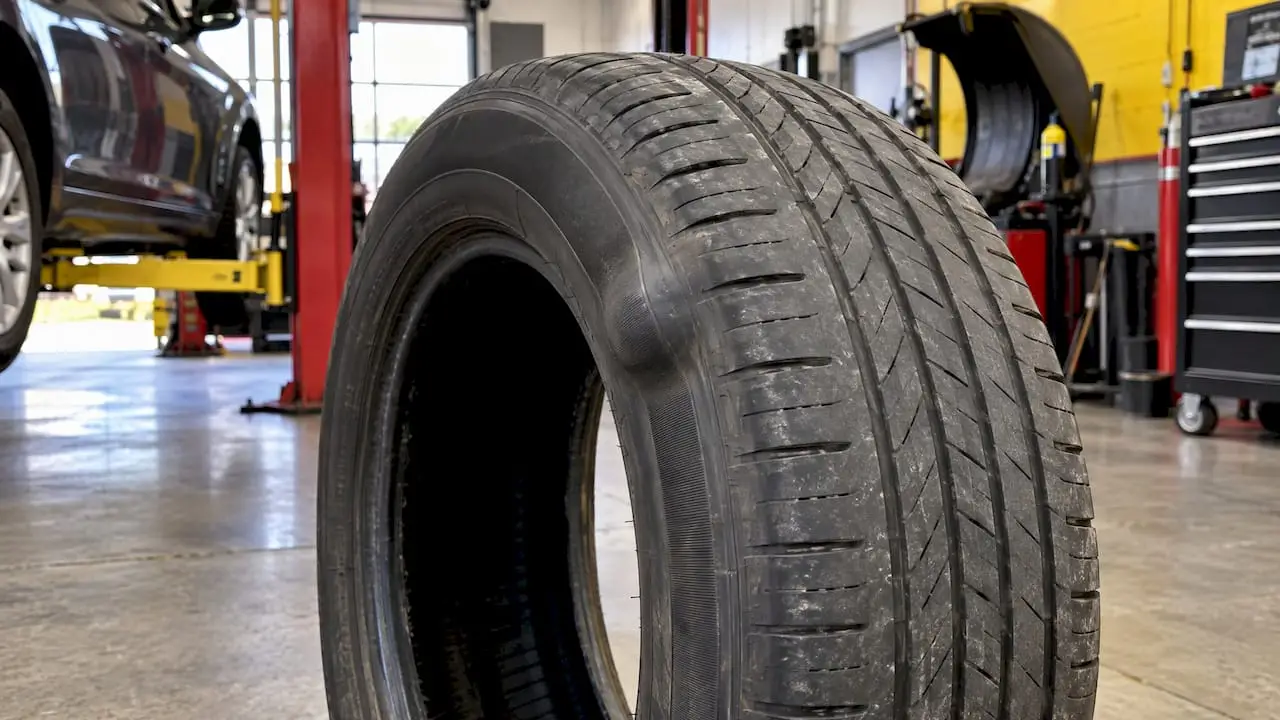
A bulge, a separated belt, flat-spotting from sitting, or a bent wheel from a curb strike can all create shake. Road force testing can reveal some of these, but a visual inspection of the tire and wheel comes first. Look for bubbles on the sidewall, uneven wear and cupping across the tread. If you see a bulge, do not wait: have the tire checked before you drive on the highway.
Driveline, brakes and other sources
A worn axle, a bent driveshaft or a failing U-joint creates speed-related vibration, and so do warped brake rotors. Which one you have depends on when you feel it: at certain speeds, under acceleration, or only while braking. Drivetrain vibration works much the same on any vehicle, and this explanation of diagnosing drivetrain vibration shows how technicians narrow down causes on all-wheel-drive systems.
Engine misfires can also feel like a shake, though that is usually more of a rough idle or stumble than a speed-related vibration. A check engine light with a shudder is worth a scan on its own.
How to describe your vibration to a technician
The clearer your description, the faster the diagnosis. Before you come in, note:
- The speed range. Does it start at 55 mph and fade at 75, or get worse the faster you go?
- Where you feel it. Steering wheel usually means front wheels. Seat or floor often means rear wheels.
- When it happens. Accelerating, coasting, braking or turning.
- When it started. After new tires, a pothole, a curb hit or a long stretch of parking.
- Other signs. Pulling, noise, uneven wear or a warning light.
We cannot tell you the cause from a description alone, and no honest shop can. What we can do is use that information to decide where to look first.
How we approach a vibration complaint
We start with an inspection, not a guess. Every vehicle gets a Digital Vehicle Inspection, where our ASE-certified technicians check the tires, wheels, suspension and steering and send you photos and updates in real time. You see what we see, and you decide what to approve.
If a vibration needs deeper testing, we tie that to our diagnostics process so you are not paying for parts that may not be the cause. Whether a particular wheel-balancing method fits your vehicle is something we will talk through with you when you call, since it depends on what the inspection shows.
Our perspective
Most people who come to us about a shake have already been told something: “it’s your tires,” “it’s your alignment,” “it’s your struts.” Sometimes they were right. Often it was one cause among several.
We think the fix starts with evidence. Photos of worn parts, a clear explanation of what each finding means and a price before work begins make the decision easy. That is why we built our service around the Digital Vehicle Inspection, and why we back repairs with a 2-year/24,000-mile warranty.
A vibration is also a safety signal. It can mean uneven tire wear, a loose component or a damaged wheel. Get it checked early, whether you are a parent sending a teen to school or a commuter heading to work, and you will usually spend less than if you wait for a part to fail.
Kwik Kar
Prevent vibration before it starts
A few habits cut your odds of chasing a shake:
- Rotate tires on the schedule in your owner’s manual so wear stays even.
- Check pressure monthly. Under-inflated tires wear on the edges and flex more.
- Get an alignment check after hitting a deep pothole or a curb, or when you replace suspension parts.
- Have balance checked whenever you replace a tire or repair a flat.
- Ask for an inspection at least once a year, and again before long trips. Our guide to summer road-trip suspension checks lists what to look at.
Get your vibration checked in Van Alstyne
If your steering wheel shakes, your new tires feel rough or you are not sure whether to approve an add-on service, bring the car in. Our team covers tires, wheels, alignment, suspension and steering under one roof, with after-hours drop-off and free local rides if your day is packed. A comfortable waiting area with WiFi and coffee is there if you would rather stay.

See our full list of auto repair services, or call us at (903) 712-5945 to set up an inspection. We will tell you what we find before anything gets done.
FAQ
What does road force balancing mean?
It means balancing a tire and wheel while a roller presses on the tire to simulate the weight of the vehicle. The machine measures both weight distribution and how much force the tire pushes back as it rolls. That lets a technician spot stiff spots, out-of-round wheels and poor tire mounting that a regular balance may not show.
How long does road force balancing take?
The machine’s diagnostic cycle is short. Hunter says about 70 seconds per assembly on its equipment. The full service takes longer if a tire has to be removed, match-mounted or replaced, so ask your shop for an estimate when you drop off the vehicle.
Do I need road force balancing on new tires?
Not always. If the car drives smoothly after a standard balance, you probably do not need it. If new tires vibrate at highway speeds, or you have large or low-profile wheels, it is a reasonable next step.
Why does my car still vibrate after balancing?
The cause may not be balance. Alignment, worn suspension or steering parts, a damaged tire, a bent wheel, brake rotors or driveline parts can all produce shaking. An inspection that checks all of these in one visit is the quickest way to find out.
Can you tell me what is wrong without seeing my car?
No. We can suggest what is likely based on when you feel the vibration, but we will not promise a diagnosis until a technician has inspected the vehicle.
Sources
- NHTSA-hosted service bulletin: Road wheel balancing with Hunter Road Force
- Tesla Model Y service manual: Tire Road Force and Balance procedure (2025)
- OEM technical information on the Hunter Road Force balancer
- Hunter Engineering: Road Force WalkAway wheel balancer
- Consumer Reports: Guide to car maintenance
- AAA: Potholes and related vehicle repairs
- Why Haldex vibration occurs