



A clunk, rattle or pop from the front corners of your car, especially over bumps, driveway dips or railroad crossings, is the classic sign of a worn sway bar link. The part is small and usually inexpensive to replace. But other suspension parts can make the same sound, so the noise alone does not prove the cause. If you drive around Van Alstyne, Anna, Howe, Melissa or Gunter and you’re hearing it, the safest move is to have someone look at the suspension instead of guessing.
TL;DR
- A worn sway bar link usually clunks, knocks or rattles over bumps and uneven pavement, and sometimes while turning at low speed.
- You can often still drive with one, but handling stability is reduced, so don’t put the repair off for months.
- Struts, ball joints, control arm bushings and even a loose exhaust hanger can sound similar. A proper inspection tells them apart.
- Independent shops in the US typically charge $80 to $250 for a pair of links, parts and labor included.
- We can inspect it, show you photos, and explain what we find before any work starts. Call (903) 712-5945.
Table of Contents
- What a sway bar link actually does
- The sounds and feelings that point to a bad link
- Why sway bar links wear out
- Is it a sway bar link, or something else?
- A quick, safe check you can do before you call
- How a shop should diagnose it
- Can you keep driving with a bad sway bar link?
- What happens if you ignore it
- What sway bar link replacement costs
- Our perspective: fix the noise, not just the part
- Get it checked at Kwik Kar of Van Alstyne
- Keeping links and suspension healthy longer
- FAQ
- Sources
What a sway bar link actually does
Your car has a sway bar, also called a stabilizer bar or anti-roll bar. It’s a metal bar that runs across the front (and on many vehicles the rear) of the suspension. Its job is to limit how much the body leans in a turn.
The sway bar link, or end link, is the short rod that connects each end of that bar to the suspension. Each link has a joint or rubber bushing at both ends so the suspension can move up and down without binding. Those joints and bushings are what wear out.
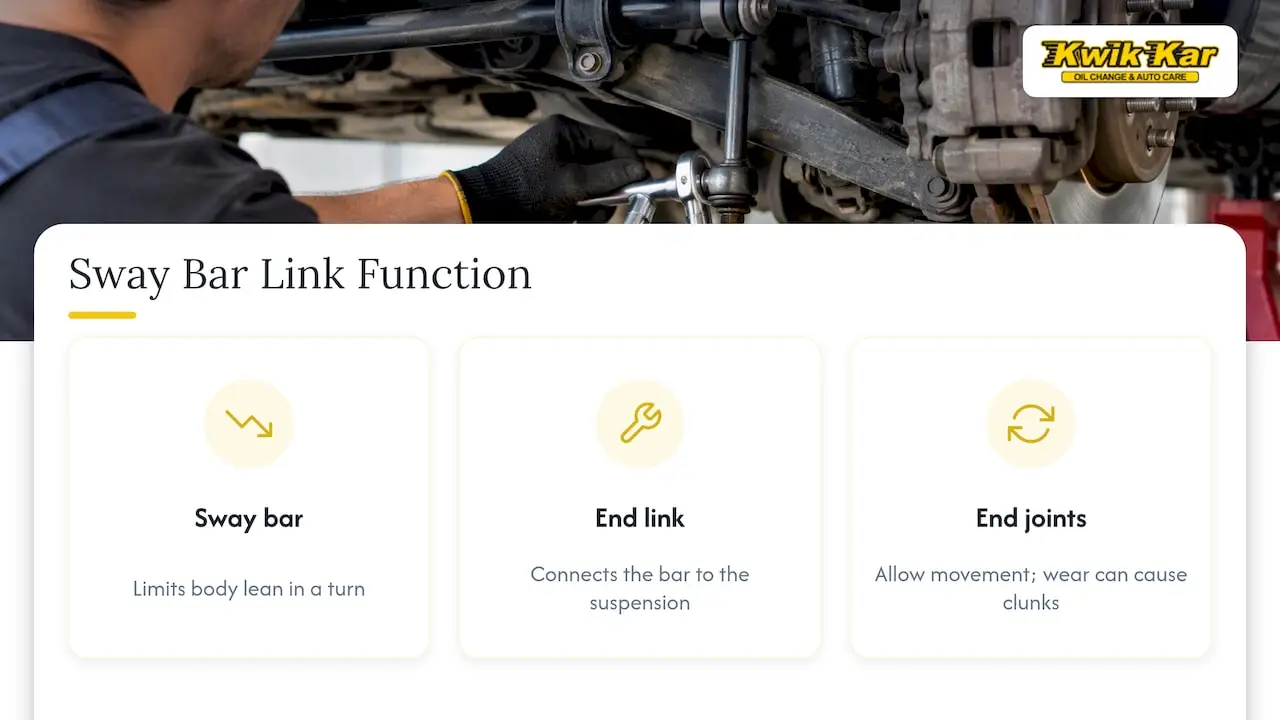
When they get loose, the bar and link knock against each other every time the suspension moves. That’s your clunk.
According to Delphi’s technical guidance, the links also help keep the tires planted on the road. When they wear, the car may feel less stable than it used to.
The sounds and feelings that point to a bad link
Not every noise is the same, and the details help. Here is what drivers and technicians commonly describe.
The clunk over bumps
This is the big one. A dull knock or metallic clunk when one wheel hits a bump, pothole or uneven patch. It often shows up first on one side. Suspension.com lists clunking, knocking and rattling, plus a metallic sound over bumps, among the most obvious signs.
The rattle at low speeds
A light rattle on rough roads or when pulling into a parking lot or driveway. Delphi notes that rattling at low speeds can go along with a damaged link, along with knocking on uneven roads.
Pops or creaks in turns
When you turn into a driveway or take an on-ramp, the bar twists and loads the links. A loose one may pop or creak right then.
More body lean than before
If the car leans more in curves or feels looser when you change lanes, that fits too. The same Suspension.com article lists excessive body roll as a symptom. Because that feeling creeps in slowly, many people don’t notice it until the link is fixed.
Sounds that are probably not the link
A squeal when you brake is a different system. If that’s what you hear, read our guide on brake squeaking and when to stop driving. A clunk only when you shift gears or accelerate from a stop leans toward other parts, such as mounts or bushings. Mevotech’s road test guidance points to worn control arm bushings for a clunk that happens when you accelerate from a stop.
Why sway bar links wear out
Links are built to last. Estimates commonly run four to five years or more, but that depends heavily on how and where you drive. A few things shorten that.
- Rough roads. Potholes, washboard gravel and broken pavement all work the joints harder. North Texas roads get plenty of freeze, thaw and heavy rain wear. Our article on how spring storms affect your alignment and suspension covers that in more detail.
- Hard cornering. More load on the bar means more load on the links.
- Heat, dirt and moisture. Once the protective boot or rubber bushing splits, grit gets in and the joint wears faster.
- Installation mistakes. Overtightening during a previous repair can stress the stud and cause early failure.
- Mileage. Sooner or later, joints simply loosen.
Is it a sway bar link, or something else?
This is where most of the frustration comes from. A clunk is a symptom, not a diagnosis. Technicians point out that struts, ball joints and even a loose exhaust component can imitate a sway bar link. If you replace the wrong part, the noise stays and you’ve paid twice.
Here is how the common suspects compare.
| Suspect | What it often sounds or feels like | Where it tends to show up |
|---|---|---|
| Sway bar link | Light clunk, knock or rattle over bumps; pop in tight turns | Front corners, often one side first |
| Sway bar bushing | Creak or groan over bumps, clunks when the bar shifts | Front or rear, center of the car |
| Strut or shock | Bouncy ride, knock over bigger bumps, fluid leaks | Any corner |
| Ball joint | Clunk plus loose or wandering steering | Front end |
| Control arm bushing | Clunk when accelerating or braking | Front or rear |
| Loose exhaust hanger | Rattle or thump from under the car, often at idle or over bumps | Underneath, along the exhaust |
If you also notice the ride feels bouncy, see our explanation of when shocks or struts need attention. Mileage and driving habits make a difference there.
A quick, safe check you can do before you call
You don’t need to crawl under the car. These steps just give us better information.
- Note when it happens. Bumps only? Turns only? Cold mornings? Over one specific dip in the road?
- Note which side. Passenger side, driver side or both.
- Try a slow bump test. In an empty parking lot at walking speed, roll over a speed bump or a dip with one wheel at a time. Don’t do anything that makes the car feel unsafe.
- Check for tire wear. Look at the tread across the tire. Wavy, uneven wear can mean the suspension isn’t keeping the tire in steady contact. Tire Advise explains that cupping or scalloping happens when a tire bounces instead of staying planted.
- Tell us what changed. New tires, a recent pothole hit, or a recent suspension repair all matter.
Please don’t jack the car up and put your hands under it without proper jack stands and know-how. That’s a job for a lift.
How a shop should diagnose it
A good inspection checks the part instead of assuming. One method is a dry park test: the vehicle sits on a drive-on rack, wheels straight, while a technician has someone turn the steering wheel back and forth and looks and feels for play in the linkage. MOOG’s technical bulletin describes isolating suspension noise this way, starting with where and when the noise happens.
A complete check also includes:
- A road test to reproduce the sound.
- Visual inspection of the link joints, boots and bushings for cracks, tears or play.
- A look at the sway bar bushings, struts, ball joints, tie rods and control arm bushings.
- A look at tire wear patterns.
At Kwik Kar of Van Alstyne we back this with a Digital Vehicle Inspection. You get real-time updates and photos of what the technician found, so you see the worn part for yourself before you approve anything. We don’t promise a diagnosis over the phone. We have to inspect your vehicle first.
Can you keep driving with a bad sway bar link?
Often, yes, for a short time. The car won’t necessarily stop working. But it isn’t a good thing to live with. Delphi explains that handling stability drops, and continued use can eventually let the bar separate from the suspension. CarParts.com says you can drive with a broken end link, but it can make the vehicle harder to control.
That matters most in the moments you need the car to respond: a sudden lane change on Highway 75, a swerve around debris, or a wet on-ramp. If a teenager drives the car, or you haul kids to practice, a car that leans and wanders more than it should isn’t one to postpone.
See us right away, not at the next convenient time, if:
- The clunk gets louder quickly or you hear a bang.
- The steering feels loose, pulls, or wanders.
- You hear scraping, or something visibly hangs under the car.
- The noise comes with a brake, steering or warning light issue.
Those can point to something beyond a link.
What happens if you ignore it
The link itself is a modest repair. The risk is what waiting can do around it. AAA’s guidance on noises you should never ignore is a good reminder that small noises often come before larger repairs. Left alone, a worn link can add strain to other suspension parts and contribute to uneven tire wear, which can bring an alignment problem or earlier tire replacement.
The same logic applies to anything you rely on for work. If you manage work vehicles, this overview of how warranties affect fleet maintenance is worth a read. It’s written for Australian fleets, so treat the specifics as local to that market, but the point about catching small problems before they become costly ones carries over.
If uneven wear has already started, a wheel alignment after the repair helps protect new tires.
What sway bar link replacement costs
We don’t publish fixed prices for this repair, because the right quote depends on your vehicle and on what the inspection finds. Here is what the wider market looks like, so you know what’s reasonable.
- Independent US shops typically charge $80 to $250 for a pair, parts and labor.
- Parts alone usually run $20 to $110 per link, according to the same source.
- Labor is commonly 30 to 60 minutes per side.
- Dealers often land at the higher end.
Three things move the number: vehicle type (European models often use pricier parts, and we handle European auto repair too), whether the links are bolted on or rusted in place, and whether the inspection turns up worn bushings, struts or other parts at the same time.
It often makes sense to replace links in pairs, since both have seen the same miles and roads. We’ll tell you what we see in the photos and let you decide.
Our perspective: fix the noise, not just the part
We see this often. A driver comes in after replacing links elsewhere or at home and the noise is still there. Sometimes the link wasn’t the problem. Sometimes the parts were fine but a bushing was worn. And sometimes the link was loose because something nearby had worn first.
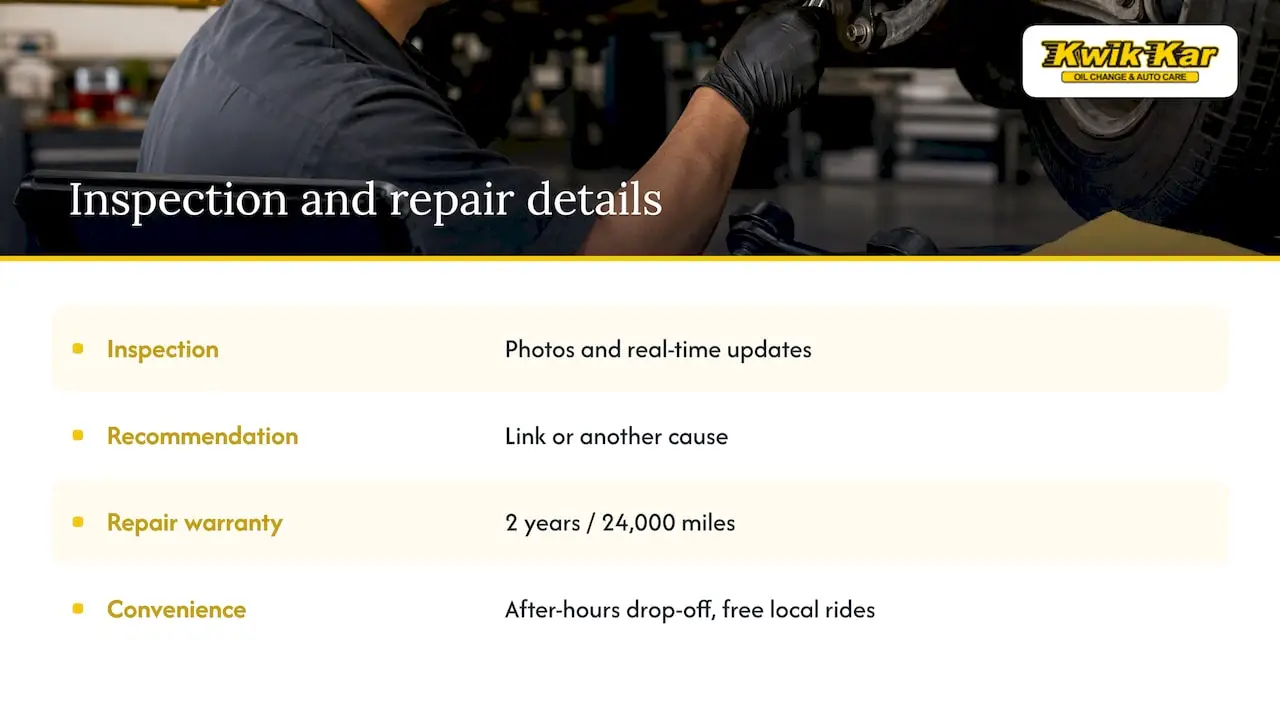
So we start with the inspection, not the parts list. We think you should see what we see. That’s why the Digital Vehicle Inspection includes photos and real-time updates: you can look at a cracked boot or a loose joint and decide with the facts in front of you. There are no surprise costs. If the recommendation is a sway bar link, we’ll say so. If it’s something else, we’ll say that too.
Our ASE-certified technicians do the work, and repairs carry a 2-year/24,000-mile warranty. For busy parents and professionals, we also offer after-hours drop-off and free local rides, so a suspension noise doesn’t have to wreck your schedule.
— Kwik Kar
Get it checked at Kwik Kar of Van Alstyne
Our steering and suspension service covers sway bar links, bushings, struts, ball joints and the rest of the front end. You can also see how we document findings on our suspension repair page, and if you want a deeper check for another noise or light, our diagnostics service can help.
Wait in our comfortable lobby with WiFi and coffee, drop the car off after hours, or take a free local ride. Call us at (903) 712-5945 or visit kwikkarvanalstyne.com.
Keeping links and suspension healthy longer
You can’t stop every pothole, but a few habits help.
- Slow down for rough pavement, railroad crossings and speed bumps.
- Have suspension and tire wear checked at routine service visits, such as oil changes. Our fall fluids and filters guide is a good time to ask.
- Don’t let a small clunk sit for months. Early repairs are usually simpler.
- Before a long drive, read our tips on getting your suspension ready for road trips.
- Make sure any shop tightens new links to the vehicle’s specification. Overtightening can damage the stud.
FAQ
Can I drive with a bad sway bar link?
Usually for a short time, yes, but it isn’t a good idea to wait. The car will handle less steadily, and a badly damaged link can let the bar come loose from the suspension. If the steering feels loose or the noise changes suddenly, stop driving and have it inspected.
How long do sway bar links last?
Often around four to five years or more, depending on road conditions, how you drive and the vehicle, according to one industry source. Rough roads and heavy loads shorten that. A worn link can happen sooner than expected.
How much does sway bar link replacement cost?
At independent US shops, a pair typically runs $80 to $250 with parts and labor. Your exact cost depends on the vehicle and whether other suspension parts are worn. We’ll give you a clear quote after inspecting your vehicle.
Can you overtighten a sway bar link?
Yes. Overtightening puts extra stress on the link stud and can lead to early breakage. That’s one reason a correct torque matters during installation.
Sources
- Driving a car with worn steering and suspension parts, Delphi
- Do Bad Sway Bar Links Wreck Your Tires?, Tire Advise
- Sway Bar Links and Bushings: Symptoms, Cost, Replacement, Suspension.com
- How to Isolate Suspension Noises, MOOG
- Accurate Diagnoses: How to Check for Worn or Loose Chassis Parts, Mevotech
- Vehicle Noises You Should Never Ignore, AAA Club Alliance
- Sway bar link overview, WHYIENJOY