




A differential fluid change drains the old gear oil from your front or rear differential and refills it with fresh fluid. Most vehicles need it somewhere between every 30,000 and 50,000 miles, and sooner if you tow, haul or drive in heavy heat. Your owner’s manual has the final word on your interval, and a quick look at your vehicle tells us whether it is due. If you drive a truck, SUV, all-wheel-drive crossover or rear-wheel-drive car around Van Alstyne, Anna, Howe, Melissa or Gunter, this is one of the easiest services to forget and one of the cheapest ways to avoid a big repair bill.
TL;DR
- Differential fluid lubricates and cools the gears that let your wheels turn at different speeds. It is not the same as engine oil or transmission fluid.
- A common range is every 30,000 to 50,000 miles, but your owner’s manual sets the real number for your vehicle.
- Towing, hauling, off-road use and Texas summer heat all shorten the interval.
- Whining, howling, clunking or vibration from the axle area are reasons to have it inspected soon.
- Changing the fluid on time costs a small fraction of what a worn differential costs to replace.
Table of Contents
- What differential fluid does
- How often to change it
- Signs your differential fluid needs attention
- What happens if you skip it
- What a differential fluid change involves
- What differential service costs
- Our perspective: why we inspect before we recommend
- Get it done at Kwik Kar of Van Alstyne
- How to keep your drivetrain healthy
- FAQ
- Sources
What differential fluid does
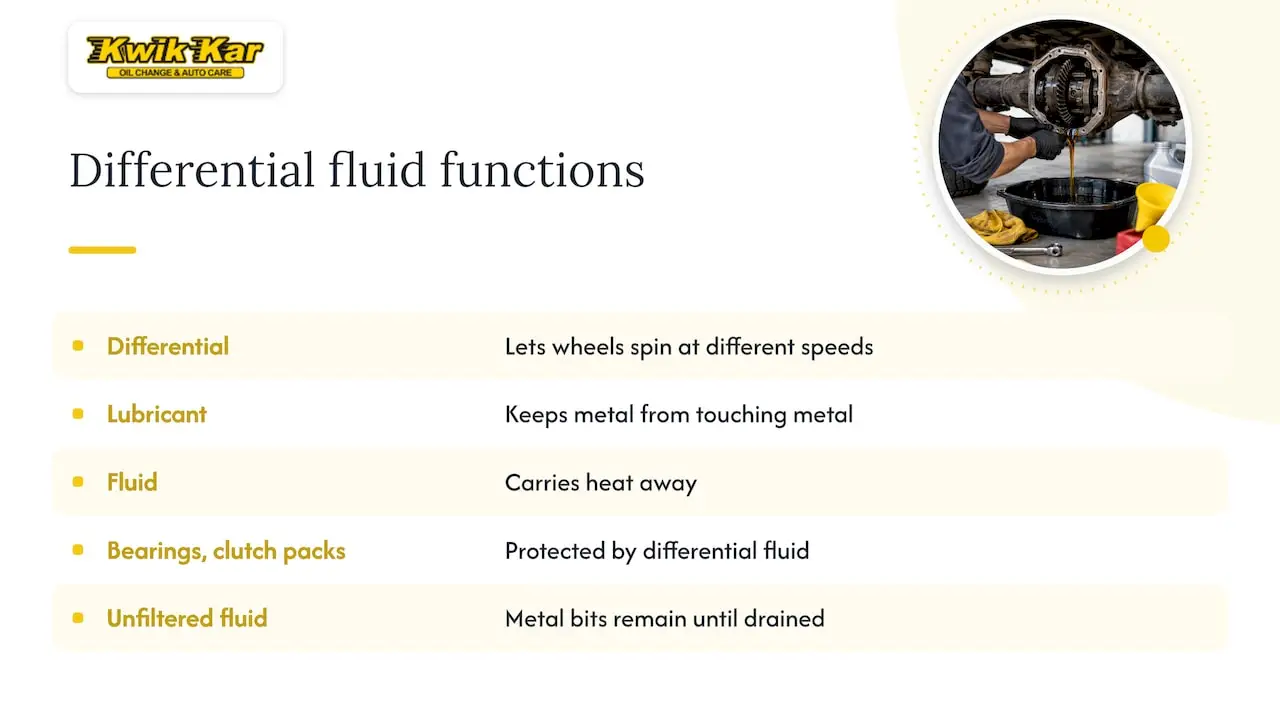
Every time you turn a corner, your outside wheel travels farther than your inside wheel. The differential is the gearset that lets them spin at different speeds. Rear-wheel-drive vehicles have one at the back. Four-wheel-drive and many all-wheel-drive vehicles have one at each end, and some have a center unit as well. Front-wheel-drive cars usually build the differential into the transaxle, so it shares fluid with the transmission.
Those gears are under heavy load. They rely on a thin layer of lubricant to keep metal from touching metal. The fluid also carries heat away and, according to UTI’s explanation of differential fluid, protects bearings and clutch packs inside the unit.
The fluid is a thick gear oil, often with a strong sulfur smell when fresh or aged. It is usually not filtered the way engine oil is, so the tiny bits of metal and the broken-down additives stay in there until someone drains it out.
How often to change it
There is no single number that fits every vehicle. Here is what the published guidance says:
- A common shop range is 30,000 to 50,000 miles, with a reminder to check the owner’s manual first.
- Many manufacturers allow 50,000 to 100,000 miles for normal driving with modern synthetic gear oil.
- Severe use, such as frequent towing, off-roading or extreme heat, may call for 30,000 to 50,000 miles, or about every two to three years.
Manufacturers are not always the same on this. Toyota’s 2009 4Runner maintenance guide, for example, lists front and rear differential oil for inspection at 15,000 miles, and calls for replacing the rear oil, and the front oil on 4WD models, when towing. Some all-wheel-drive schedules, such as the 2021 Toyota ES 250 AWD, list the rear differential oil for replacement or inspection too. Those are examples of how different the schedules can look, not a rule for your vehicle.
Why the “normal” and “severe” labels matter in North Texas
Most manuals have two schedules. The “severe” one often fits more drivers than they expect. Pulling a boat to Lake Texoma, hauling a loaded trailer, carrying heavy cargo or sitting in summer traffic all push differential temperatures up. Heat breaks gear oil down faster, and towing in warm weather is one of the situations where more frequent changes make sense. If that sounds like your week, read our piece on what heat and heavy loads do to your transmission. The same stress hits the drivetrain behind it.
Front and rear can differ
On a 4WD or AWD vehicle, the front and rear differentials are separate housings with their own fluid. They often hold different amounts, and some call for different fluid types. Limited-slip units, for instance, need gear oil formulated with friction modifier (or a separate additive) so the clutch packs do not chatter. Using the wrong fluid is a common mistake, which is why we match the fluid to your manufacturer’s specification rather than topping off with whatever is on the shelf.
Signs your differential fluid needs attention
Differentials are tucked under the vehicle, so you rarely see a problem. You hear and feel it instead. Common signs include:
- Whining or howling that changes with speed, often more noticeable when accelerating or letting off the gas.
- Grinding or clunking from the rear or front axle area, which can point to more advanced wear.
- Vibration or shuddering when accelerating or turning, especially with limited-slip differentials.
- Fluid spots under the axle, or a gear-oil smell after a drive.
- Roughness on turns when a seal or bearing is already failing.
None of these proves the fluid is the problem. A worn bearing, tire noise or a driveshaft issue can sound similar, and we do not guess about a diagnosis before we have looked at the vehicle. What we can say is that these symptoms are worth a prompt inspection. If you are comparing drivetrain warning signs, the way low fluid shows up in a transmission is worth knowing too, and this guide to low transmission fluid symptoms covers it well.
One caution: if the axle is still noisy after the fluid level is restored, assume some wear may already have happened. A fluid change helps protect what is left. It does not repair worn gears.
What happens if you skip it
Old or low fluid increases friction and heat, wears down gears and other parts, and can eventually lead to a differential failure and a large repair bill. Popular Mechanics notes that this is among the most overlooked maintenance jobs on non-front-wheel-drive trucks, SUVs and cars, and that metal-to-metal contact can weaken gears.
The pattern is simple. The fluid wears out quietly, nothing seems wrong, and then a hum starts. By then the cheap fix is gone.
What a differential fluid change involves
This is a drain-and-refill service, not a high-pressure flush. The steps look like this:
- The vehicle is lifted and the differential is located.
- The fill plug is checked first, so the technician knows new fluid can go back in.
- The drain plug comes out and the old fluid drains. On units without a drain plug, the cover may need to come off.
- The magnetic plug is checked for debris. A fine paste of metal on the magnet is normal. Chunks or shavings are not.
- The plug is reinstalled and new fluid goes in through the fill hole until it reaches the opening.
- The area is cleaned and checked for leaks.
On a limited-slip unit, we confirm whether the vehicle needs a friction modifier. On a 4WD vehicle, we look at both ends and at the transfer case if the schedule calls for it.
Can you do it yourself?
Some people do, and the job is straightforward on many vehicles. It still takes jack stands, the right torque on the plugs, the correct fluid and a way to pump thick gear oil into a hard-to-reach hole. Getting the fluid type or level wrong causes the damage you were trying to avoid. For most busy drivers, having a shop do it takes less time than the trip to buy supplies.
What differential service costs
Published figures put a professional differential fluid change at roughly $80 to $180 in the United States, and a complete differential replacement at $1,300 to $3,700. Those are national ranges, not our prices. We do not publish a flat price for this service, because the cost depends on your vehicle.
What moves the price:
- How many differentials you have. A 4WD truck with front and rear units is two services.
- Fluid type and capacity. Synthetic, limited-slip and specialty fluids cost more, and some units hold more than others.
- Access. Some covers need to be removed and resealed, which adds labor.
- What we find. Leaking seals, worn bearings or metal debris can add repairs.
The math is easy to see in the ranges above. Even at the high end, the service costs a small share of a replacement. We give you the number before any work starts.
Our perspective: why we inspect before we recommend
We see the same thing again and again with drivetrain fluids. Drivers know the oil change schedule by heart, but the differential, transfer case and transmission fluids slip by. Nobody wants a surprise, and a surprise is exactly what a neglected differential delivers.
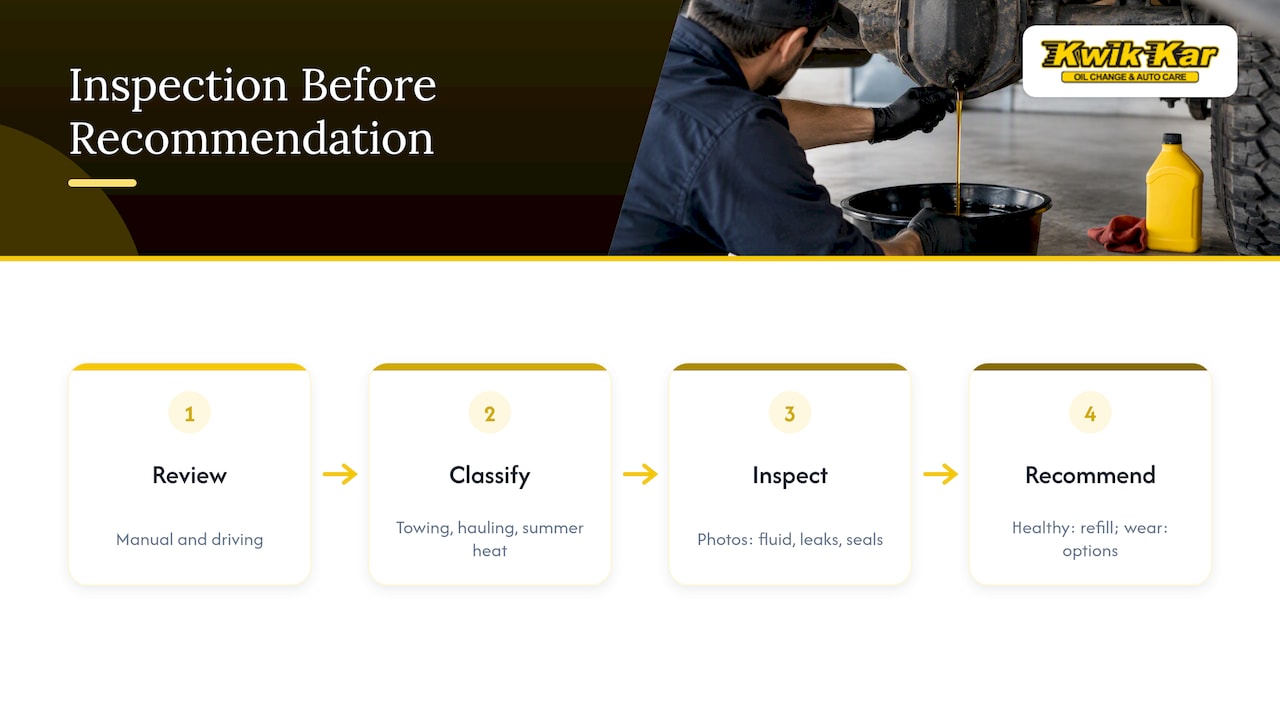
So we start with your manual and the way you actually drive. If you tow, haul or commute long distances in summer heat, we treat your schedule as severe service. Our technicians are ASE-certified, and every vehicle gets a Digital Vehicle Inspection with photos and real-time updates, so you can see what we see: fluid condition, leaks, seal condition. You decide what happens next. We never promise a diagnosis from a phone call, because a noise at the back of a truck can come from several places.
If the fluid is due and the unit is healthy, a drain-and-refill is usually all you need. If something is wearing, we say so, show you why and explain the options.
— Kwik Kar
Get it done at Kwik Kar of Van Alstyne
Differential service fits naturally into a visit for other fluid work. We can check the drivetrain during an oil change, a factory scheduled maintenance visit, or when you bring a vehicle in for a noise we need to track down through our diagnostics service. Our work comes with a 2-year/24,000-mile warranty on repairs, and we offer after-hours drop-off and free local rides if you cannot wait around. If you can, the waiting area has WiFi and coffee.

Bring your vehicle to our shop in Van Alstyne, or call (903) 712-5945 to set up an appointment. You can see everything we do on our auto repair page.
How to keep your drivetrain healthy
A few habits go a long way:
- Read the manual’s maintenance schedule and look for the words “differential,” “rear axle,” “transfer case” and “severe service.” Our guide on starting with your manual walks through it.
- Count your towing and hauling. If it is more than occasional, use the severe schedule.
- Service fluids as a group. Our article on essential fluids and filters to change for fall is a good checklist.
- Listen after service. A new hum a few hundred miles after any drivetrain work is worth a call.
- Do not ignore leaks. A damp axle seal now can become a dry differential on the highway.
FAQ
How often should I change differential fluid?
A common range is every 30,000 to 50,000 miles, and some manufacturers allow longer intervals for normal driving. Your owner’s manual gives the right number for your vehicle. If you tow, haul or drive off-road, plan for the shorter end.
Is differential fluid the same as transmission fluid?
No. Differential fluid is a heavier gear oil made for the high-pressure contact between gears, and it lives in its own housing. Front-wheel-drive cars often share fluid between the transmission and the differential in one unit, so the service is different.
Can I drive with a bad differential?
It depends on the problem, but noise, grinding or leaking are signs to stop putting it off. Driving on low or worn-out fluid can turn a simple service into a replacement. Have the vehicle inspected as soon as you can.
How long does a differential fluid change take?
The drain-and-refill itself is usually a short job on a vehicle that is already on a lift. The time can grow if the cover needs to come off or if we find a leak. When you call, we can tell you what to expect for your vehicle.
Do front and rear differentials use the same fluid?
Not always. Fluid type, amount and interval can differ between the front and rear, especially on 4WD vehicles and limited-slip units. We follow the manufacturer’s specification for each one.
Sources
- What Is Differential Fluid? | UTI
- How to Change Differential Fluid | Castrol USA
- 2009 4Runner Scheduled Maintenance Guide | Toyota
- 2021 Toyota ES 350 / ES 250 AWD Scheduled Maintenance Guide
- How Often Should I Change Differential Fluid? | AMSOIL Blog
- Gear Oil for Differentials | Red Line Oil
- Signs Your Differential Fluid Needs To Be Changed | JEGS
- Low Differential Fluid? Diagnose It Before Damage | VehicleRuns
- What is Differential Fluid? | AutoZone
- How to Maintain Your Car’s Differential | Popular Mechanics
- How Much Does Differential Repair Cost in 2026? | Empire Auto Protect
- Low Transmission Fluid Symptoms | FrenzyCars