

A rhythmic click or pop when you turn, loudest at low speed and full steering lock, is the classic sound of a worn CV axle. A clunk when you accelerate or shift into gear can point to the inner joint, and grease sprayed inside the wheel usually means a torn boot. The noise is a warning, not a verdict: a wheel bearing, a steering part or a tire can sound similar, so the answer comes from inspecting the vehicle. If you’re in Van Alstyne, Anna, Howe, Melissa or Gunter, we can put it on the lift, show you photos of what we find and give you the price before any work starts.
TL;DR
- A clicking or popping noise that repeats while you turn, especially in a parking lot, most often points to a worn outer CV joint.
- A clunk when you get on or off the gas, or a shudder under acceleration, can point to the inner joint.
- Grease flung around the inside of the wheel or on the suspension means the protective boot has split. Catching it early can save the joint.
- A mild, steady click allows only short, gentle trips until it’s checked. Louder clicking, vibration or a hard clunk means stop driving and call for a tow.
- A hum or growl that rises with speed is more often a wheel bearing, which is why the noise should be inspected before parts are replaced.
Table of Contents
- What a CV axle does, in plain terms
- What bad CV axle noise sounds like
- Is it the CV axle or a wheel bearing?
- Why CV axles go bad
- Is it safe to drive with a clicking CV joint?
- What the repair involves
- What does CV axle repair cost?
- How we diagnose it at Kwik Kar of Van Alstyne
- Keeping CV axles healthy
- Hearing a click? Bring it to us
- FAQ
- Sources
What a CV axle does, in plain terms
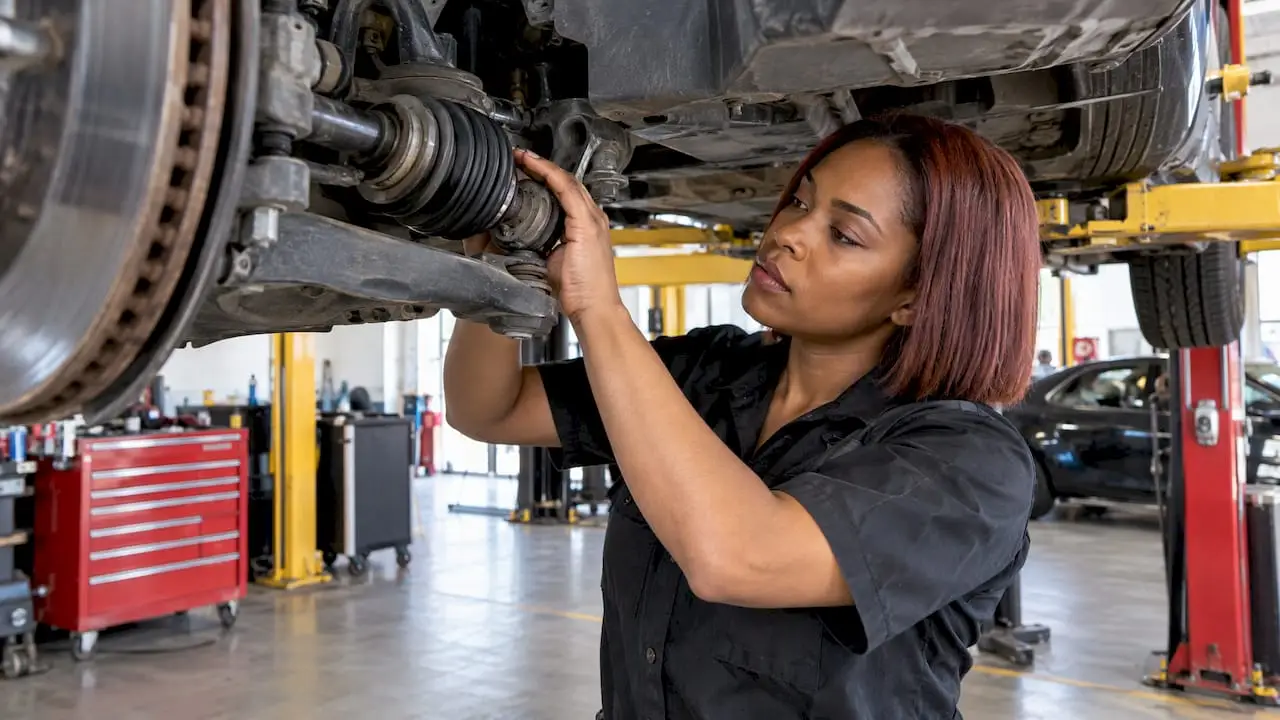
If your car is front-wheel drive or all-wheel drive, the engine’s power reaches the front wheels through two shafts called CV axles. (CV stands for constant velocity.) Each axle has a joint at both ends that lets the wheel turn left and right and move up and down over bumps while still receiving power.
The outer joint, near the wheel, bends the most. The inner joint, near the transmission, slides in and out as the suspension moves. Each joint is packed with special grease and sealed by a rubber boot that looks like a small black accordion.
That boot is the weak point. Engineers who studied boot performance describe a torn boot as the most common cause of CV joint failure: grease escapes, dirt and water get in, and the joint wears much faster. The first thing most drivers notice is clicking when turning.
What bad CV axle noise sounds like
The sound changes depending on which joint is wearing and what you’re doing with the wheel and pedal. Here is how to match what you hear to what’s likely going on.
Clicking or popping when you turn
This is the one most people search for. A clicking or popping noise during turns usually indicates a worn or damaged outer CV joint. It speeds up as the wheels speed up, so it sounds like a steady tick-tick-tick. It’s typically clearest in tight, low-speed turns such as pulling into a parking space or backing out of a driveway.
A quick note on direction: some mechanics treat the side where the click is loudest as a clue, but it’s only a clue. On the loaded side of a turn the joint carries more force, so the noise can seem to come from the opposite side of the car. Pinning it down takes a look at the actual axles.
Clunking when you accelerate, decelerate or shift
A single clunk when you press the gas, lift off it, or shift from park into drive or reverse is more often tied to the inner joint, where extra slack has developed. You may also feel a shudder as the car pulls away. That feels different from the outer joint’s click, and it’s worth mentioning when you call us.
Vibration that grows with speed
A worn, bent or binding axle can cause vibration that gets worse the faster you go. Vibration has many other causes, including tire balance and worn suspension parts, so don’t assume it’s the axle. Our page on road force balancing explains one of the common tire-related causes.
Grease where it shouldn’t be
Look at the inside face of your front wheels and the area behind them. Dark, thick grease spattered there means a boot has split and the joint is throwing grease as it spins. You may hear nothing yet. That’s the best time to be seen, because a joint that hasn’t started clicking is far more likely to be saved.

Is it the CV axle or a wheel bearing?
These two get mistaken for each other all the time, and the repair bill is very different. The simplest way to separate them is to ask what changes the noise.
| What you notice | More likely a CV axle | More likely a wheel bearing |
|---|---|---|
| Type of sound | Click, pop or clunk | Hum, growl or drone |
| Changes with steering angle | Yes, worse in tight turns | Can change as weight shifts in a long curve |
| Changes with throttle | Often, especially inner joint clunk | Usually not |
| Changes with road speed | Click speeds up, but it appears only in turns | Rises steadily with speed, even driving straight |
| Visible clue | Grease around the wheel from a torn boot | Often none |
A constant growl or hum while driving straight ahead most likely points to a worn or dry wheel bearing. If that sounds like your car, read our guide to wheel bearing noise.
Two more sources of confusion are worth knowing about. Worn inner tie rod ends in the steering can also click or pop, and a clunk when power is applied can come from the differential. A sway bar link can clunk over bumps and be mistaken for a joint. All of these live in the same area of the car, so guessing is expensive.
A simple observation you can make safely
In an empty parking lot, at walking speed, turn the wheel fully one way and drive a slow circle, then repeat the other way. Notice whether the sound appears only while turning and which direction makes it louder. Write it down. That’s useful information for us. It isn’t a diagnosis, and you don’t need to crawl under the car or take anything apart.
Why CV axles go bad
Most failures follow the same path:
- The boot cracks or tears. Age, heat, cold, road debris and constant flexing take their toll. Researchers found that cracks tend to start in the creases between the boot’s segments.
- Grease escapes. It’s thrown outward as the axle spins.
- Grit and water enter. The polished surfaces inside the joint start to wear.
- The clicking starts. The steel balls are no longer riding smoothly in their grooves.
- The joint fails. If it’s ignored, it can eventually break apart and the car loses power to that wheel.
Other causes include a hard impact from a pothole or curb, and age and mileage on the original axle. Either way, the sound usually arrives after the damage has begun, which is why a boot check is worth more than waiting for noise.
Is it safe to drive with a clicking CV joint?
It depends on how bad it is, and the honest answer is that you can’t tell from the driver’s seat. Here’s how we’d think about it if it were our own family car.
Short, gentle trips only: the click is faint, hasn’t changed in days, and there’s no vibration, no clunk and no heavy grease loss. Get it inspected soon and avoid hard acceleration in turns.
Stop driving and arrange a tow: the clicking is getting louder or faster to develop, you feel a shudder during ordinary acceleration, you hear a hard clunk, or the car feels like it isn’t engaging the drive properly. A joint that fails completely can leave you without power to the wheel, often at the worst moment, such as on a busy road with kids in the back seat.
Load matters, too. Hard acceleration while turning and full steering lock put the most stress on a worn joint, which is why a bad axle tends to give up when you’re pulling out into traffic. The same principle applies to other worn driveline joints, as covered in this overview of U-joint failure symptoms.
AAA notes that a popping sound when turning in a front- or all-wheel-drive vehicle could mean the front CV joints need replacement. It isn’t an immediate emergency, but driving on worn joints puts extra stress on other steering parts and can turn a modest repair into a bigger one.
If you’re not sure which side of that line you’re on, don’t gamble. Call us at (903) 712-5945 and describe what you’re hearing. If the car can’t be driven, you’re better off arranging a tow than risking a breakdown.

What the repair involves
There are two paths, and which one applies depends on the condition of the joint when it’s inspected.
- Boot replacement. If the boot has torn but the joint is clean and still smooth, replacing the boot and regreasing may be an option. Once clicking has started, the joint is generally already worn.
- Axle replacement. This is the most common fix for a clicking axle. The old axle comes out and a new or remanufactured axle goes in. Afterward, the repair should be verified with a road test, because the click that brought you in should be gone.
The axle is also tied into the steering and suspension, so a thorough technician looks at the surrounding components while the car is up. Our steering and suspension repair page covers the parts that most often share symptoms with a bad axle.
What does CV axle repair cost?
Prices vary by vehicle, parts and labor rates, so treat any number you read online as a ballpark. One 2026 cost guide puts a single front CV axle at an independent shop at roughly $155 to $340, with both front axles around $310 to $685. The same guide lists a boot-only kit at about $5 to $23 in parts when the joint is still good, with labor on top.
What moves the number:
- Vehicle. Some cars, especially all-wheel-drive and European models, take more time or costlier parts.
- Parts quality. An axle is a wear item, and quality varies.
- Labor time. Rusty or seized fasteners slow the job.
- One axle or both. Replacing in pairs is sometimes sensible on high-mileage cars, but that’s a call made once you’ve seen the condition of each.
- The right diagnosis. Replacing an axle when the real culprit was a wheel bearing or tire is the most expensive mistake.
We don’t publish prices for this repair, so we won’t quote one here. What we can promise is that you’ll see the recommendation and cost before work begins.
How we diagnose it at Kwik Kar of Van Alstyne
When a car comes in with a clicking or clunking complaint, we start with a digital vehicle inspection. Our ASE-certified technicians check the boots, joints and related parts, and you get photos and real-time updates, so you can see the torn boot or the grease on the wheel for yourself instead of taking our word for it. If the noise needs more investigation, our diagnostics service is built for exactly that.
Here’s what that means for busy people:
- After-hours drop-off if you can’t get to us during the day.
- Free local rides so you’re not stranded while we work.
- A comfortable waiting area with WiFi and coffee if you’d rather stay.
- A 2-year/24,000-mile warranty on repairs.
For parents, the point is simple: a car that makes a new noise before a school run or a road trip deserves a look, and you shouldn’t have to guess about it.
What we tell drivers about CV axle noise
Most of the time, the customer who comes in about a click has already done the hard part: they noticed. We’d rather see a car with a faint click and a torn boot than the same car after it has been towed in.
Our approach is to inspect first and recommend second. A noise isn’t a diagnosis, and we don’t want you paying for an axle that turns out to be a wheel bearing, or the other way around. That’s why we use digital vehicle inspections with photos: you see what we see, and decisions are yours.
When an axle does need replacing, our technicians are ASE-certified and the repair carries a 2-year/24,000-mile warranty. And if your day is packed, after-hours drop-off and a free local ride mean the repair doesn’t have to wreck your schedule.
Kwik Kar
Keeping CV axles healthy
You can’t stop a boot from aging, but you can catch problems early.
- Have the boots looked at with every oil change. A service guide for CV joints suggests checking about every 3,000 miles, though your owner’s manual interval governs oil changes. Our oil change service is a convenient time to have the boots looked at.
- Act on grease sooner than noise. A split boot caught early costs far less than a worn joint.
- Watch hard turns on a cold start. Lots of full-lock turns, especially with a heavy load, are tough on aging joints.
- Mention new noises when you book. Describe when it happens: turning, accelerating, or at a steady speed. That detail speeds up diagnosis.
Our auto repair page lists the services we offer for the rest of your drivetrain, brakes and suspension.
Hearing a click? Bring it to us
If your car clicks when you turn, clunks when you accelerate or has grease on the inside of a wheel, we’d like to take a look. We serve drivers in Van Alstyne, Anna, Howe, Melissa, Gunter and nearby communities. Our digital vehicle inspection shows you what’s going on, our technicians are ASE-certified, and repairs come with a 2-year/24,000-mile warranty. See the full list on our services page or head to our home page.
Call us at (903) 712-5945 to book an appointment, or drop your car off after hours and we’ll take it from there.
FAQ
What does a bad CV axle sound like?
Most often it’s a rhythmic clicking or popping that appears when you turn, loudest in tight, slow turns. A clunk when you accelerate or shift into gear can point to the inner joint. A humming or growling noise that rises with speed is more typical of a wheel bearing.
Can I drive with a clicking CV joint?
A faint click that isn’t changing may allow short, gentle trips until you can be seen. If the clicking gets louder, the car vibrates, you hear a clunk or the car doesn’t seem to engage drive, stop driving and arrange a tow, since a failed joint can cut power to the wheel.
Is the noise a CV axle or a wheel bearing?
CV noise depends on turning and throttle: it clicks in turns and may clunk when you get on or off the gas. Wheel bearing noise tends to be a hum or growl that rises with speed, even on a straight road. Because other steering and driveline parts can mimic both, a hands-on inspection is the reliable way to know.
How much does it cost to fix a CV axle?
A 2026 cost guide lists about $155 to $340 for one front axle at an independent shop, but the actual price depends on your vehicle, the parts and the labor involved. Call us at (903) 712-5945 and we’ll go over the specifics for your car.
Can a torn CV boot be fixed without replacing the axle?
Sometimes. If the boot has split but the joint is still clean and smooth, replacing the boot may be possible. Once the joint has started clicking, it has typically worn too far for a boot alone to solve it. An inspection tells us which case you have.
Sources
- CV joint tech: A primer on constant velocity drive joints and diagnostic tips, Vehicle Service Pros
- Analyzing elastomeric CV boot performance, Rubber & Plastics News
- Vehicle Noises You Should Never Ignore, AAA Club Alliance
- CV Axle Replacement Cost (2026), CarWhere