


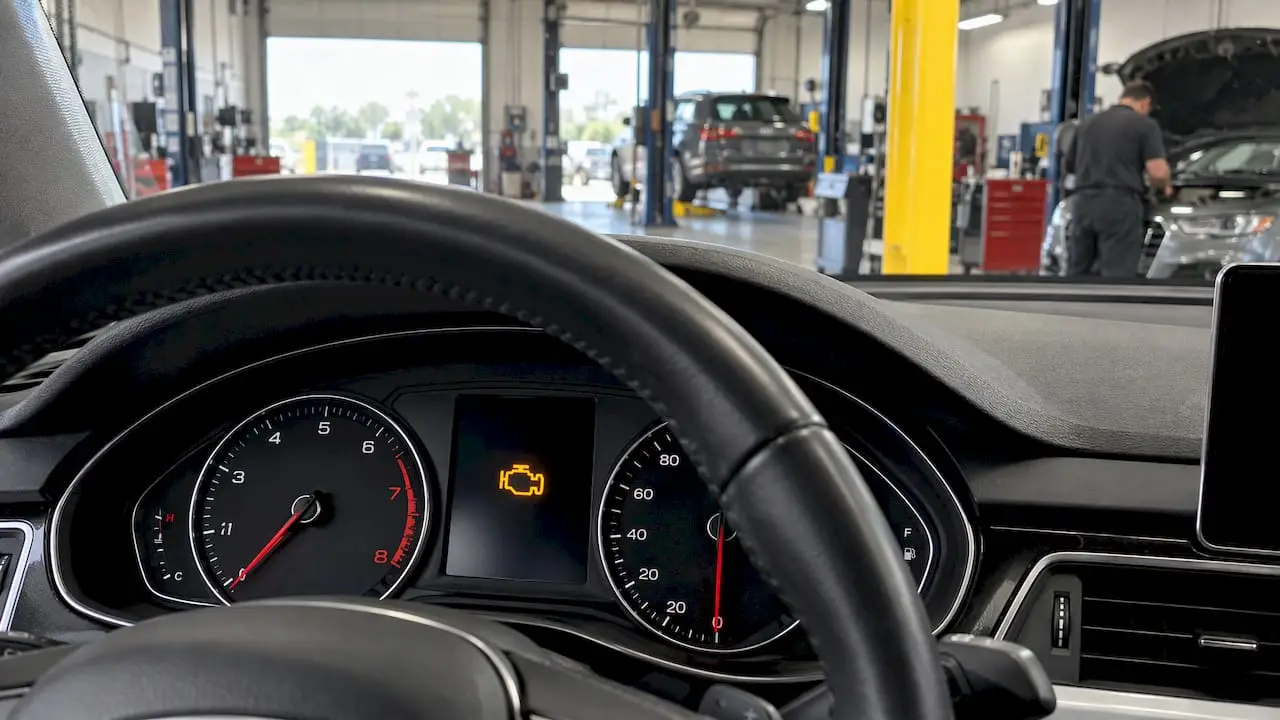
When the check engine light comes on in your Audi, the car’s onboard computer has stored a fault in the engine or emissions system. A steady light means you should get it scanned soon. A flashing light, or a light with rough running, loss of power or strange noises, means you should slow down, pull over safely and stop driving. The light does not tell you what failed, so the next step is reading the stored code and testing the system behind it. At Kwik Kar of Van Alstyne, our diagnostics service is built for exactly that, and we can only name the cause after we inspect your vehicle.
TL;DR
- A steady Audi check engine light means a fault is stored. Drive gently and get it scanned soon. A flashing light, or any sudden rough running, means stop driving and call for a tow.
- The light covers a wide range, from a loose gas cap to a failing oxygen sensor, a misfire or a catalytic converter problem.
- A code points to the system that has a problem. It does not name the part to replace, so testing matters before you spend money.
- A red warning symbol, such as low oil pressure, means stop the car and turn off the engine right away.
- We can scan your Audi, inspect it, and send you photos and updates through a Digital Vehicle Inspection. Call (903) 712-5945.
Table of Contents
- What the Audi check engine light actually means
- Steady light vs. flashing light
- Common reasons an Audi check engine light comes on
- What you can safely check before you call
- Why a code is the start, not the answer
- What a diagnostic visit at Kwik Kar looks like
- Promo: Get your Audi’s light checked in Van Alstyne
- Our perspective
- How to keep the light from coming back
- FAQ
- Sources
What the Audi check engine light actually means
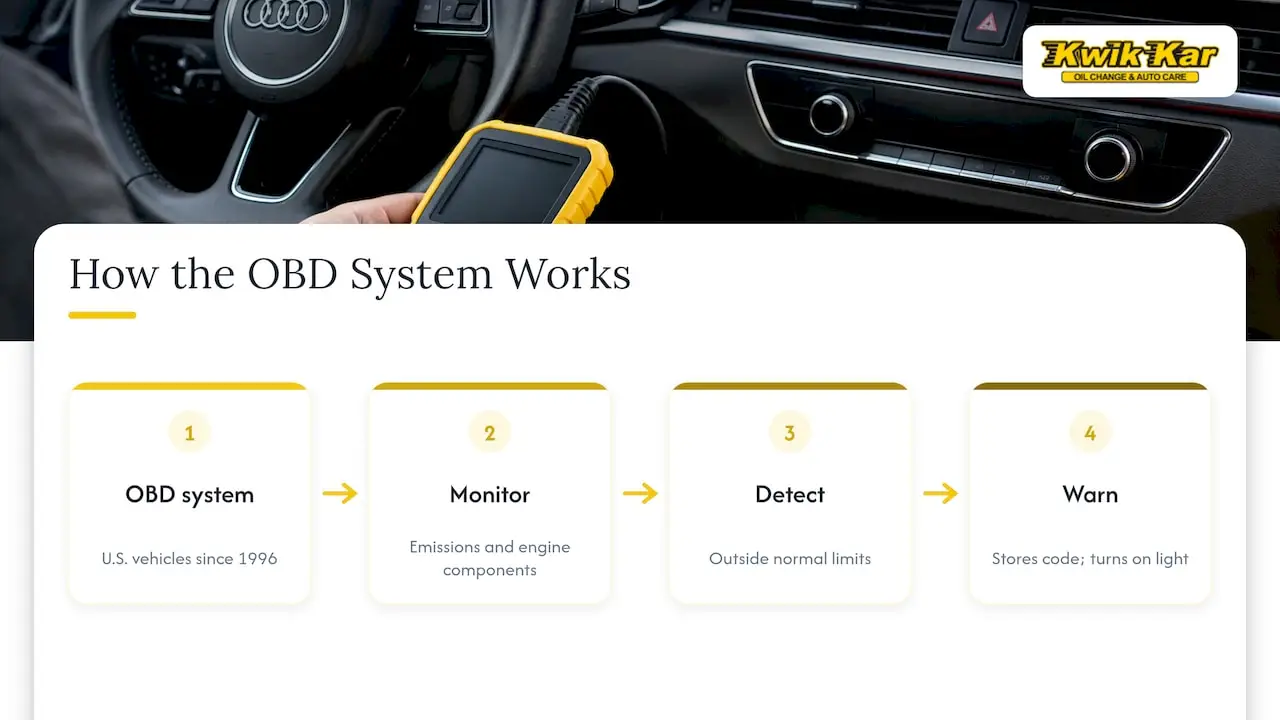
Your Audi, like every car and light-duty truck sold in the U.S. since 1996, has an onboard diagnostic (OBD) system. Car and Driver explains that this system is legally required and monitors emissions and vital engine components. When it sees something outside normal limits, it stores a trouble code and turns on the light.
AAA describes the check engine light as a warning of a potential problem within the engine or emission system, anything from a loose gas cap to a serious engine fault. That range is why the light feels so frustrating. It is ambiguous by design. It says something is off, not what.
On many Audis you may also see the light with an EPC (electronic power control) lamp, or a message in the instrument cluster. Those can point to throttle, sensor or engine management trouble. Treat the combination as a reason to get the car looked at promptly, especially if power feels limited.
Steady light vs. flashing light
This is the first thing to check, and it changes how you should respond.
| What you see | What it usually points to | What to do |
|---|---|---|
| Steady light, car drives normally | A stored fault, which may be minor or may need a complex repair | Get it scanned soon. Drive gently until then. |
| Flashing light | An ignition problem, most likely an engine misfire | Reduce load, pull over safely and stop. Do not keep driving. |
| Light plus shaking, loss of power or strange noises | A possible active misfire | Pull over and call for a tow. |
| Red warning symbol (oil pressure, for example) | A priority-one danger | Stop the car and switch off the engine. |
AAA’s experts say the difference lies in severity: a solid light may signal a minor or complex repair to address soon, while a flashing light indicates an ignition malfunction that could become a catastrophic problem if left untreated. Car and Driver gives the same warning: if the car suddenly runs erratically or makes strange noises, pull over and call for a tow, because a misfire can permanently damage the engine.
We wrote a short page on exactly this: why a flashing check engine light can cook your catalytic converter. The catalytic converter is the emissions part in your exhaust, and unburned fuel from a misfire can overheat it. That turns a repair that might have been small into a much bigger one.
When to stop driving right now
Stop in a safe place and shut the engine off if you see any of these:
- The check engine light is flashing.
- The car shakes, stumbles or loses power.
- You hear knocking, grinding or other new noises.
- A red warning symbol appears, or the message tells you to stop.
Audi’s own owner’s manual treats red symbols as a priority-one danger. For example, the 2009 Q7 manual says to pull off the road, stop and turn off the engine when engine oil pressure is too low. Check your own model’s manual for the symbols on your dash.
If the light comes on while you are driving and everything seems fine, Car and Driver’s advice is to get the vehicle to a mechanic for a diagnostic test.
Common reasons an Audi check engine light comes on
The list below is where most check engine lights start. None of it tells you what is wrong with your car until it is tested.
A loose or faulty gas cap
AAA lists a loose or faulty fuel cap as a common cause, and notes it also lets fuel evaporate. If the light came on right after you filled up, make sure the cap is tight. The light may take a few drive cycles to clear after a fix.
A failing oxygen sensor
Oxygen sensors measure what is in your exhaust so the engine can mix fuel and air correctly. AAA notes that a failing one can make the car burn more gasoline and drop in miles per gallon. You may not feel anything, which is why a steady light with a normal-feeling car still deserves a scan.
Misfires from spark plugs or ignition coils
A misfire means one or more cylinders are not burning fuel properly. Worn spark plugs and weak ignition coils are classic reasons. Rough idle, hesitation and a flashing light are the signs. Our guide to the signs your car’s spark plugs need replacement covers what to watch for, and our P0300 diagnosis walkthrough explains how a random-misfire code is traced step by step instead of by swapping parts.
Catalytic converter trouble
Catalytic converter problems are on AAA’s list of common causes. A converter code such as P0420 does not always mean the converter itself has failed. Other faults upstream can trigger it. See our explanation of the P0420 code, its causes and next steps.
Other sources
Evaporative emissions leaks, intake leaks, sensor wiring, coolant temperature issues and throttle faults can all set the light too. That breadth is the reason a scan is the starting point, not the finish line.
What you can safely check before you call
A few quick looks cost nothing and can help us help you.
- Check the gas cap. AAA suggests making sure it is screwed on tightly.
- Think back on recent service. AAA also recommends reviewing recent maintenance records. A light that appears soon after work was done is useful information.
- Notice how the car feels. Rough running, odd smells, hesitation, poor fuel economy or noises are all worth telling us about.
- Check for other lights and messages. Note whether EPC, oil or temperature warnings are on, and write down any message text.
- Keep the engine area dry. If you decide to wash the engine, follow safe engine bay cleaning steps and keep water away from sensors and electrical connectors, since moisture there can create new problems.
Do not clear the light and hope. Clearing a code erases information that helps with diagnosis, and the fault is still there.
Why a code is the start, not the answer
The OBD system can be read through a port under the dash on the driver’s side. AAA notes that OBD2 scanners plug into this port and work on most vehicles made after 1996. Car and Driver says a scan makes sourcing the problem easier.

Easier, not finished. A code names a system and a symptom. For example, a lean code says the engine is getting too much air or too little fuel. The cause could be a vacuum leak, a dirty sensor, a fuel delivery issue or something else. Replacing the part that seems most likely is how people end up paying for parts that did nothing, and still have the light.
Good diagnosis follows the code with testing: looking at live data, checking related components and confirming the failure before a repair is recommended. Audi engines also run tightly integrated systems, so related codes and sensor readings tell a story together.
What a diagnostic visit at Kwik Kar looks like
We cannot promise what is wrong with your Audi until we inspect it. What we can tell you is how we work.
- ASE-certified technicians perform the work.
- Digital Vehicle Inspection. You receive detailed inspection results with real-time updates and photos, so you can see what we see. We explain how it works on our Digital Vehicle Inspection page.
- Clear, upfront pricing and honest recommendations. You are informed about what the vehicle needs without surprise costs.
- European vehicle repair. Audi owners can read about our European auto repair service.
- A 2-year/24,000-mile warranty on repairs.
What affects the cost
We do not publish prices for diagnostics or repairs, and no honest shop can quote a repair for a warning light over the phone. Cost depends on what the testing finds: a cap or a sensor is a very different job from a misfire that has gone on for weeks. Other factors are your Audi’s model and engine, the parts involved, how much labor access takes and whether one fault has caused another. Once the inspection is done, we give you the findings and the pricing before the work begins.
Promo: Get your Audi’s light checked in Van Alstyne
If your light is steady and the car drives normally, you do not need to wait for it to get worse. Bring it to Kwik Kar of Van Alstyne and we will start with a proper check engine light diagnosis. Busy schedule? After-hours drop-off and free local rides keep your day moving, and our waiting area has WiFi and coffee if you prefer to stay.

You can also see everything we handle on our services page. Call us at (903) 712-5945 to set a time. If the light is flashing, do not drive in: arrange a tow.
Our perspective
Most people who call us about a check engine light are not worried about the light. They are worried about the bill. They have heard stories about a warning light turning into a long list of repairs, and they do not know whether to trust the list.
That is why we built our process around showing you. A Digital Vehicle Inspection puts photos and updates in your hands, so a recommendation comes with a reason you can see. A code is a clue, and we treat it as a clue. We confirm the cause before recommending a repair, because replacing parts on a guess helps nobody.
For Audi and other European vehicles, that careful approach matters even more, since many systems work together. Our technicians are ASE-certified, and our repairs carry a 2-year/24,000-mile warranty, so you are covered after you drive away.
For drivers in Van Alstyne, Anna, Howe, Melissa and Gunter, the easiest way to take the worry out is to get the light read early, while a fix is still small. If your car is not safe to drive, we would rather you tow it than risk the engine.
Kwik Kar
How to keep the light from coming back
You cannot prevent every fault, but routine care removes many of the common triggers.
- Stay on schedule with oil changes. See our guide to oil change intervals for Van Alstyne drivers.
- Replace spark plugs when they are due. Worn plugs are a common misfire source.
- Follow factory-scheduled maintenance. We service vehicles to the manufacturer’s schedule.
- Fuel up carefully. Tighten the cap until it clicks.
- Do not ignore small changes. A slight hesitation or a drop in fuel economy is often the first sign.
- Fix a light early. A steady light handled promptly is far less likely to become a flashing one.
FAQ
Can I keep driving my Audi with the check engine light on?
If the light is steady and the car drives normally, you can usually drive gently to a shop and have it scanned soon. If it is flashing, or the car shakes, loses power or makes strange noises, pull over safely and call for a tow. A red warning symbol means stop and switch off the engine.
What does it mean when the EPC light and check engine light are on together?
Both lights point to a fault in the engine management system, often something involving sensors, throttle control or electrical connections. Some Audis reduce power to protect the engine when this happens. Have the car scanned and inspected before driving it far. We cannot name the cause without testing your vehicle.
Will tightening the gas cap turn off the light?
If a loose cap triggered the light, tightening it can solve the problem, although the light may stay on for a few drive cycles first. If it does not clear, or the car feels different, the cause is something else and a scan is the next step.
Can I just clear the code myself?
Clearing it turns the light off but does not fix the fault, and it erases stored data that helps with diagnosis. The light will return if the problem remains. It is better to have the code read and the cause confirmed first.
How much does it cost to diagnose an Audi check engine light?
We do not publish a diagnostic price, and the repair cost depends on what testing finds. Call (903) 712-5945 and we will explain the process for your Audi. After the inspection, we give you the findings and pricing before any work begins.
Sources
- The Check Engine Light: Common Causes and How To Fix It, AAA
- Dashboard Warning Lights Explained, Car and Driver
- Audi Q7 2009 Owner’s Manual, oil pressure warning
- Clean engine bay: safe steps and ceramic protection