


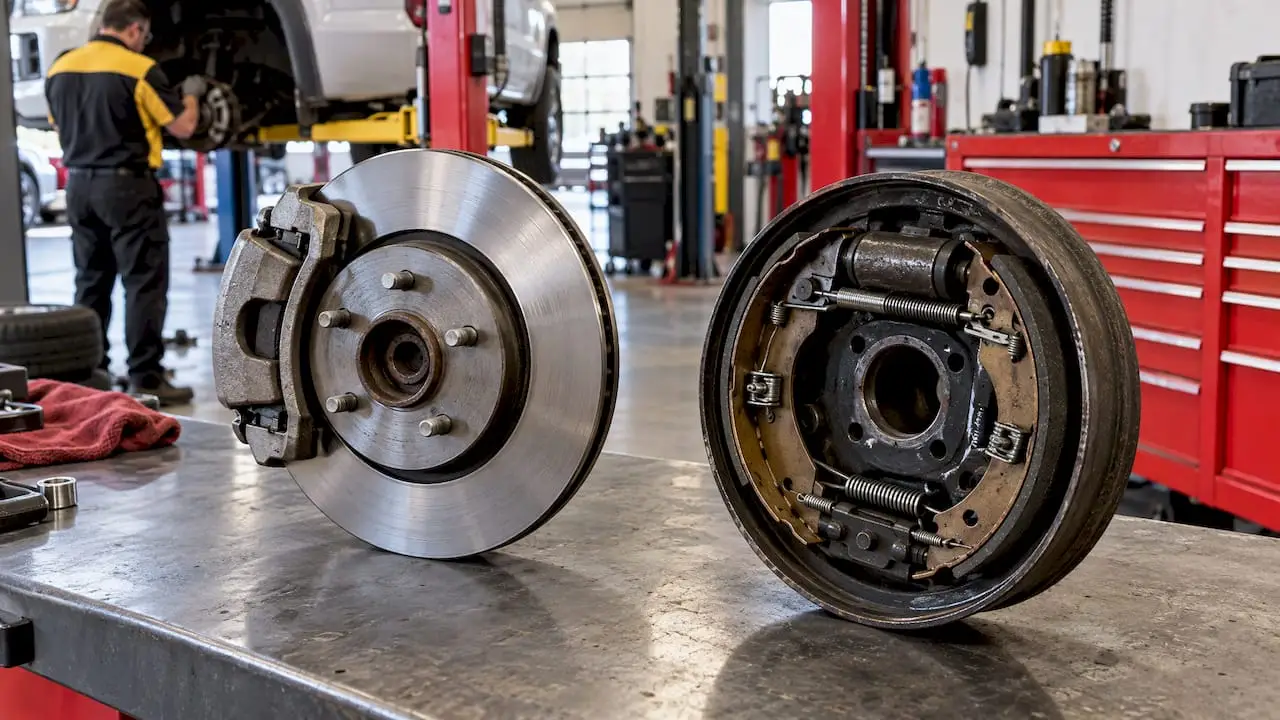
Disc brakes clamp pads against a spinning rotor. Drum brakes press shoes against the inside of a spinning drum. Disc brakes handle heat and wet roads better and give more stopping power. Drum brakes are simpler and usually cheaper to service, and automakers still use them on the rear wheels of some cars. Neither type is “bad.” What matters is that whichever your car has is in good shape, because worn brakes are a safety problem no matter the design.
This guide explains how both work, how they compare, how to tell which one is on your car, and what to watch for. It’s written for everyday drivers in Van Alstyne, Anna, Howe, Melissa and Gunter who want to understand what a technician is talking about when they walk through a brake inspection.
TL;DR
- Disc brakes use a rotor, pads and a caliper. Drum brakes use a drum and curved brake shoes. Both turn motion into friction to slow your wheels.
- Discs shed heat and water more easily, so they are considered more effective and practical. Drums are simpler and usually cost less to service.
- Many cars have discs up front and drums in the back. Your owner’s manual or a quick look through the wheel will tell you which you have.
- Drum brakes are not unsafe when they are maintained. Squealing, a soft pedal or a longer stopping distance means it’s time for an inspection, whichever type you have.
Table of Contents
- How brakes slow your car
- Drum brakes vs disc brakes: side-by-side
- Are drum brakes bad?
- Which brakes does your car have?
- Warning signs that apply to both types
- What a brake inspection looks like at our shop
- Brake service in Van Alstyne
- Keeping any brake system healthy
- FAQ
- Get your brakes checked in Van Alstyne
- Sources
How brakes slow your car
Every brake system does the same job. When you press the pedal, fluid carries that movement to each wheel. Friction material then rubs against a part that turns with the wheel, and that friction slows you down.
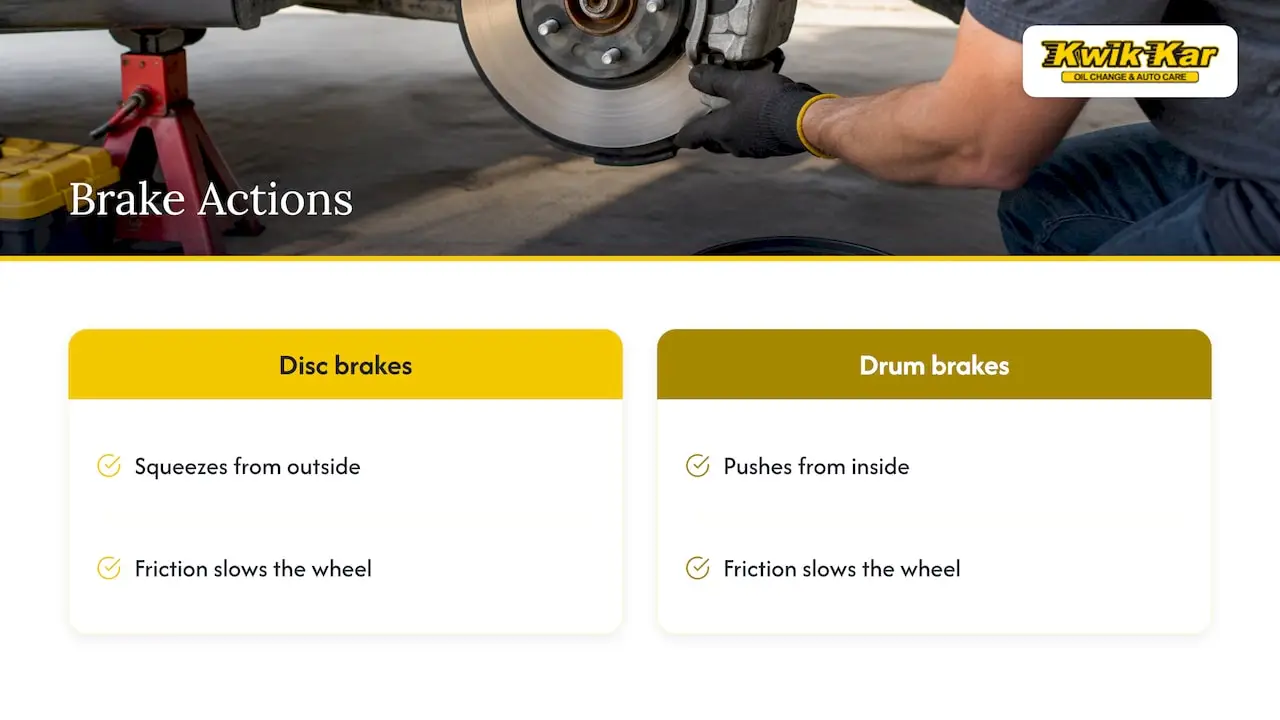
The difference is in the hardware. One design squeezes from the outside. The other pushes from the inside.
How disc brakes work
A disc brake has a rotor, which is a flat metal disc that turns with the wheel. Two brake pads sit inside a caliper, a clamp that fits over the rotor like a hand over a plate. When you press the pedal, the pads clamp against the rotor to slow the wheel.
Because the rotor is out in the open air, it cools quickly and throws off water and debris. That’s the main reason discs are the standard choice on the front wheels, where most of the stopping work happens.
How drum brakes work
A drum brake hides its parts inside a round metal drum that rotates with the wheel. Inside are curved brake shoes. Fluid moves the shoes outward, and they press against the inside of the drum to create friction. Springs pull the shoes back when you let off the pedal.
This answers a common question: do drum brakes have pads? Not exactly. The friction material on a drum brake is bonded to a curved metal piece called a brake shoe. Disc brakes have pads. Drum brakes have shoes. Both wear down and both need to be replaced eventually.
Drum brakes vs disc brakes: side-by-side
| Disc brakes | Drum brakes | |
|---|---|---|
| Friction parts | Two pads clamped on a rotor | Two shoes pressing outward inside a drum |
| Heat handling | Open to the air, so they cool well | Heat builds up inside the drum |
| Wet weather | Shed water easily | Can trap water |
| Stopping power | Stronger | Adequate on many lighter-duty rear axles |
| Typical location | Front wheels, and often all four | Rear wheels on some vehicles |
| Service cost | Usually higher | Usually lower |
The general picture comes from Edmunds, which says discs are considered more effective and practical but usually cost more to repair and service. A training-school overview adds that discs are self-cleaning, manage heat better and perform better in wet conditions, while drums can trap water.
Heat and brake fade
The biggest real-world difference is heat. Hard braking turns your car’s motion into heat. Edmunds notes that drum brakes can fade and lose effectiveness when heat builds up inside the drum, for example during repeated high-speed slowdowns or on a long, steep downhill with a heavy load.
In North Texas, you’re more likely to feel heat from stop-and-go traffic on US-75, summer temperatures or towing a boat to Lake Texoma than from mountain descents. Still, heat is why the brake pads, rotors and fluid all need to be in good condition. If you want to read more about why hot brakes lose bite, this explainer on brake fade causes covers it well.
Maintenance and cost
Drum brakes have a reputation for being cheaper to make and service. Because the parts sit inside the drum, they’re also protected from some road grime. Disc parts are exposed, which helps them cool but also leaves them open to rust on the rotor surface after sitting in damp weather.
Cost depends on your vehicle, which axle is being serviced and how worn the parts are. That’s why we don’t quote brake jobs without looking at the car.
Are drum brakes bad?
No. People search this because discs get all the praise, but a drum brake that is in good working order does its job. Edmunds says modern disc and drum setups are completely adequate for some new cars. Automakers choose the setup that suits the vehicle’s weight and use.
GM, for example, says most of its vehicles have disc brakes at all four wheels, but some have front discs and rear drums. That’s a design decision, not a flaw.
The things to care about are the same for both types:
- How much friction material is left on the pads or shoes
- The condition of the rotors or drums
- The brake fluid
- Whether the brakes pull, grab, shake or feel soft
Worn friction material can reduce braking power and increase stopping distance, which is why AAA treats brake maintenance as a safety matter. That applies to your car whether it has two drums or four discs.
Which brakes does your car have?
Most drivers never need to know until a technician mentions it. Here are easy ways to find out:
- Check your owner’s manual or the vehicle’s specs. It will list the brake type for each axle.
- Look at the front wheels. On nearly all modern cars, the fronts are discs.
- Look at the rear wheels. Through the openings in the wheel you may see a shiny, flat rotor with a clamp over it (disc) or a solid round, often rust-colored, housing (drum).
Don’t take wheels off or climb under the car to find out. If you’re curious, ask us. When your car is in for service, we can tell you what you have, and our Digital Vehicle Inspection includes photos and real-time updates so you can see the condition of your brakes yourself.
Warning signs that apply to both types
If your brakes are doing any of the following, get them checked soon:
- Squealing or chirping. Some pads have built-in metal tabs that chirp, squeal or whistle when they rub the rotor, a signal that service is due. Our page on brake squeaking explains when to stop driving.
- Grinding. A harsh metal-on-metal sound means the friction material may be gone.
- A soft or sinking pedal. See our guide to a soft brake pedal.
- Pulling to one side or a longer stopping distance.
- A brake warning light or a pad life monitor alert. Some vehicles have a Brake Pad Life Monitor that alerts you when service is needed.
There’s no single mileage at which every car needs brakes. GM notes there are no specific mileage intervals because wear depends on how and where you drive. Heavy commuting, school-run stop-and-go and towing all wear brakes faster.
Brake fluid matters too, since it’s what carries your pedal movement to the wheels. We cover that in how often to change brake fluid and the signs you need a flush.
We can’t tell you what’s wrong with your brakes from a description. The only way to know is to inspect the vehicle. If your car doesn’t stop the way it should, don’t wait for a convenient moment: have it looked at right away.
What a brake inspection looks like at our shop
Brake work is where drivers most often worry about surprise costs. We built our process around removing that worry.
Your vehicle goes through a Digital Vehicle Inspection. You get real-time updates and photos of what we find, so you can see worn pads, shoes, rotors or drums for yourself. Our technicians are ASE-certified, and we give you clear, upfront pricing and honest recommendations before the work begins.
That matters most on a car with drums in back and discs in front, since the two axles can wear at different rates. You see each one, and you decide what to approve.
Our perspective
When someone asks us whether drums or discs are better, we start with the car in front of us. Discs give stronger stopping power and handle heat and water well. Drums are a proven design that many automakers still choose for rear axles. The type matters less than the condition.
What we care about is that you can see what’s going on. That’s why every inspection comes with photos and updates, and why we explain the choices in plain language. A brake job should never feel like a guessing game.
We also stand behind our repairs with a 2-year/24,000-mile warranty, because brakes are one of the systems your family depends on every day.
Kwik Kar
Brake service in Van Alstyne
Whether your car has discs, drums or a mix, our brake repair service covers it. If you’re hearing something odd and aren’t sure why, our diagnostics service can find the cause. You can see the full range of what we do on our auto repair page.
We built the shop around busy schedules. After-hours drop-off lets you leave the car when you can. Free local rides get you to work or home, and our waiting area has WiFi and coffee if you’d rather stay.
Brakes also matter more as the weather turns. Our article on brake maintenance before winter covers what to check when roads get wet and slick.
Keeping any brake system healthy
A few habits help both types last:
- Look ahead and brake smoothly. Gradual braking creates less heat and wear than late, hard stops.
- Don’t ride the pedal downhill. Heavy, repeated braking builds heat, which is when fade becomes a risk.
- Take loads seriously. A trailer, a full car and a hot day all add stress.
- Have brakes looked at with every tire rotation or service visit. Catching thin pads or shoes early is easier than fixing damaged rotors or drums.
- Keep fluid fresh. Old fluid affects pedal feel and performance.
Parents of new drivers have extra reasons to stay on top of this. A teenager is still learning how a car behaves, and they shouldn’t also be learning what a worn brake feels like. A quick check before the school year or a road trip is a simple way to send them out with confidence.
FAQ
Are disc brakes always better than drum brakes?
Disc brakes are generally more effective because they cool quickly and handle water well. That’s why they’re standard up front. Drum brakes still work well on many rear axles when they’re maintained. The right choice for your car is the one the manufacturer designed it with, in good condition.
Can I switch my car from drum brakes to disc brakes?
It depends on the vehicle, and it isn’t a simple swap. It involves changing hardware and sometimes other parts of the brake system. If you’re curious about your car, call us at (903) 712-5945 and we can talk through what makes sense after looking at it.
Do drum brakes have pads?
No, they have brake shoes. The shoes are curved and sit inside the drum. They press outward against it to slow the wheel. Disc brakes have pads that clamp onto a rotor.
How do I know if my brakes need service?
Listen for squealing or grinding, and notice a soft pedal, pulling or longer stopping distances. A warning light or pad monitor alert is another cue. There’s no set mileage for every driver, so an inspection is the reliable way to know.
Get your brakes checked in Van Alstyne
If you’re wondering what’s behind your wheels or hearing something you don’t like, call us at (903) 712-5945, visit us in Van Alstyne or request an appointment through our website. We serve drivers in Van Alstyne, Anna, Howe, Melissa, Gunter and nearby communities, and we’ll show you what we find with photos before any work begins. Check our coupons page for current offers.
Sources
- Brakes: Drum vs. Disc | Edmunds
- The Brake System | Vehicle Support | Chevy
- How Do Car Braking Systems Work? | UTI
- Signs Your Brakes Need Service | Via (AAA)