




If your car’s heater isn’t working, the cause is usually one of a few things: low coolant, a thermostat stuck open, air trapped in the cooling system, a clogged heater core, a stuck blend door, or a blower problem. The symptom alone doesn’t tell you which one. A few simple checks narrow it down, and a technician can confirm it by inspecting the vehicle. This guide walks you through each cause, what you can safely look at yourself, and the signs that mean you should stop driving.
We’re Kwik Kar of Van Alstyne, and we see this every time the first real cold snap hits North Texas. Drivers in Van Alstyne, Anna, Howe, Melissa and Gunter switch the heat on for the first time in months, and nothing comes out. Here’s how to make sense of it.
TL;DR
- Cold air with the heater on usually means hot coolant isn’t reaching the heater core, or air isn’t being routed over it.
- Low coolant and a thermostat stuck open are two of the most common causes, and both can affect engine health, not just comfort.
- Only check coolant when the engine is completely cool. Opening a hot, pressurized system can cause serious burns.
- A sweet smell, a damp passenger-side floor, or a windshield that fogs fast can point to a heater core leak. Stop driving and call us.
- We can’t diagnose by symptom alone. We inspect the vehicle and send you photos in a Digital Vehicle Inspection before any work starts.
Table of Contents
- How a Car Heater Actually Works
- Why Your Car Is Running but There’s No Heat
- Why Your Car Heater Blows Cold Air: Heat Problem or Airflow Problem?
- What You Can Safely Check Yourself
- When to Stop Driving
- Rear Defroster Not Working
- Foggy Windshield and Defroster Problems
- Our Perspective: Why We Inspect Before We Recommend
- How a Technician Diagnoses a Heater Problem
- Repair Options and What Drives the Cost
- Keeping Your Heater Working Season After Season
- Get Your Heat Back at Kwik Kar of Van Alstyne
- FAQ
- Sources
How a Car Heater Actually Works
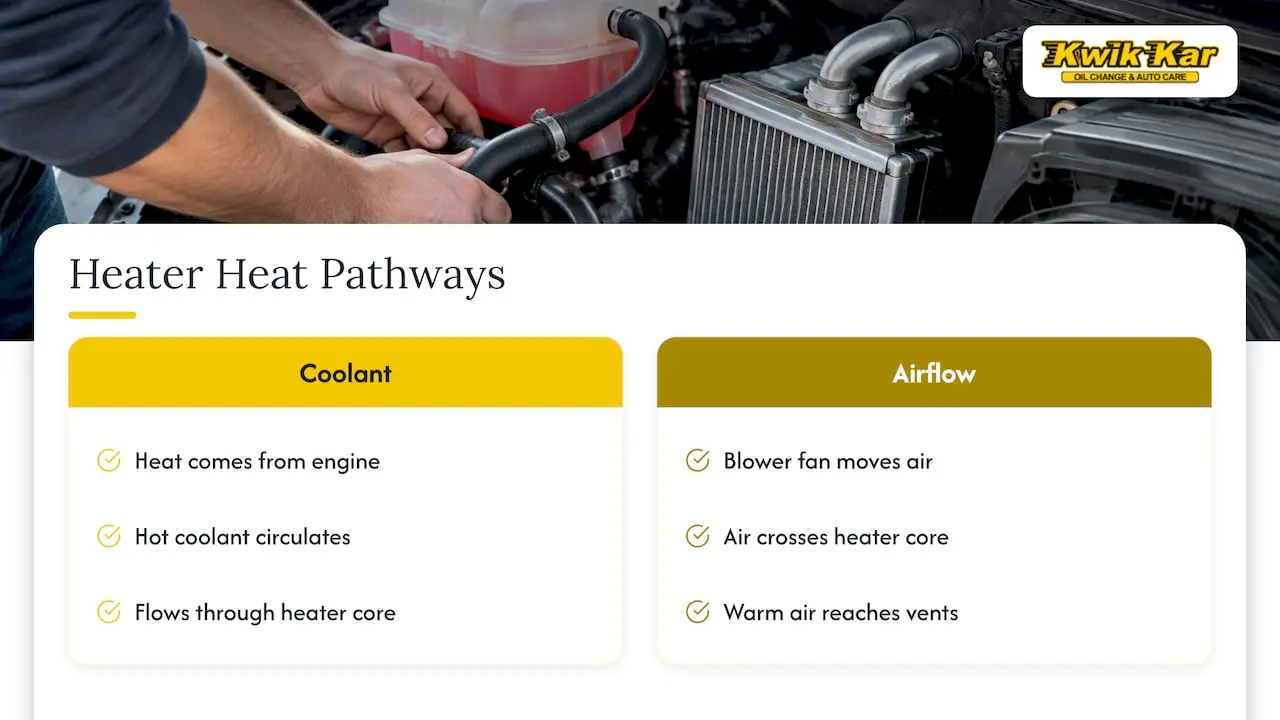
Your heater doesn’t make heat on its own. It borrows it from the engine. Hot coolant flows from the engine through two hoses to a small radiator-like part behind the dashboard called the heater core. The blower fan pushes cabin air across that core, and the warmed air comes out of your vents.
That means two things have to happen for you to feel heat. First, hot coolant has to circulate through the heater core. Second, air has to be blown across it and directed to your vents. Cars.com explains that when the engine is at normal temperature but the vents blow cold, one of those two things isn’t happening.
That gives you a useful way to think about the problem. Is the issue heat (the coolant side) or airflow (the fan, vents and doors side)? Almost every cause below falls into one of those buckets.
Why Your Car Is Running but There’s No Heat
Here are the usual suspects, roughly in the order we’d think about them.
Low coolant
This is the first thing to rule out. If the level is low, there may not be enough coolant to move from the engine to the heater core. Low coolant also means the engine isn’t being protected the way it should be, so a weak heater can be an early warning of an overheating problem. Family Handyman lists low coolant first among the reasons a heater won’t blow hot air.
Coolant doesn’t just evaporate in a healthy system. If it’s low, it went somewhere. That could be an external leak, a worn hose, or something deeper. Topping it off may bring the heat back, but it doesn’t answer why the level dropped.
A thermostat stuck open
The thermostat controls how quickly your engine warms up. When it sticks open, coolant keeps flowing through the radiator and the engine struggles to reach normal temperature. ALLDATAdiy notes that this prevents the engine from reaching its normal operating temperature, so the coolant reaching the heater core never gets hot enough.
The classic sign is a temperature gauge that stays low for a long drive, or never settles in the middle. You may notice the heat is lukewarm at highway speed and worse at idle. We’ve written up five technician tests for a stuck-open thermostat if you want the full list.
Air trapped in the cooling system
After a coolant service or a repair, air pockets can get trapped in the system. An air pocket near the heater core can block hot coolant from flowing through it. The heat may come and go, or work only when you rev the engine. The fix is to properly bleed the system, which is part of doing a cooling system job correctly.
A clogged heater core
Over time, old coolant breaks down. Sediment and corrosion can build up inside the narrow passages of the heater core and restrict flow. Haynes recommends periodic cooling-system flushes, about every 30,000 miles or two years, to help prevent heater core blockage. Always follow the interval in your owner’s manual for your specific vehicle.
A quick clue is the two heater hoses running to the firewall. Cars.com describes comparing them once the engine is warm: if they aren’t both at least very warm, coolant likely isn’t circulating through the core. That can mean a plugged core or a control valve that isn’t opening. Be careful, because these hoses and the parts around them get hot and sit near moving belts.
A faulty heater control valve
Some vehicles have a valve that opens and closes to let coolant into the heater core. If it sticks closed, hot coolant never gets there and the heater blows cold. Not every vehicle has one, so this is something a technician checks against your specific make and model.
A stuck blend door or failed actuator
Behind the dash, a small door swings between hot and cold paths. A motor called an actuator moves it. If that door sticks in the cold position, you can have perfectly hot coolant and still get cold air. Cars.com points out that if both heater hoses are quite warm, a stuck blend door is the most likely reason. Clues include clicking or tapping behind the dash when you change the temperature, or one side of the car (driver or passenger) blowing a different temperature than the other.
Water pump trouble
The water pump moves coolant through the engine. If it’s failing, you may see a heater that stays cold along with an engine that runs hot, even when the coolant level looks normal. That combination is a reason to stop and have the car looked at right away, not to keep driving and hope.
Why Your Car Heater Blows Cold Air: Heat Problem or Airflow Problem?
Use this quick table to sort what you’re noticing.
| What you notice | Likely side | Possible causes a technician checks |
|---|---|---|
| Air flows strongly but never warms up | Heat (coolant) | Low coolant, thermostat stuck open, air pocket, clogged heater core, heater control valve |
| Temperature gauge stays low | Heat (coolant) | Thermostat stuck open |
| Gauge runs hot and the heater is cold | Heat (coolant) | Low coolant, water pump, thermostat stuck closed |
| Hoses are both hot but air is cold | Airflow/routing | Blend door or actuator, climate control fault |
| Weak airflow or no airflow at all | Airflow | Blower motor, blower resistor, fuse, clogged cabin air filter |
| Fan works only on the highest speed | Airflow | Blower motor resistor |
| Sweet smell, damp carpet, greasy fog | Leak | Heater core leak |
These are possibilities, not a diagnosis. Two different failures can look identical from the driver’s seat.
What You Can Safely Check Yourself
We’re not asking you to turn into a mechanic. But a few observations make the conversation with a technician faster, and make the diagnosis more accurate.
- Watch the temperature gauge. Start the car cold and see how the needle moves. Does it climb to the middle within several minutes of driving? Or does it hover low?
- Note when the heat fails. Is it cold at idle but warm while driving? Does it work for a few minutes and then fade? Does it never warm up?
- Check the coolant, but only when the engine is completely cool. ALLDATAdiy warns that opening a pressurized cooling system while hot can cause third-degree burns. Look at the reservoir level against its marks. Don’t open the radiator or reservoir cap on a warm engine.
- Listen and feel. Does the fan change speed when you turn the dial? Do you hear clicking behind the dash when you change temperature settings?
- Smell and look. Check for a sweet, syrupy smell inside the cabin, damp carpet on the passenger side, or a film on the inside of the windshield.
- Check the vent settings. Make sure the temperature is set to hot, the mode isn’t stuck on a setting that only sends air to one place, and the fan is on.
Write down what you find, or take a photo of the gauge and the coolant reservoir. It helps.
When to Stop Driving
A cold cabin is uncomfortable. Some of these signs are more serious than that.
- The temperature gauge climbs toward hot or a warning light comes on. Pull over safely and shut the engine off. ALLDATAdiy advises doing exactly that if the engine begins to overheat. Driving an overheating engine can lead to major damage, including problems like a failed head gasket. If you’ve seen overheating, read about the tests that confirm head gasket failure.
- You smell sweet coolant and the passenger-side floor is wet. These can point to a heater core leak. Coolant loss can lead to overheating, and a leaking core can cause sudden fogging on the windshield, which affects your visibility.
- You smell something burning, or fuses blow repeatedly. Repeated blown fuses suggest a short circuit somewhere in the system. That needs proper diagnosis, not a bigger fuse.
- The windshield fogs and won’t clear. If you can’t see, you shouldn’t be driving. Pull over where it’s safe and wait for visibility to improve.
If any of those sound familiar, call us at (903) 712-5945 before you drive further.
Rear Defroster Not Working
The rear defroster is a different system from your cabin heater. It’s an electric grid of thin lines bonded to the back glass, and it has nothing to do with coolant.
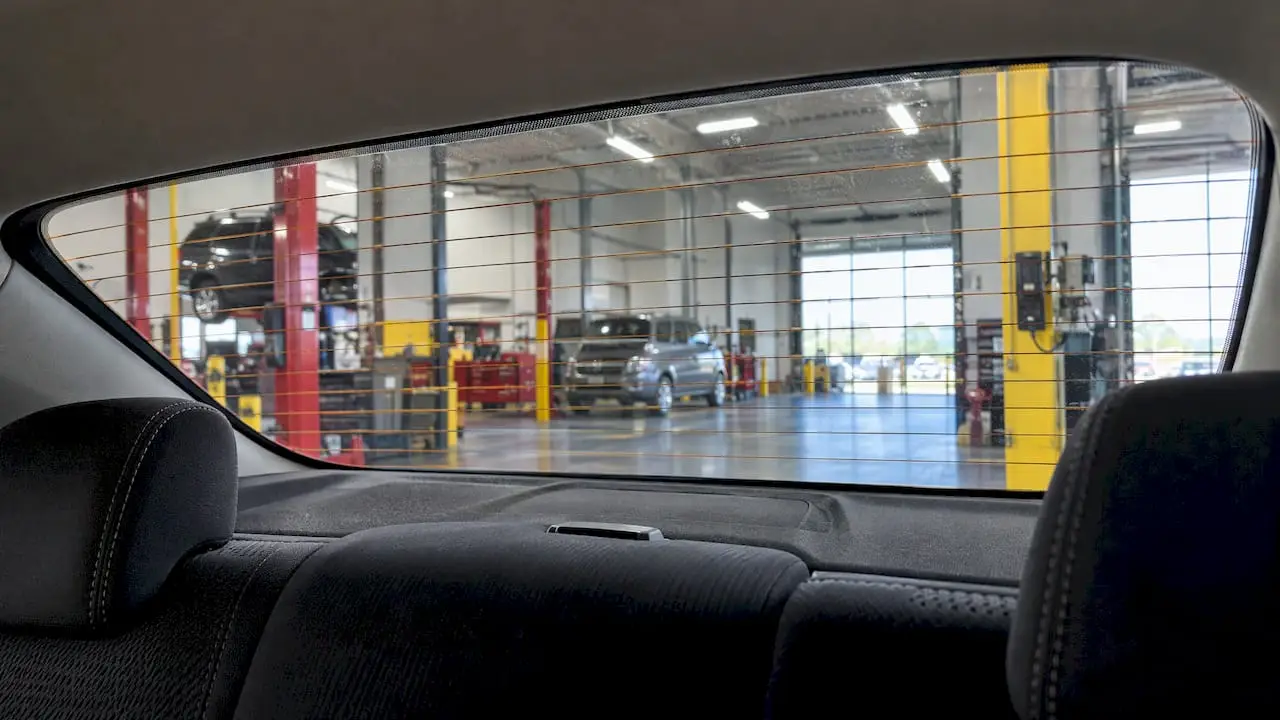
Three parts typically fail: the grid lines themselves, the tabs or connectors that feed power to the grid, and the switch, relay or wiring behind it. Frost Fighter’s repair guide lists broken or scratched grid lines, detached power tabs, and damage from window tint removal among the causes. It also says that when the whole grid is dead, a separated main power tab is the most likely culprit.
Here’s how to read what you see:
- Part of the grid works and part doesn’t: a break in one or more lines.
- None of it works: a power tab, fuse, relay, switch or wiring issue.
- Switch light doesn’t come on: look at the switch or its circuit.
Scraping ice off the back glass with a hard tool is a common way to damage the grid, so use a plastic scraper or let the car warm up. If your front defrost is also struggling, the cause may be in the heating system rather than the electrical side.
Foggy Windshield and Defroster Problems
Your defroster blows warm, dry air on the glass. If the heat isn’t working, the defroster usually isn’t either, and that’s a safety issue as much as a comfort one.
A few things to try in the moment:
- Turn the temperature up and the fan on, and select the defrost mode.
- Turn on the A/C if your car has a defrost setting that uses it, since A/C dries the air. Many vehicles do this automatically.
- Switch off recirculation so the car draws in drier outside air.
- Crack a window briefly if you need quick relief.
If the fog returns fast and leaves a greasy, sticky film inside the glass, along with a sweet smell, that points to a heater core leak and it needs a professional look. If your A/C is acting up too, our notes on what to record when the A/C isn’t blowing cold apply here as well, since both systems share the blower and the dash controls.
Our Perspective: Why We Inspect Before We Recommend
We hear the same thing every cold season: “My heater quit, can you just fix it?” The honest answer starts with a question, because a heater that blows cold can mean a $0 fix or a serious cooling system problem, and from the driver’s seat they feel the same.
That’s why we don’t guess. Our ASE-certified technicians inspect the vehicle first. Our Digital Vehicle Inspection gives you photos and real-time updates, so you can see what we see, what needs attention now, and what can wait. You approve the work before it starts, so there are no surprise costs.
The cooling system is also where small problems hide. Low coolant, a tired thermostat and old fluid can all show up first as a weak heater, then later as an overheating engine. We’d rather catch it while it’s a heater complaint.
When we do repair something, it’s backed by our 2-year/24,000-mile warranty. And if you’re busy, you can use after-hours drop-off or our free local rides, so a repair doesn’t wreck your week.
Kwik Kar
How a Technician Diagnoses a Heater Problem
Here’s the general path a shop follows. The exact steps vary by vehicle.
- Listen to your description. When does it fail, what do you smell, what do you hear?
- Check coolant level and condition. Low, dirty or rusty coolant tells a story.
- Watch the engine warm up. Does it reach normal operating temperature and hold it?
- Compare the heater hoses. Both hot, one cold, or both lukewarm each point in a different direction.
- Test airflow and controls. Blower speeds, resistor, fuses, cabin air filter, blend door movement.
- Scan for codes. Modern climate systems can store error codes that point to a failed actuator or sensor.
- Pressure test if a leak is suspected. This finds external leaks and shows whether the system holds pressure.
That’s the work our diagnostics service covers. We don’t promise an answer before the car is in the bay, because we won’t know until we’ve looked.
Repair Options and What Drives the Cost
What the fix looks like depends entirely on the cause.
- Low coolant from a leak: repair the leak (a hose, clamp, radiator or other component), then refill and bleed the system.
- Thermostat stuck open: replace the thermostat and refill the coolant.
- Air in the system: bleed the system properly.
- Old, dirty coolant or a partly clogged core: a coolant service, and in some cases a flush. Our article on coolant flush versus drain and fill explains the difference.
- Blower motor, resistor or fuse: replace the failed electrical part and find out why it failed.
- Blend door actuator: replace the actuator. Access can range from easy to a long job depending on where it sits.
- Heater core: replace it. This is typically the most labor-intensive of the group, because the core sits deep behind the dashboard, which often has to come out or be moved.
Cost is driven mostly by labor time, your vehicle’s design, and parts. European models can add complexity, which is why we have a dedicated European auto repair service. We don’t publish flat prices for heater repairs, because the cause decides the job. What we do is give you clear, upfront pricing after the inspection and before any work begins. For a look at how that process works on cooling system jobs, see our page on cooling system repair with a Digital Vehicle Inspection.
Keeping Your Heater Working Season After Season
A few habits make heater trouble less likely.
- Keep up with coolant service. Old coolant is a common reason cores clog. Follow your owner’s manual interval, and use the coolant type it specifies.
- Check your coolant level when the engine is cool, especially before winter.
- Replace worn hoses before they fail. A leaking hose is a common reason coolant disappears.
- Swap the cabin air filter on schedule so airflow stays strong.
- Test the heat early. Don’t wait for the first frost to find out. Run it on a mild afternoon so there’s time to schedule a repair.
- Watch the temperature gauge on every drive. If it starts acting differently, that’s information.
Our seasonal guide on fluids and filters to change for fall is a good checklist to run through before cold weather arrives.
Get Your Heat Back at Kwik Kar of Van Alstyne
If your heater isn’t working, we’ll find out why. Our ASE-certified technicians inspect the vehicle, and you get a Digital Vehicle Inspection with photos and real-time updates, so you know exactly what your car needs before you approve anything.

Need to leave the car? Use our after-hours drop-off, or ask about a free local ride. Repairs are backed by our 2-year/24,000-mile warranty. See everything we handle on our auto repair page, or call (903) 712-5945 to set up a time.
FAQ
Why is my car running but there’s no heat?
The heater depends on hot coolant reaching the heater core and air being blown across it. Low coolant, a thermostat stuck open, trapped air, a clogged heater core or a stuck blend door can each interrupt that. A technician needs to inspect the vehicle to tell which one it is.
Why is my car blowing cold air when the heater is on?
If the engine reaches normal temperature but the air is cold, either hot coolant isn’t circulating through the heater core or the air isn’t being routed across it. If the engine never warms up, the thermostat is a prime suspect. Checking the coolant level (engine cool) is a good first step.
Can I drive with a broken heater?
Sometimes, but not always. If the cause is a blower or blend door, it’s mostly a comfort and defrost issue. If the temperature gauge climbs, you smell coolant, or the windshield fogs and won’t clear, stop driving and call us. Those can point to a cooling system problem or a heater core leak.
How do I know if it’s the heater core?
Clues include a sweet smell inside the car, a damp passenger-side carpet, a greasy film on the inside of the windshield, fogging that returns quickly, and coolant that keeps dropping with no visible puddle. These are signs, not proof, so we confirm with an inspection before recommending a repair.
Why is my rear defroster not working when the heater is fine?
They’re separate systems. The rear defroster is an electric grid, so the usual causes are broken grid lines, a loose power tab, a fuse, a relay or the switch. The heater runs on engine coolant, so a working heater says nothing about the defroster grid.
Sources
- Why Does My Car Heater Blow Cold Air? | Cars.com
- No Heat In Car? This Is What Having No Car Heat Might Mean | Family Handyman
- Why Your Car Heater Blows Cold Air | ALLDATAdiy
- Why Is My Car’s Heater Not Working and How to Fix It | Haynes
- Defroster Repair and Troubleshooting Guide | Frost Fighter