




To reset a TPMS light, fix the cause first. Set all four tires to the pressure on your door-jamb placard while they are cold, then use your vehicle’s reset method (a button, a dashboard menu, or simply driving for a few minutes). If the light comes back, or if it flashes and then stays on, the problem is no longer low air. It is a fault in the system, and that needs a proper look. If you are in Van Alstyne, Anna, Howe, Melissa or Gunter, we can inspect it for you and show you what we find.
TL;DR
- A steady tire pressure light usually means one or more tires are low. Add air to the placard pressure, when the tires are cold, before you try any reset.
- A light that flashes for about a minute and then stays on points to a TPMS malfunction, not a low tire. Pressure alone will not clear it.
- Reset steps differ by vehicle. Your owner’s manual has the exact method for your make and model.
- After a tire rotation or new tires, some vehicles need a reset so the system relearns where each sensor sits.
- If the light returns after correct inflation, have the vehicle inspected. You can call us at (903) 712-5945.
Table of Contents
- What the tire pressure light is telling you
- Before you reset anything: check the pressure
- How to reset the TPMS light
- TPMS light after a tire rotation or new tires
- When the light is blinking or flashing
- TPMS sensor battery life
- Can you drive with the TPMS light on?
- Our perspective
- Get the light checked in Van Alstyne
- Keep the light from coming back
- FAQ
- Sources
What the tire pressure light is telling you
TPMS stands for tire pressure monitoring system. It is the dashboard symbol that looks like a flat tire with an exclamation point. Its job is to warn you when a tire has lost enough air to be a safety problem.
Federal rules set the threshold. According to NHTSA’s November 2024 tire survey report, the standard behind TPMS (FMVSS No. 138) requires covered vehicles to warn the driver when pressure falls 25% or more below the recommended level, or below the standard’s specified minimum if that is higher. The same standard requires a separate warning when the system itself is malfunctioning.
That 25% figure matters. By the time the light appears, a tire can already be well below where it should be. The same NHTSA report frames TPMS as a warning aid, not a replacement for routine gauge checks.
Two kinds of system
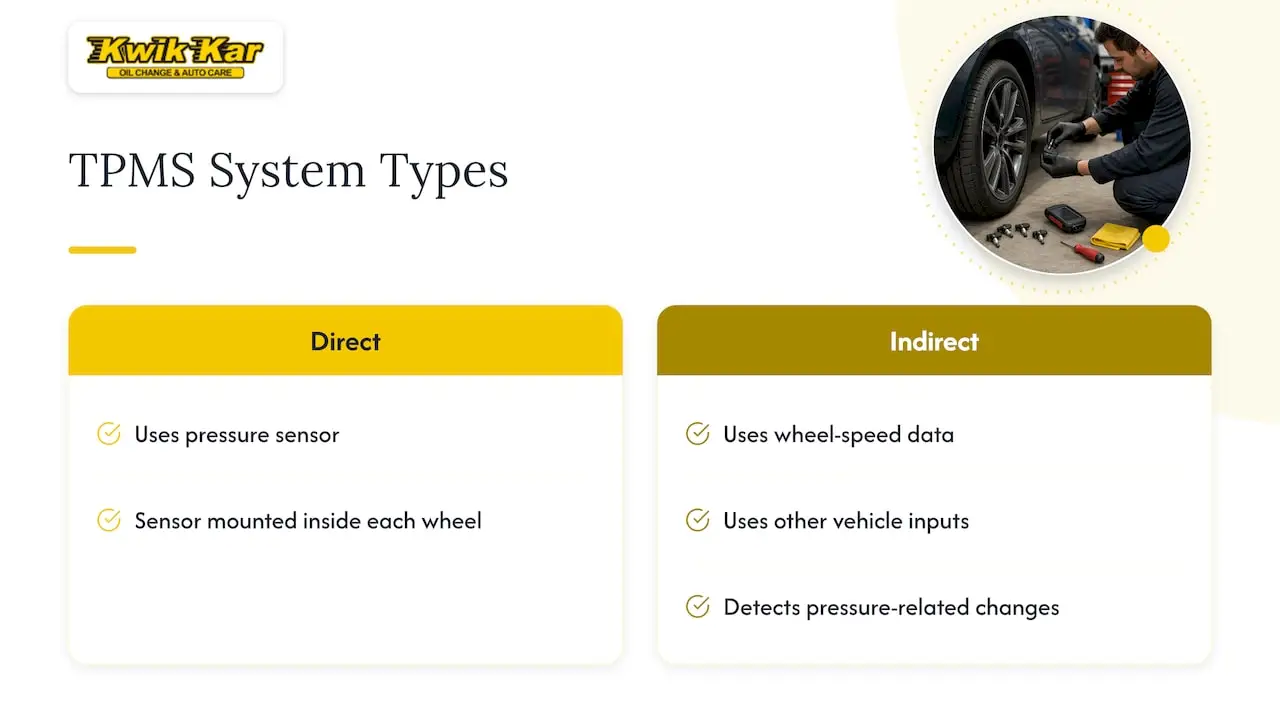
The NHTSA report describes two designs. A direct system uses a pressure sensor mounted inside each wheel. An indirect system uses wheel-speed data and other vehicle inputs to detect pressure-related changes. Which one you have affects how the reset works and what can fail, so it is worth a quick look in your manual.
Steady light versus flashing light
This is the single most useful thing to know before you touch a button.
| What you see | What it usually means | What to do |
|---|---|---|
| Steady light | One or more tires at or below the warning pressure | Check and inflate all tires to placard pressure |
| Flashes about a minute, then stays on | The system has a fault | Have it diagnosed |
| Light comes on in a cold snap | Cold air lowered the pressure | Re-check and inflate to placard pressure |
A 2023 GM service bulletin describes it this way: a steady low-pressure light means the system is operating as designed and correcting pressure resolves it, while flashing followed by steady illumination indicates a system fault that should be diagnosed. Ford’s owner’s manual and Honda’s 2023 CR-V document describe the same pattern: about one minute of flashing, then a continuous light that repeats at later starts while the malfunction exists.
Before you reset anything: check the pressure
Resetting a light over a tire that is actually low only hides the warning. Start with the tires.
- Find the right number. Use the pressure on the placard in the driver’s door jamb, not the maximum number printed on the tire sidewall. The sidewall figure is the tire’s limit, not your vehicle’s recommendation.
- Check when the tires are cold. That means the car has sat for a few hours or has been driven only a short distance. The 2024 Mazda MX-5 owner’s manual explains why: pressure set while the tires are warm can drop below the specified value once they cool and bring the warning back.
- Check all four tires. Ford’s owner’s manual also says to check the spare if your vehicle has a full-size one monitored by the system. Do not assume the light is about the tire that looks lowest.
- Inflate to placard pressure. Use a reliable gauge. Gas station gauges can be worn or off.
- Look for a cause. If one tire keeps dropping, it may have a nail, a leaking valve stem or a bead leak. Air alone will not solve that. Our guide on tire patch versus plug explains how a puncture is properly repaired.
Why does this matter beyond the light? Ford’s manual warns that underinflation can cause tire overheating and failure, and can affect handling and stopping. If you are hauling kids to practice or driving US-75 at highway speed, that is the part that counts.
Why the light can come on when the tires “look fine”
You cannot judge pressure by eye. A tire can be 25% low and still look normal. Temperature also plays a part. Honda’s CR-V document notes that low ambient temperature and altitude changes can affect tire pressure and trigger the indicator. North Texas cold mornings after a warm afternoon are a classic trigger. If the light comes on and the tires are properly inflated to the placard, that same document says to have the vehicle checked.
For general routine checks, this overview of essential car safety checks is a handy companion to your monthly pressure habit.
How to reset the TPMS light
The web is full of one-size-fits-all instructions, and they do not fit every vehicle. Many of the top results describe holding a reset button until the light blinks three times, then starting the car and driving for about 20 minutes. That works on some vehicles. Others have no button at all.
Here are the common methods. Confirm which applies to you in your owner’s manual.
Method 1: Reset button
Some vehicles have a TPMS reset button, often below the steering wheel or in the glove box area.
- Inflate all tires to placard pressure.
- Turn the ignition to on (engine off, or as your manual states).
- Press and hold the reset button until the light blinks as your manual describes.
- Release it, start the vehicle and drive as directed.
Method 2: Dashboard menu
Ford’s owner’s manual describes a menu-based reset on many models: use the ignition and the tire-monitor menu, then hold the OK button until the vehicle confirms. A physical reset button is used where the vehicle has one. After the reset, Ford says to drive for at least two minutes above 20 mph.
Other makes use steering wheel controls or an infotainment screen. Look for “tire pressure,” “TPMS” or “calibrate” in your settings.
Method 3: Drive it
Many direct systems simply update on their own. Once pressures are correct, a short drive lets the sensors report in and the light goes out. If it has not cleared after a normal drive and a restart, do not keep repeating the procedure. A light that will not clear is information.
Common mistakes
- Resetting before inflating. The system stores the wrong baseline, especially on indirect systems.
- Inflating warm tires to the exact number. They drop below spec as they cool.
- Ignoring the spare. On vehicles that monitor it, a low spare keeps the light on.
- Pressing the button over and over. If a sensor is failing, nothing you press fixes it.
TPMS light after a tire rotation or new tires
You rotate your tires, and a day later the light is on. It is a common question, and it is usually about location, not leaks.
On many direct systems, the vehicle needs to know which sensor is at which corner. Ford’s owner’s manual requires a reset after tire replacement or pressure adjustment, and after a rotation so the system can relearn the sensor positions. Other makes handle this on their own after a short drive. Some need a scan tool to relearn the positions.
If you recently had work done and the light is on, set the pressures first. Then follow the reset method in your manual. If it still will not go out, bring it in. Our tire services cover new tires and tire repair, and we can look at the system while the vehicle is with us.
Tires are also worth a look at the same time for wear and balance. Uneven wear and vibration sometimes go along with pressure problems, and our page on road force balancing explains when it is worth doing.
When the light is blinking or flashing
This is the question most drivers type in, and the answer is different from a steady light.
A flashing TPMS light that turns solid after about a minute is the system’s way of saying it has a malfunction. Ford’s owner’s manual says that if the light flashes for approximately one minute and then remains illuminated, the system has a fault. If the tires are properly inflated, no spare is in use and the warning remains, it says to contact an authorized dealer as soon as possible.
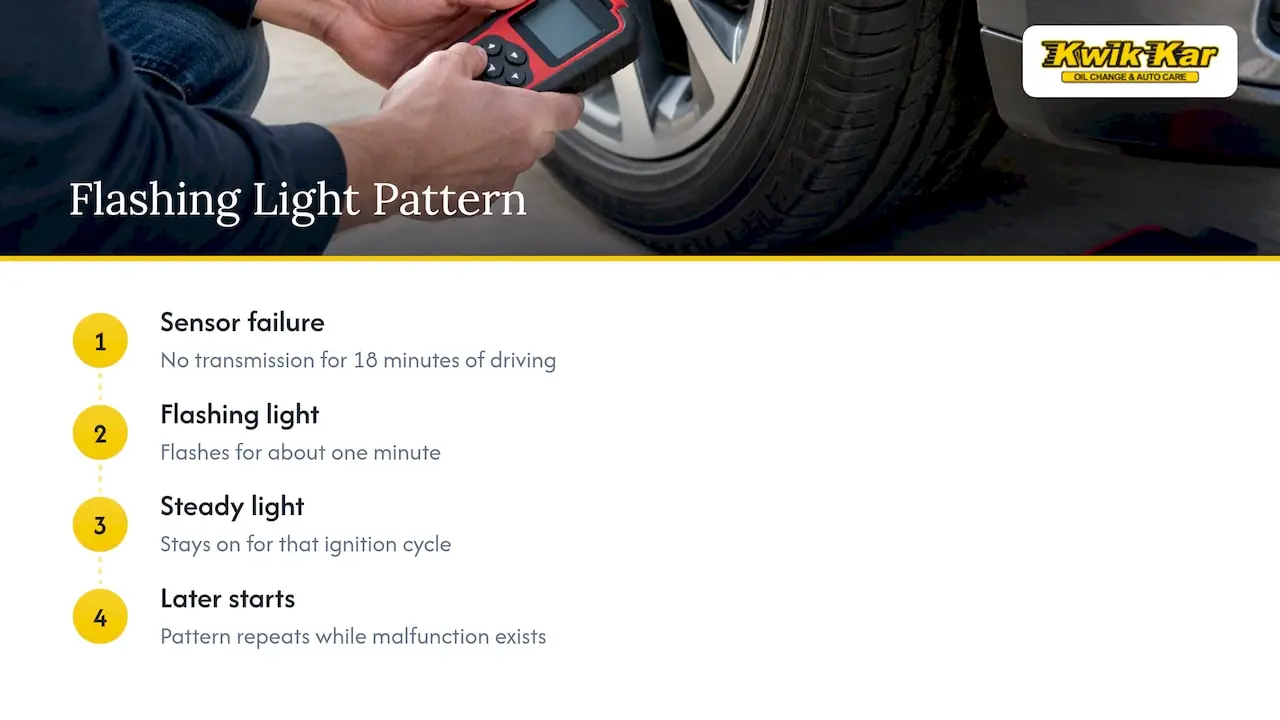
The 2023 GM bulletin gives one example of what triggers it: if one or more sensors fail to transmit for 18 minutes of driving, the system can set a code and flash the light for about a minute before it stays on for that ignition cycle. Honda’s CR-V document says the pattern repeats at later starts for as long as the malfunction exists.
Likely causes of a flashing light
- A sensor that has stopped transmitting, often from a dead battery
- A damaged sensor or valve stem, sometimes after a tire change
- A missing sensor, for example after wheels were swapped
- A problem with the receiver or module that listens to the sensors
- Aftermarket wheels or a spare that the system cannot read
We cannot tell you which one it is from a description. That takes inspecting the vehicle. Our diagnostics service is built for this: a technician finds the actual fault instead of guessing, and you get the answer before any repair is approved.
Note that the malfunction requirement covers most newer passenger vehicles. NHTSA’s report says FMVSS No. 138 applies to new passenger cars, trucks, multipurpose passenger vehicles and buses with a gross vehicle weight rating of 10,000 lb or less, with exceptions including vehicles with dual wheels on an axle.
TPMS sensor battery life
Direct TPMS sensors run on small batteries sealed inside the sensor. They are not designed to be swapped on their own.
How long do they last? It depends on the vehicle. The GM bulletin states that its sensor is designed to last 10 years or 150,000 miles. That is a GM specification, not a universal number, and other makes will differ. Driving habits, climate and how many miles you put on also matter.
What is clear is how common this failure is. NHTSA’s November 2024 report found that sensor failure, including battery failure, appears to be the most common contributor to direct-TPMS malfunctions. So if you drive an older vehicle and your light is flashing, a sensor reaching the end of its life is a leading suspect.
There is a practical tip here. If a sensor has died, it is the right moment to have the other wheels checked too, and to talk through whether other sensors are likely to follow. That also saves a second trip.
Can you drive with the TPMS light on?
It depends on the light.
Steady light: Treat it as a low tire. Pull over somewhere safe when you can and check the pressures. Driving on a tire that is well below spec heats it and can lead to failure. If a tire is visibly flat, do not drive on it.
Flashing then steady: The system is not monitoring properly. The tires may be fine, but you have lost your warning. Check pressures with a gauge each time you fill up until it is fixed, and book an inspection soon.
Either way, do not ignore it. Ford’s manual states that TPMS does not replace manual pressure checks, so a monthly gauge check is part of the deal.
Our perspective
Most TPMS visits start the same way. A driver has reset the light, it went out, and it came back a few days later. The reset was never the problem. Something was behind the warning, and the light was doing its job.
That is why we start with an inspection, not a button. Our Digital Vehicle Inspections give you real-time updates and photos, so you see what the technician sees: the tire, the valve stem, the wheel. You approve what is needed with clear, upfront pricing and no surprise costs.
Our work is done by ASE-certified technicians, and repairs carry a 2-year/24,000-mile warranty. For busy parents and professionals, we also offer after-hours drop-off and free local rides, so a warning light does not have to wreck your schedule.
If your tire pressure light will not stay off, we would rather look at it with you than have you guess.
Kwik Kar
Get the light checked in Van Alstyne
If you have set your pressures, tried the reset in your manual and the light is still on or flashing, bring the vehicle to us. We are a full-service shop covering tire and wheel services, diagnostics, steering and suspension, brakes and routine maintenance, so a tire pressure warning can be looked at alongside anything else on your list. See everything we offer on our auto repair page.

You get a Digital Vehicle Inspection with photos and live updates. Learn how our digital inspection works, then call (903) 712-5945 or visit us in Van Alstyne. We serve drivers from Anna, Howe, Melissa, Gunter and nearby towns.
Keep the light from coming back
A few habits cut down on repeat warnings:
- Check pressures monthly. Do it cold, with your own gauge, and write down the placard numbers.
- Check when the weather swings. A sharp temperature drop can lower pressure enough to trip the light.
- Look at your tires. Nails, bulges and uneven wear show up before a warning does.
- Mind the season. Our winter car prep checklist covers tires along with the rest of the car.
- Match tires to how you drive. Our comparison of all-season and summer tires helps you choose.
- Know your highway risk. Heat and speed are hard on tires, as we explain in our article on tire blowouts on US-75.
FAQ
Why is my TPMS light on but my tires are fine?
Tires can be well below the right pressure without looking low. The warning triggers when pressure falls 25% or more below the recommended level, and cold air can push you there overnight. Check all four with a gauge when they are cold. If everything is at placard pressure and the light stays on, have the system inspected.
Why is my TPMS light flashing?
A light that flashes for about a minute and then stays on points to a system malfunction, such as a sensor that is not reporting. Adding air will not clear it. Bring the vehicle in for diagnosis so a technician can find which part of the system is at fault.
Can I reset the TPMS light myself?
Often yes, once the tires are correctly inflated. Use the method in your owner’s manual, which may be a button, a menu or a short drive. If the light returns after a reset, the cause is still there and the vehicle needs an inspection.
Do I need a reset after a tire rotation?
Some vehicles do. Ford’s manual, for example, calls for a reset after a rotation so the system can relearn sensor positions. Check your manual for your model. If the light is on after a rotation and will not clear, we can take a look.
How long do TPMS sensor batteries last?
It varies by vehicle. One GM service bulletin states a 10-year or 150,000-mile design life for its sensor. Because the batteries are sealed inside the sensor, a failed battery usually means a sensor that needs attention. Our technicians can inspect it and explain your options.
Sources
- NHTSA Tire-Related Surveys: Results and Implications (November 2024)
- GM service bulletin 07-03-16-004E (2023)
- Honda CR-V 2023 Tire Pressure Monitoring System
- Mazda MX-5 2024 owner’s manual: Tire Pressure Monitoring System
- Ford owner’s manual: Wheels and Tires, Tire Pressure Monitoring System
- Essential car safety checks