


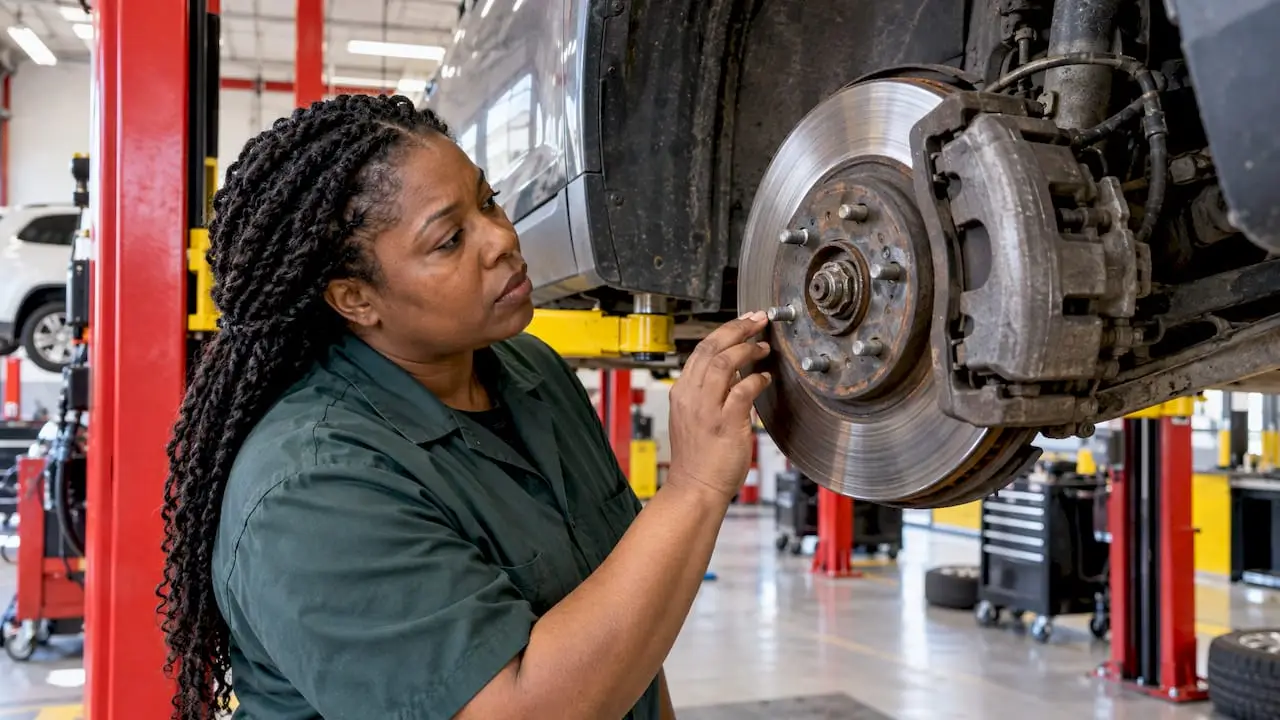
The classic warped rotor symptom is a brake pedal that pulses or a steering wheel that shakes when you slow down, and it goes away when you let off the brake. That pattern usually points to the brake rotors (the metal discs your pads squeeze to stop the car) or to something closely tied to them, like a sticking caliper or uneven pad deposits. The only way to know which is a hands-on inspection with measurements. If you live in Van Alstyne, Anna, Howe, Melissa or Gunter, our ASE-certified technicians can check it and show you what they find with a Digital Vehicle Inspection that includes photos.
TL;DR
- A pulsing brake pedal, a steering wheel that shakes only when you brake, or a vibration you feel in the seat are the signs most linked to rotor trouble.
- Where you feel it helps narrow it down: pedal pulse and steering wheel shake usually point to the front, seat vibration to the rear.
- Shaking that happens all the time, not just when braking, usually has a different cause, such as a bent wheel, a worn part or loose lug nuts.
- Rotors with light surface problems can sometimes be machined. Rotors worn below their limits need to be replaced. Only measurements tell which one you have.
- If the wheel starts shaking abruptly, pull over when it is safe and call for help.
Table of Contents
- What “warped rotors” actually means
- The signs of warped rotors, and what each one feels like
- What does not point to rotors
- What actually causes rotor-related vibration
- How a technician finds the real cause
- Resurface or replace: how the decision works
- What happens if you keep driving with the symptoms
- How to help your rotors last
- Our view: why we show you the rotor before we touch it
- Get your brakes checked in Van Alstyne
- FAQ
- Sources
What “warped rotors” actually means
A brake rotor is a heavy steel disc that spins with your wheel. When you press the pedal, the brake pads clamp down on it and friction slows the car. That friction makes a lot of heat, and the rotor is built to absorb and shed it.
Shops and drivers use “warped rotors” as shorthand for a rotor that no longer gives a smooth, even surface to the pads. According to AAA, as cited by Yahoo Autos, the friction and heat of braking can wear on the discs over time, and hard braking and heavy stop-and-go traffic speed that up.
In practice, the rotor surface can end up uneven in a few ways. It can vary in thickness, it can wobble slightly as it spins (called runout), or it can pick up uneven layers of pad material. Each one sends a vibration back through the brakes, and you feel that vibration in the pedal, the wheel or the seat.

The signs of warped rotors, and what each one feels like
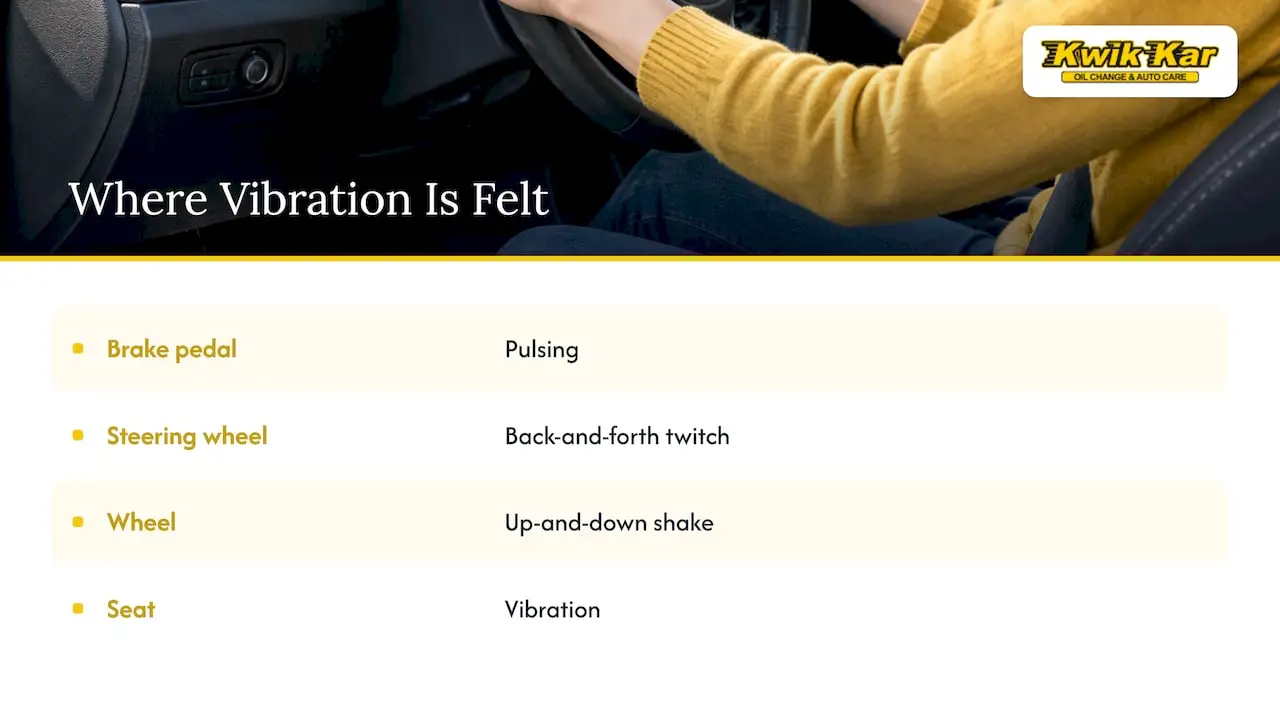
The same underlying problem can feel different depending on the car. A technical update in Brake & Front End Magazine describes the ways the vibration reaches the driver: pulsing in the brake pedal, a back-and-forth twitch in the steering wheel, an up-and-down shake in the wheel, or a vibration through the seat. It is often most noticeable during light braking toward the end of a stop.
A pulsing brake pedal
This is the sign most people mention first. You press the pedal and feel it push back against your foot in a steady rhythm. The pulse speeds up and slows down with your speed, because it follows the turning of the wheel.
A steering wheel that shakes when you brake
If the wheel shimmies or shakes only while you are braking, that is a strong clue. HowStuffWorks points out that other causes, like motor mounts, bent rims, CV joints or loose lug nuts, tend to shake the car all the time, not only when you brake. Steering wheel shake generally points to the front rotors.
Vibration in the seat or floor
When the shaking comes through the seat instead of the wheel, the rear brakes are often involved. This is a useful detail to give your technician, because it tells them where to start.
Noises while braking
Some drivers also hear a rhythmic thumping or groaning as they slow down. Noise on its own is less specific, since worn pads make noise too. If your main complaint is a squeal or scrape, our guide to brake squeaking and when to stop driving covers that side.
It gets worse after hard or long braking
Many drivers notice the shake is worse after a long downhill stretch, towing, or highway stops, when the brakes are hot. If you can describe when it happens, you are already helping the diagnosis.
What does not point to rotors
Not every shake is a brake problem. A few clues help you separate them:
- Shaking at highway speed with no braking. That is more often a tire or wheel balance issue. Our page on road force balancing explains one way to find tire and wheel problems that a standard balance can miss.
- A humming or growling noise that changes when you turn. That can be a wheel bearing.
- A loose or wandering steering feel. Worn steering and suspension parts can cause it. Our steering and suspension service covers those.
- A soft or sinking pedal. That is a different symptom from pulsing. See our article on a soft brake pedal.
The reverse also happens. A technician at ALLDATA-style repair references aside, the point is that several parts can create the same feeling, so a quick guess at the cause can lead to the wrong repair.
What actually causes rotor-related vibration
Rotor heat is only part of the story. Here are the causes that show up most.
Uneven rotor thickness
Kelley Blue Book lists uneven rotor thickness, a sticking caliper and unevenly worn pads as causes of vibration when you press the pedal. A rotor that varies by even a tiny amount can send a pulse through the pedal every turn of the wheel.
Uneven pad material on the rotor
Brake & Front End Magazine separates “judder,” which you feel in the seat or steering wheel, from pedal pulsation. It traces judder to variation in how much the brakes grip as the wheel turns, which can come from an inconsistent rotor finish or from uneven deposits of pad material on the rotor. That means a rotor can feel “warped” when the real issue is what has built up on its surface.
A caliper that sticks
The caliper is the clamp that holds the pads. If it does not release fully, a pad can drag on the rotor, heat one spot, and leave uneven deposits behind. A good inspection looks at the caliper and its hardware, not only the rotor.
Hard braking and heat
Repeated heavy stops, long downhill runs and towing put more heat into the rotors. If you drive a lot of stop-and-go traffic on US-75 or around the DFW commuter routes, your brakes work harder than they do on open highway.
Hybrids and EVs
If you drive a hybrid or electric vehicle, Kelley Blue Book notes that regenerative braking means the friction brakes get used less. That can leave rotors prone to rust, corrosion and material buildup that cause pulsing. Rotors that rarely get a hard workout can still need attention.
How a technician finds the real cause
A vibration is a symptom, and we do not promise a diagnosis before we have looked at your vehicle. Here is what a careful inspection involves.
- Listen to how you describe it. Pedal pulse, steering wheel shake and seat vibration each point to different places. The Brake & Front End Magazine tech update calls this distinction very critical. Tell us when it happens: light braking, hard braking, after a long drive, at certain speeds.
- Road test and visual check. We look at the rotors, pads, calipers and wheel-end parts for wear, uneven surfaces, rust and signs of overheating.
- Measure runout. Vehicle Service Pros describes using a dial indicator to measure how much the rotor wobbles as it turns, with a typical limit of about 0.001 to 0.002 inch for most applications. Your vehicle’s own specification is what counts.
- Measure thickness. The same source describes checking rotor thickness at several points around the disc with a micrometer, because even small variation matters.
- Check the hub and mounting. Vehicle Service Pros also notes that a rotor with excess runout can sometimes be remounted at a different position on the hub, since the tolerances of the rotor and hub can stack up. Rust or debris on the hub face can also cause runout.
- Rule out other causes. Tires, wheel bearings, and steering and suspension parts all get a look if the brakes are not the whole story.
This is also where a Digital Vehicle Inspection helps. You get photos and real-time updates of what the technician sees, so you are not asked to approve work on faith.
Resurface or replace: how the decision works
This is the question many drivers ask once they know the rotors are the issue. Resurfacing (also called turning) means a technician machines a thin layer off the rotor face so it is flat and smooth again.
HowStuffWorks explains that machining can correct light warpage, but it cannot fix a rotor that has worn outside the manufacturer’s specifications. Every rotor has a minimum thickness. Once a rotor is at or near that limit, there is no metal left to remove safely.
So the decision comes down to a few things:
- Thickness. Is there enough rotor left to machine and still stay above the minimum?
- Surface condition. Are there deep grooves, cracks, heavy rust at the edges or signs of overheating?
- Cause. If a sticking caliper caused the problem, fixing the caliper matters as much as the rotor. Otherwise the vibration can return.
- The vehicle. Your owner’s manual and the rotor itself give the limits.
We will show you the measurements and photos, and recommend what your vehicle needs. Our brake repair service covers pads, rotors and calipers, and repairs come with our 2-year/24,000-mile warranty.
What happens if you keep driving with the symptoms
A mild pulse is not usually a roadside emergency, but it is a warning that something in the braking system is off. Putting it off can mean more wear on pads and other parts, and a repair that grows.
Abrupt shaking is different. According to Yahoo Autos, if the wheel starts shaking suddenly, you should stop as soon as it is safe and call for assistance, because it can signal a wheel or steering part about to fail.
Stop driving and call us if you notice:
- Shaking that suddenly gets much worse
- A brake pedal that sinks toward the floor or feels soft
- The car pulling hard to one side when you brake
- A burning smell or smoke from a wheel after driving
- A loud grinding noise from the brakes
If you cannot drive the car safely, we offer free local rides when you drop it off, and after-hours drop-off if your day gets in the way.
How to help your rotors last
You cannot control everything, but a few habits help.
- Look ahead and brake early. Gradual slowing puts less heat into the rotors than late, hard stops.
- Use a lower gear on long downhills and when towing, so the brakes do not do all the work.
- Do not sit with your foot on the pedal after a hard stop. Holding hot pads against one spot of the rotor can leave uneven deposits.
- Keep the fluid fresh. Old brake fluid can hurt braking performance. See when to test and change brake fluid.
- Get brakes checked on a schedule. Pads wear down and rotors thin out over time. Our article on brake maintenance before winter lists what a seasonal check covers.
- Have wheels torqued correctly after tire work. Uneven lug nut tightening can distort the rotor mounting.
Our view: why we show you the rotor before we touch it
Most of the time a driver walks in and says, “My steering wheel shakes when I brake.” It is a fair guess that the rotors are the cause, and sometimes they are. But a pulse in the pedal can also come from a caliper that is not releasing, pad material built up unevenly, a hub that is not clean, or a worn part in the steering and suspension.
That is why we start with an inspection, not a parts order. Our ASE-certified technicians look at the whole braking system and the parts around it. We send you a Digital Vehicle Inspection with photos and real-time updates, so you can see what we see and decide with clear information, with no surprise costs.
We would rather you understand the repair than simply approve it. When the work is done, it is backed by our 2-year/24,000-mile warranty. For busy parents and professionals, we also offer after-hours drop-off and free local rides, so a brake repair does not take over your week.
Kwik Kar
Get your brakes checked in Van Alstyne
If your brake pedal pulses or your steering wheel shakes when you slow down, we can find out why. Our technicians inspect the rotors, pads, calipers and the parts around them, and you see the results in photos as we go. The shop is in Van Alstyne, and we serve drivers in Anna, Howe, Melissa, Gunter and nearby towns. The waiting area has WiFi and coffee if you want to stay, or you can take a free local ride.
See our brake repair service, or browse everything we do on our auto repair page.

Call us at (903) 712-5945 to book a brake inspection.
FAQ
What does driving with warped rotors feel like?
Most drivers feel a pulsing in the brake pedal, a shake in the steering wheel, or a vibration through the seat when they brake. It is often most noticeable at the end of a stop and may be worse after the brakes get hot. Where you feel it helps point to front or rear brakes.
Why does my steering wheel shake only when I brake?
Shaking that appears only under braking usually points to the front brakes, most often the rotors, according to HowStuffWorks. Problems like bent wheels or loose lug nuts tend to shake the car all the time. A sticking caliper or uneven pad deposits can also cause it, so an inspection should confirm the cause.
Can warped rotors be fixed, or do they need to be replaced?
It depends on measurements. Light surface problems can sometimes be corrected by machining the rotor, but a rotor worn below the manufacturer’s limit cannot be machined safely. Our technicians measure the rotor and show you the results before recommending a repair.
Is it safe to keep driving with a pulsing brake pedal?
A mild pulse is a sign to schedule an inspection soon, not to wait for it to get worse. If the shaking suddenly gets worse, the pedal feels soft, or the car pulls to one side when you brake, pull over when it is safe and call for help.
Can a vibration when braking come from something other than the rotors?
Yes. Sticking calipers, uneven pad wear, wheel bearings, tires and worn steering or suspension parts can all create a similar feeling. A full inspection looks at all of them so the repair fixes the actual problem.
Sources
- Tech Update: Warped Rotor Syndrome, Brake & Front End Magazine
- Why Does Your Steering Wheel Shake When Braking? HowStuffWorks
- Why is My Car’s Steering Wheel Shaking? Yahoo Autos
- Why Does My Car Shake When I Brake? Kelley Blue Book
- Why Does My Car Shake When I Brake? Brake & Front End Magazine
- Brake Rotor Runout, Vehicle Service Pros