



Fuel injector cleaning is worth paying for when your car shows real symptoms and testing points to dirty injectors. It is usually not worth paying for as routine “preventive” maintenance on a car that runs well. General Motors, for one, says in a 2024 technical bulletin that it does not endorse injector cleaning as preventative maintenance. Below, we explain what the service is, what it costs, what symptoms matter, and how to tell a needed repair from an upsell.
TL;DR
- If your car starts, idles and accelerates normally, and your owner’s manual does not call for it, you can skip fuel injector cleaning.
- Rough idle, hesitation, stalling, a hard start or a drop in fuel economy are reasons to get the car checked first, not to buy a cleaning on the spot.
- Professional fuel injector or fuel induction service commonly runs about $150 to $200, and more when bundled with throttle-body work.
- Buying gas from stations that sell TOP TIER detergent gasoline is the simplest long-term protection for injectors.
- Cleaning does not fix a failed injector, a worn spark plug or a weak fuel pump, so diagnosis comes first.
Table of Contents
- What fuel injector cleaning actually is
- Port injection and direct injection are not the same
- Is fuel injector cleaning necessary?
- How a shop should confirm injectors are the problem
- How much does fuel injector cleaning cost?
- Is fuel system cleaning worth it for better gas mileage?
- When to do a fuel system cleaning
- The cheapest protection: good gas and regular maintenance
- Can you clean fuel injectors yourself?
- What if cleaning does not fix it
- Our perspective
- Have us check it out
- FAQ
- Sources
What fuel injector cleaning actually is
Your fuel injectors are small, precise nozzles. They spray a fine mist of gasoline into the engine so it burns cleanly. When deposits build up, the spray gets weaker or uneven, and the engine can run rough.
The phrase “fuel injector cleaning” covers several different jobs, and shops use different names for them:
- Fuel additive in the tank. A bottle of detergent poured in at a fill-up. This is the lightest option.
- Fuel system or fuel induction service. A technician runs a cleaning solution through the fuel system with the engine running, and often sprays a cleaner into the throttle body or intake. Many shops sell this as a package.
- Off-car (ultrasonic) cleaning and flow testing. The injectors are removed, cleaned and tested for spray pattern and flow. This is the most thorough and the most labor-intensive.
- Intake valve cleaning. On some direct-injection engines, carbon builds up on the back of the intake valves, and the fix is a more involved cleaning of the intake side.
When a menu says “fuel injection service,” ask which of these you are getting. The price and the benefit are very different.
Port injection and direct injection are not the same
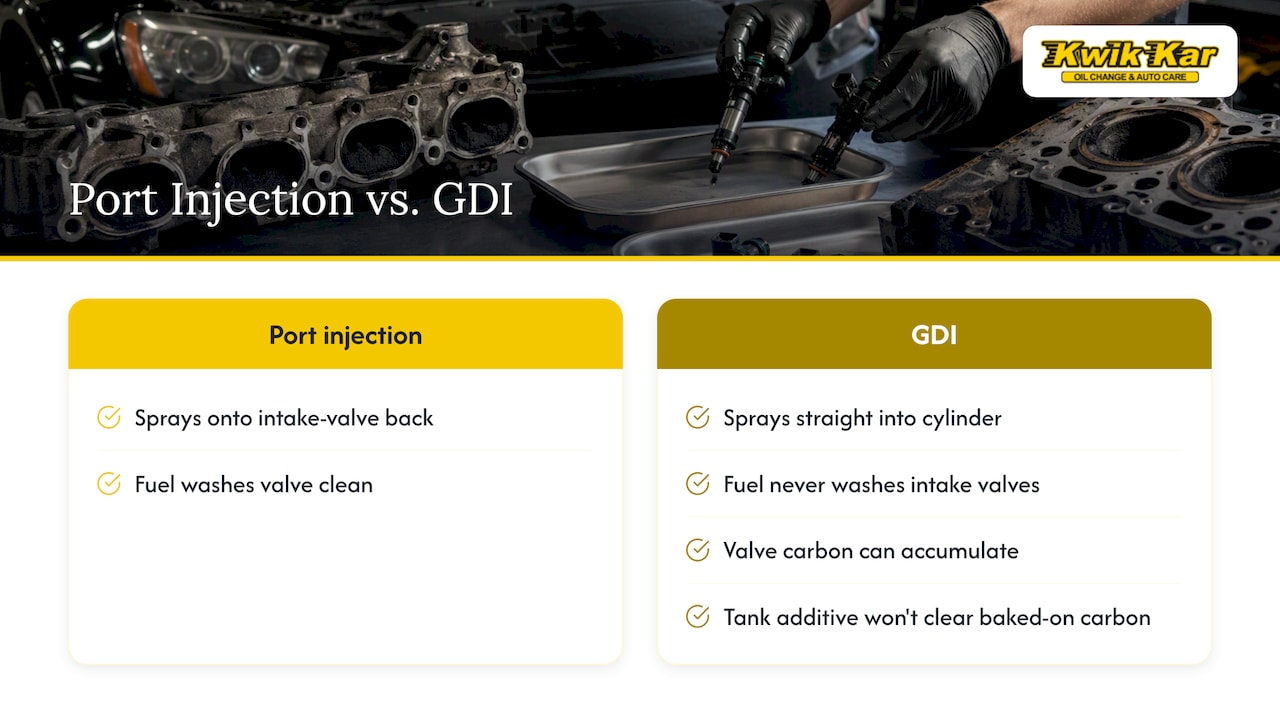
Older and many current engines use port fuel injection. The injector sprays fuel onto the back of the intake valve, and the fuel itself helps wash that valve clean.
Gasoline direct injection (GDI) engines spray fuel straight into the cylinder. That means fuel never washes over the intake valves. As one automotive reference explains, carbon can accumulate on the intake valves of some GDI engines for exactly that reason.
This matters because the right fix is different. A bottle of tank additive will not do much for baked-on valve carbon. And aggressive cleaning of direct injector tips can do harm. In a 2014 manufacturer bulletin filed with NHTSA, GM said GDI injector tips are designed to be self-cleaning, that visible deposits on the tip do not necessarily mean fuel delivery is impaired, and that mechanical or ultrasonic cleaning may damage the spray orifices.
Is fuel injector cleaning necessary?
For most drivers, no, not on a schedule. The same 2024 GM bulletin says the company approves injector cleaning only when a published drivability or diagnostic-trouble-code procedure directs it. Car Talk’s advice to consumers is similar: fuel-injector service is not worth buying if the car runs well and the owner’s manual does not call for it.
That is not the same as saying injectors never need attention. They can foul, especially on engines with a long history of short trips, low-quality fuel or very high mileage. The question is whether your car is showing it.
Symptoms that can point to dirty injectors
GM’s bulletin lists conditions where an approved detergent fuel-system treatment may be used, following the owner’s manual: loss of power, diminished performance, frequent stalls, no-start conditions and a noted decrease in fuel economy. Reference material on deposits also lists rough running, cold-start misfiring, an unstable idle and a lack of power at higher speeds.
If you notice any of these, write down when they happen. Cold mornings only? Only at highway speed? With the check engine light on? Those details help a technician far more than a guess at the cause.
Why those symptoms are not proof
Here is the catch. Almost every symptom above also shows up with other problems:
- Worn or fouled spark plugs. See our guide to signs your spark plugs need replacement.
- A weak fuel pump or clogged fuel filter. We cover the symptoms of fuel pump failure separately.
- Ignition coil trouble or a vacuum leak that causes a misfire. If your check engine light is flashing, our P0300 misfire diagnosis walkthrough shows how a technician narrows it down.
- A dirty air filter, which can choke the engine of air. Here is how often to replace the engine air filter in Texas.
Paying for an injector cleaning when the real problem is a $30 part is the classic way drivers end up disappointed. We never promise a diagnosis without inspecting the vehicle, and a symptom alone is not enough to say injectors are the cause.
How a shop should confirm injectors are the problem
A careful shop checks before it cleans. The usual steps look like this:
- Scan for codes. Stored trouble codes show whether the computer has flagged a misfire on one cylinder or a fuel trim problem across the engine.
- Check the basics. Spark plugs, ignition coils, air filter, fuel pressure and vacuum leaks are cheaper to rule out than injectors.
- Test the injectors. Innova notes that restricted injectors are generally investigated with a power-balance test and/or an injector-flow test, and describes flow testing as the more reliable way to find a bad injector.
- Decide on the repair. Clean if the injector is restricted but healthy, replace if it is not.
That last point matters. The same source says an injector that is still restricted or has a poor spray pattern after cleaning may need replacement, and an injector that has failed electrically cannot be restored by cleaning at all.
Our diagnostics service follows this order: find the cause first, then talk about the repair.
How much does fuel injector cleaning cost?
Prices vary by method, engine and shop. These are national figures, not Kwik Kar prices:
| Service | Typical U.S. cost | Source |
|---|---|---|
| Professional fuel injector service | $150 to $200 | Car Talk, July 2025 |
| Injector service bundled with throttle-body cleaning | Around $250 to $300 | Car Talk, July 2025 |
| Fuel induction service | $89 to $205 | Testingautos |
| Manual intake valve cleaning | $450 to $900, depending on engine size | Testingautos |
What moves the price up or down:
- The method. A pour-in treatment costs a fraction of removing injectors for off-car cleaning and testing.
- Engine layout. A V6 or V8 with a buried intake takes longer than a four-cylinder with easy access.
- What is bundled in. Throttle-body cleaning, new seals or o-rings, and a fuel filter can each add to the bill.
- What the diagnosis finds. If one injector is dead, replacing it costs more than cleaning, but it is the repair that actually fixes the problem.
Before you approve anything, ask the shop to tell you exactly what the service includes, why it is recommended for your car, and what evidence supports it. That is a fair question at any shop.
Is fuel system cleaning worth it for better gas mileage?
Don’t count on it. If your fuel economy has dropped because injectors are truly restricted, restoring them can bring performance back. But a cleaning is not a mileage booster for a healthy engine. Consumer Reports tested a range of gas-saving products and found no improvement in fuel economy from the devices it tried.
A sudden drop in miles per gallon is more often a tire pressure issue, a dragging brake, a dirty air filter, an old oxygen sensor or worn plugs. Rule those out first.
When to do a fuel system cleaning
There is no universal mileage number. Some manufacturers publish a fuel-system service in their maintenance schedule, and many do not. The right answer for your car is in your owner’s manual and the factory maintenance schedule.
A reasonable approach:
- Follow the manual. If it calls for a fuel system service at a set interval, do it then.
- Act on symptoms. If the car idles rough, hesitates or struggles to start, get it checked, then clean if testing supports it.
- Skip it otherwise. A car with no symptoms and no manual requirement does not need it.
If you want a plain-language look at how the schedule works, read about factory scheduled maintenance in Van Alstyne. For businesses with several vehicles, a fleet vehicle maintenance checklist is a handy way to track each vehicle’s owner-manual intervals in one place.
The cheapest protection: good gas and regular maintenance
Prevention beats cleaning. GM says regular use of TOP TIER detergent gasoline, as recommended in the owner’s manual, helps prevent injector and intake-valve deposits. That is the one habit with real support behind it.
A few other habits help:
- Use the fuel grade your manual specifies.
- Keep up with oil changes. On GDI engines, oil vapor feeds deposits on intake valves, and fresh oil on schedule is part of the picture. See our oil change intervals guide.
- Replace the fuel filter and air filter when the schedule says so.
- Do not let the tank run near empty all the time, especially in a hot Texas summer.
- Take a longer drive now and then. Constant short trips never let the engine fully warm up.
Can you clean fuel injectors yourself?
You can pour a bottle of detergent into your tank, and that is low risk if you follow the label and your manual. Real injector cleaning is another matter. Car Talk notes that proper cleaning requires removing the injectors and advises against opening up the engine without a diagnosis or a symptom.
The homemade methods that circulate online carry real risks. Fuel is flammable, and a spark near an open fuel rail is dangerous. Harsh solvents can attack rubber seals. Scraping or wire-brushing a direct-injection tip can damage the spray orifices, as the 2014 bulletin cited above warns. If you want to clean the engine bay itself without harming sensors or wiring, here is how to clean your engine bay safely. Leave the fuel system to a technician.
What if cleaning does not fix it
If symptoms continue after a cleaning, the cause is probably something else, or an injector is beyond saving. Possible next steps:
- Replace the failed injector or injectors.
- Repair ignition, fuel pump or sensor problems found during testing.
- On older direct-injection engines, consider intake valve cleaning. Consumer Reports explains in its piece on walnut blasting that older GDI vehicles may need periodic engine cleaning, and that there is no long-term fix.
If you also hear a knock or ping under load, do not wait. Read about what an engine knocking sound means and get it looked at soon.
Our perspective
Most of the time, when a Van Alstyne driver asks us about fuel injector cleaning, they have read an ad or been told at a quick-lube counter that they “need it.” Our view is simple: you should only pay for work your car needs, and you should be able to see why.
That is why we lean on inspection first. Our Digital Vehicle Inspections come with photos and real-time updates, so you see what the technician sees before you approve anything. Our ASE-certified technicians start with the owner’s manual, the symptoms you describe and the test results. If the data points to injectors, we will tell you. If it points to a plug, a filter or a pump, we will tell you that instead.
We would rather earn a repeat customer than sell a service your car does not need.
— Kwik Kar
Have us check it out
If your car is running rough, hesitating or burning more gas than it used to, bring it to us for a look. We offer diagnostics and a full range of auto repair services for drivers in Van Alstyne, Anna, Howe, Melissa, Gunter and nearby communities. Every digital vehicle inspection includes photos and updates, repairs carry a 2-year/24,000-mile warranty, and we offer after-hours drop-off and free local rides when you cannot wait around.
Call us at (903) 712-5945 to set up an appointment.
FAQ
Is fuel system cleaning worth it?
It is worth it when your car has symptoms and testing points to dirty or restricted injectors, or when your manual calls for it. It is usually not worth it for a car that runs well. Ask the shop to explain why it is recommended for your specific vehicle.
How much does fuel injector cleaning cost?
National figures put professional fuel injector service at roughly $150 to $200, and about $250 to $300 when bundled with throttle-body cleaning. Removing the injectors for off-car cleaning and testing, or cleaning intake valves, costs more. Ask for the price in writing before you approve the work.
Is a fuel induction service necessary?
Only if the manufacturer lists it in your maintenance schedule or your car shows symptoms that testing ties to deposits. GM, for example, does not endorse injector cleaning as preventative maintenance. Check your owner’s manual first.
How often should I do a fuel system cleaning?
There is no single interval for every car. Follow the schedule in your manual, and otherwise clean only when symptoms and testing call for it. Using TOP TIER gasoline regularly is the better long-term habit.
Can a fuel additive replace a professional cleaning?
An additive can help with light deposits in some cases, and it is low risk when used as the label directs. It will not fix a failed injector, and it will not remove heavy carbon from intake valves. If symptoms persist, have the car diagnosed.
Sources
- GM technical bulletin on fuel system cleaning, 2024 (NHTSA)
- GM technical bulletin on GDI injector cleaning, 2014 (NHTSA)
- Car Talk: Automotive service upsells and scams to decline
- Car Talk: How much does fuel injector cleaning service cost
- Consumer Reports: Gas saving devices
- Consumer Reports: What is walnut blasting for cars
- Innova: Fuel injector maintenance
- Testingautos: Fuel induction service